Daily Digest — 2026-09-24
Jump to a section
Signals
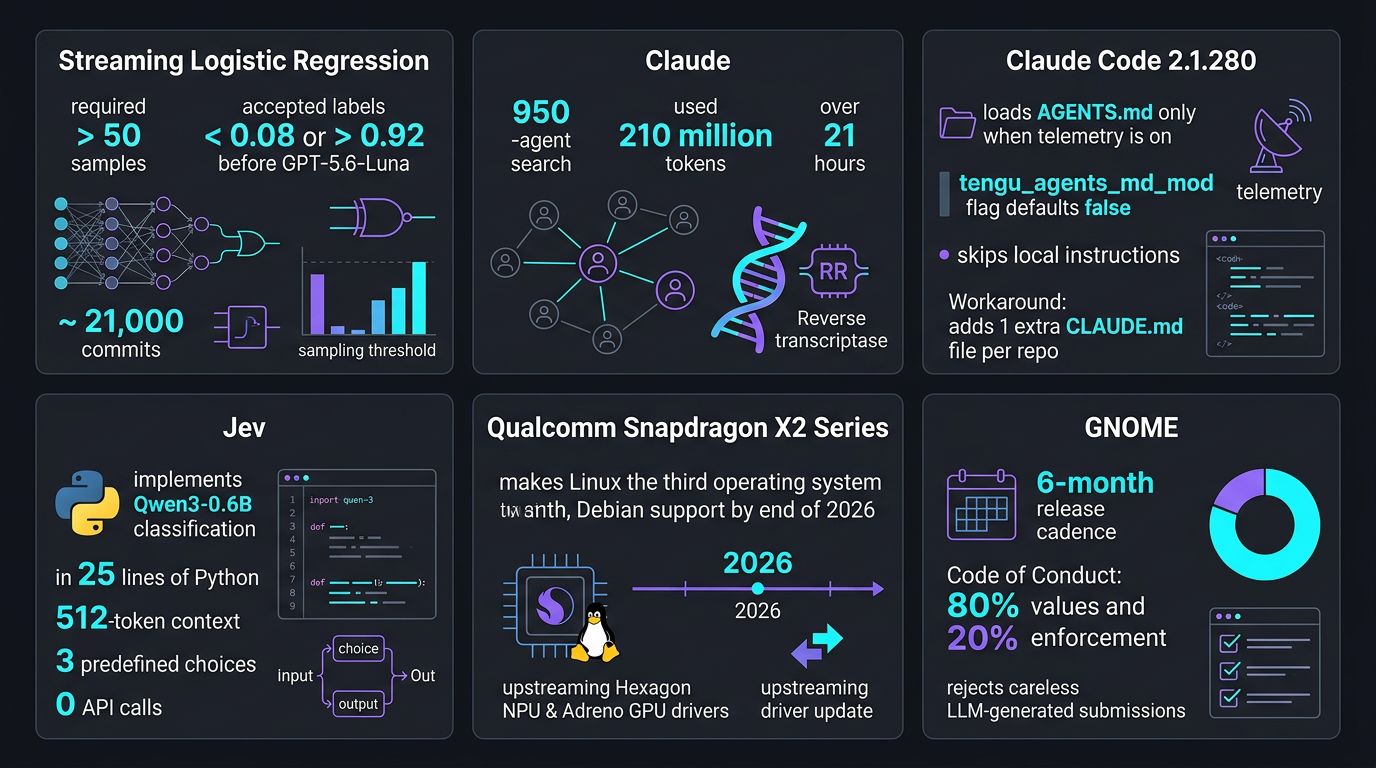
- Streaming Logistic Regression required over 50 samples and accepted labels below 0.08 or above 0.92 before GPT-5.6-Luna on about 21,000 commits, using confident labels to avoid LLM calls. LLM workflows.
- Claude’s 950-agent search used 210 million tokens over 21 hours with high-level human direction to find a repeating noncoding DNA array beside a reverse transcriptase gene; laboratory analysis identified a new enzyme system. AI research.
- Claude Code 2.1.280 loaded AGENTS.md only when telemetry was on, because the tengu_agents_md_mod flag defaults false and can skip local instructions; the workaround adds one extra CLAUDE.md file per repo. AI tooling.
- Jev implements Qwen3-0.6B classification in 25 lines of Python, using a 512-token context and three predefined choices without an API call. Local AI economics.
- Qualcomm Snapdragon X2 Series makes Linux the third operating system, with Debian support by the end of 2026 and upstreaming Hexagon NPU and Adreno GPU drivers. Agentic AI PCs.
- GNOME’s six-month release cadence and Code of Conduct, described as 80% values and 20% enforcement, support rejecting careless LLM-generated submissions. Open-source desktops.
Themes
AI research, evaluation, and economics
AI research is becoming an allocation problem: cheap signals must decide which expensive calls, agents, or credibility checks deserve attention. The strongest work treats automation as a filter, not a substitute for evidence.
- Cheaper LLM labelling
Cheaper LLM labelling: 21,000 commits can route labels through streaming logistic regression. p < 0.08 or p > 0.92 means skip the LLM call; otherwise GPT-5.6-luna gets up to five tries. - Claude discovers a novel enzyme system with CRISPR-like repeats585

Claude: 21 hours and roughly 950 agents found a CRISPR-like repeat beside a reverse transcriptase gene. The discovery shows AI can surface biological structure, but ART function remains unknown. - FLAWED’s Flaws and What This Means for Industry Research — Suha Sabi Hussain
FLAWED: 73 citations still may not rescue a paper with 19 sources and avoidable errors. The industry label draws attention, but 2.8 != roughly 4 exposes why evaluation rigor matters.
AI policy and open-source desktop values
Open-source desktops are debating whether their next wave of polish comes from faster community UX loops or firmer boundaries around AI-generated work. The tension is not just tooling: it is who gets to shape the desktop, and which values survive each release.
- The GNOME LLM Policy That I Want

GNOME’s six-month release train is facing a values test: careless LLM-generated submissions could erode the community the project ships software with. - KDE for People
KDE’s one clear signal is anti-generative-AI: Plasma work is being kept away from generative-AI assumptions for users and contributors. - Ideas on modernizing the open-source desktop
Jenson’s few-hour drag fix separates mouse-down and mouse-up actions, keeping the source window from raising and making desktop UX prototypes feel less risky.
AI tools and platform shifts
AI software is moving capability closer to the machine, but the useful question is no longer whether a model runs—it is which hidden platform switch decides what the user actually gets.
- Claude Code reads AGENTS.md only when telemetry is on [fixed]262
Claude Code 2.1.280 can silently skip AGENTS.md unless telemetry is on. That turns repo instructions into a feature flag outcome, not a reliable local contract. - Jev in 25 Lines of Python200

Jev 25 lines of Python makes Qwen3-0.6B classify three choices locally. No API call is needed, but the 512-token context sets a hard boundary for useful prompts. - Inside Snapdragon Summit 2026: Agentic AI PCs, Googlebooks and Linux | Qualcomm
Qualcomm Snapdragon X2 Series targets a third OS with Debian support and upstreamed drivers. That makes Linux agentic-AI PCs less dependent on Qualcomm’s Windows-only story. - Automatically detecting AI text in my browser
Deckard 4-bit Gradient MLX runs as a local Chrome extension. It catches 52.35% of AI-involved text while avoiding a third-party browser scan.

Software engineering and interactive tooling
Powerful software tools often win by moving friction into the environment rather than asking people to carry it: messy state becomes something the system can reason about. The surprising part is that these gains come from stricter boundaries—between prose and code, old and new values, docs and implementation—not from adding more features.
- Solid Modeling in your browser
Solid Modeling in your browser uses one journal editor with Vim-style modal editing and direct Codex prompts. It matters because prose and code can share a stateful modeling session instead of two disconnected tools. - Do not let your type system reason about aliasing in your programming language
Futhark tracks one alias set per variable and consumes arrays in-place. That keeps updates cheap, but it makes the type system carry aliasing work. - I don’t want the details205
I don’t want the details: 385 points and 205 comments point to a hard question: when empathy for reasonable people removes urgency, what system change prevents the next failure? The shift is from blaming individuals to changing processes so the same class of failure is less likely. - Why you should check your gem’s lines of code
A gem under 100 lines of code is a useful audit target. Compare your rough estimate with cloc and use the gap to cut scope or expose hidden complexity. - The GitHub wiki is an anti-pattern
The GitHub wiki after 6 months or so often becomes a one-page pointer to stale knowledge. Put docs in /docs, build them with GitHub Pages, and keep the wiki as a redirect so code and documentation stay versioned together. - The Zig Journey

The Zig Journey uses 3 tiers to turn syntax lessons into dependency strategy. If you can model operations at the target-system level, zig build can own C/C++ dependencies while efficiency, fuzzing, and full ownership shape the design.
Security and trust
Security here is less about hiding every packet than about proving who owns each decision. The shared lesson is that trust can be engineered, leaked, or made to look legitimate from the wrong direction.
- I want my mesh networks to be signed, not encrypted
64 bytes per message buys identity checks without encryption; signed cleartext meshes improve accountability but trade privacy. - Sandboxing with minimal effort
1024m memory limit plus path and network rules let Inko apps enter OS sandboxes with little code; containers can add read-only volumes and dropped capabilities. - Radicle: Disclosure of Vulnerability in the Network Protocol

2 critical vulnerabilities let path attackers read private repository objects and later impersonate nodes; rotate credentials, keys, and tokens. - Latest BGP hijack targets hosting software vendor

162.55.80.0/24 was a RPKI-valid, longer BGP route that still delivered a valid TLS update; small installations trusted the path. - SAML: A fractal of bad design
2002-era SAML made SSO scalable, then XML complexity and signature-validation gaps left modern identity stacks carrying brittle trust; migrate to OpenID Connect.
Data and storage engineering
Data systems keep finding that the cheapest path is often to make locality explicit: Redis exposes it through slot placement, while Parquet reshapes numeric bytes so readers can skip and decode more cheaply. The shared lesson is less about bigger storage and more about choosing the right boundary for movement.
- Why didn’t anybody tell me about Redis hash slots?
16,384 Redis hash slots can make cache batching legal; without the right tags, 12 route keys meant 12 round trips. A shared hash tag cut that to 3 round trips across 3 primaries, keeping thousands-key batches fast. - Adaptive Lossless Floating-Point Encoding in Apache Parquet
32-bit FLOAT and 64-bit DOUBLE data can pay for slower Parquet compression; ALP makes decoding 10x faster and random access thousands of times faster. Lossless, SIMD-friendly decoding matters when dashboards, column scans, and GPU paths need cheap numeric reads.
Systems infrastructure and hands-on engineering
The odd pairing is the point: a 19th-century clock and a 2,200-node Linux migration both turn on whether engineers can trace control paths before deciding what to replace.
- Abandoning Scientific Linux Was a Mistake
Fermilab’s 2,200 industrial systems are moving to Debian 13, and an abandoned rebuild now looks like insurance against upstream churn. - Fixing the Portobello Police Station Clock93
Portobello’s 1877 clock still chimes through a 2001 PIC box, so a one-hour shaft and a lifted pawl beat a full restoration.
Filtered out14 links
These scored below 40% relevance, so they were left out of the digest.
- We just shipped support for the ugliest part of HTTP: Varyblog.cloudflare.com · 38%
- GPT-6 Astra has gained the ability to drive a cardrivingbench.com · 36%
- A brief history of Windows scroll bar shortcutsdevblogs.microsoft.com · 33%
- Seattle City Council votes to ban surveillance pricing in sale of groceriesadvocacy.consumerreports.org · 30%
- Beware overreliance on metaphorevnm.substack.com · 25%
- DoorDash Spent $1.4M Trying to Stop Mamdani from Becoming Mayor. Now We Know Whytheintercept.com · 8%
- Italian parliament votes for return to nuclear energyapnews.com · 5%
- The darker side of being a doctordrericlevi.pages.dev · 3%
- The most expensive 33 hours in WordPress history...youtube.com · 0%
- 🚨🚨 TheStandup: Trash's Show And Tell and Casey Judges🚨🚨youtube.com · 0%
- Use these CSS features instead of JavaScriptyoutube.com · 0%
- They can’t take it anymoreyoutube.com · 0%
- What are normies using AI for?youtube.com · 0%
- Redis is not a map you talk to over TCPblog.verygoodsoftwarenotvirus.dev · 0%
Generated by Clio Analyst