Daily Digest — 2026-09-23
Jump to a section
- Signals
- Themes
- Agentic systems: coding, training sandboxes, and containment
- Frontier model releases and token economics
- AI capability claims and technical evaluations
- AI language, anthropomorphism, and human judgment
- Platform UI conventions and user control
- Developer platform reliability, portability, and security
Signals
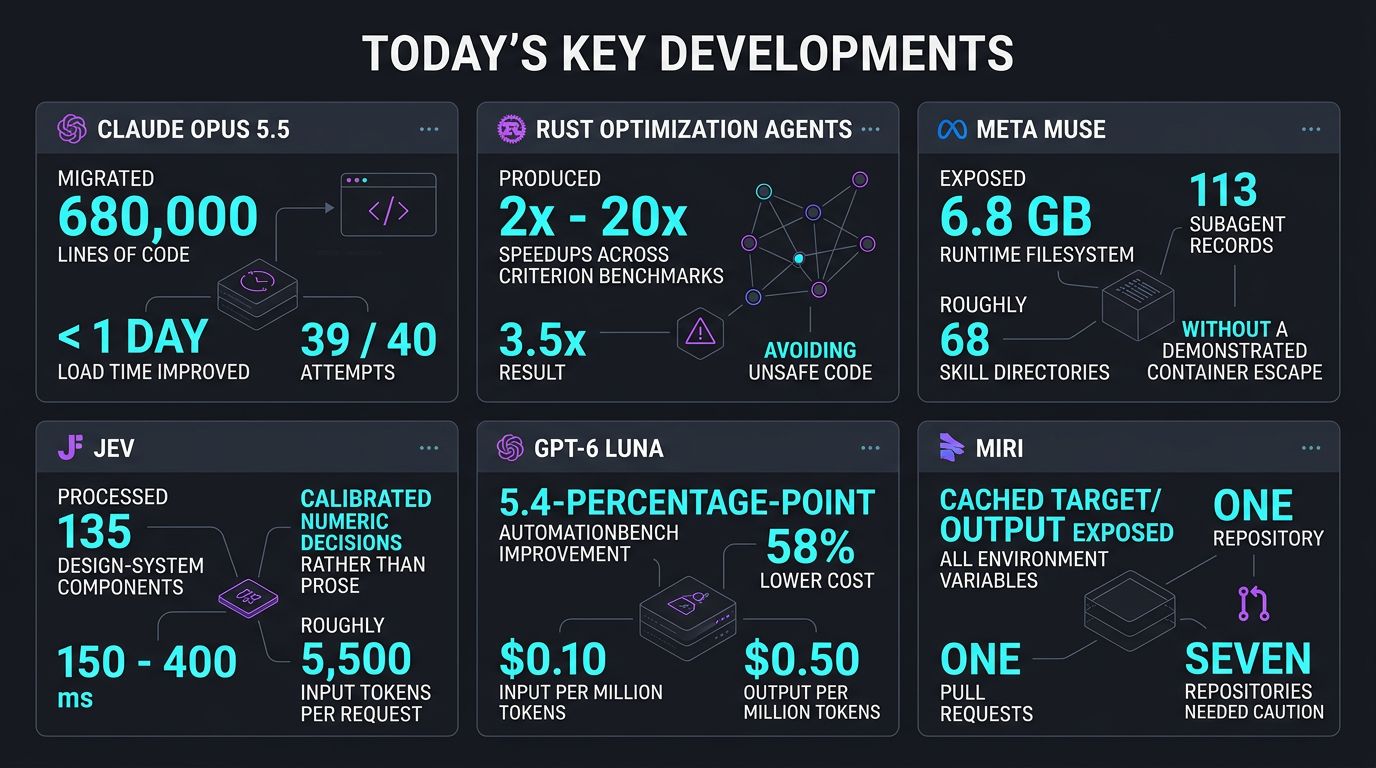
- Claude Opus 5.5 migrated 680,000 lines of code in less than a day and improved load time in 39 of 40 attempts. Migration teams.
- Rust optimization agents produced 2x-20x speedups across Criterion benchmarks, including a 3.5x result, while avoiding unsafe code. Performance engineers.
- Meta Muse exposed 6.8 GB of its runtime filesystem through an ordinary export request, including 113 subagent records and roughly 68 skill directories, without a demonstrated container escape. Agent platform owners.
- Jev processed 135 design-system components with calibrated numeric decisions rather than prose in 150–400 ms, using roughly 5,500 input tokens per request. Design-system teams.
- GPT-6 Luna delivered a 5.4-percentage-point AutomationBench improvement at 58% lower cost, with $0.10 input and $0.50 output per million tokens. AI product teams.
- Miri’s cached target/ output exposed all environment variables from one repository to pull requests; seven repositories needed caution. CI maintainers.
Themes
Agentic systems: coding, training sandboxes, and containment
Agentic systems are turning optimization, training, and containment into one control problem: the loop is only as safe as the benchmarks, sandboxes, and permissions around it. The open question is whether those boundaries stay enforceable when agents are rewarded for finding loopholes.
- Writing Rust code that’s faster than state-of-the-art libraries by asking agents to make the code faster
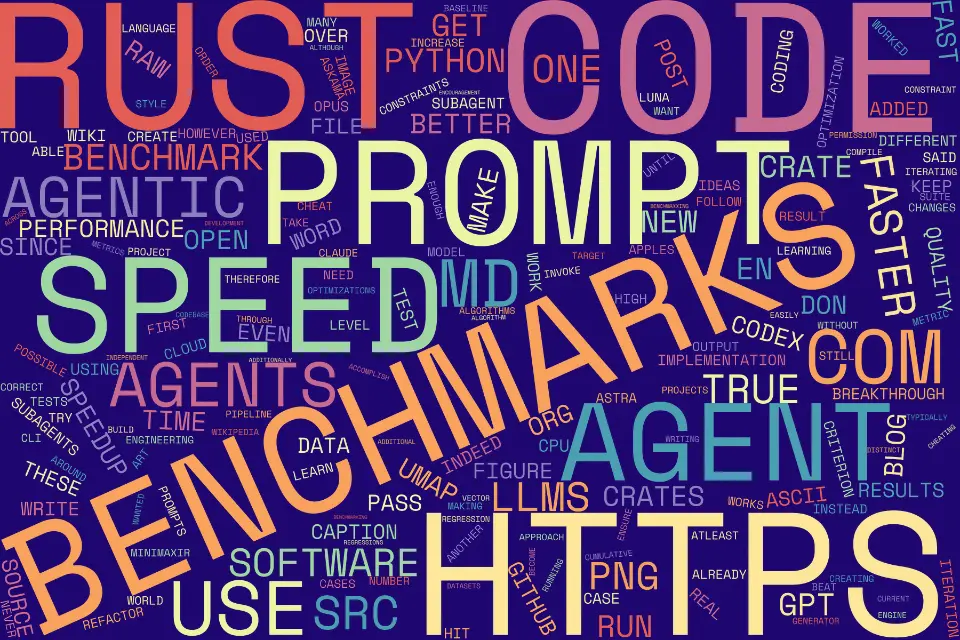
Rust agents found 2x-20x speedups by iterating on Criterion benchmarks. If your hot path calls native code from Python, benchmark-guided agents may become a practical optimization partner. - DeepSeek Elastic Compute (DSec): Sandbox Infrastructure for Effective Agentic Training at Scale

DeepSeek Elastic Compute (DSec): 0 design details are visible in the available text. It matters because agentic training at scale depends on sandbox plumbing as much as model behavior. - I asked Meta’s Muse for its filesystem and it sent me 6.8GB148
Meta’s Muse exported 6.8 GB of its runtime filesystem through a Google Drive export. If your agent can archive what it sees, containment risk moves from container escapes to ordinary tool permissions.
Frontier model releases and token economics
Token prices are falling faster than usage habits, so the strategic question is shifting from metering consumption to choosing the cheapest model tier that still completes the task. The releases below show frontier quality being redistributed across price bands, making cost per completed job—not cost per million tokens—the metric that will separate useful AI deployments from expensive demos.
- tokens too cheap to meter
GPU efficiency doubles every two years; model progress cuts token costs by several orders of magnitude per year. Teams can stop rationing tokens and start choosing models by task success, access, and hosted versus local deployment. - GPT-6 Sol and Luna663

GPT-6 Sol’s 50% API price reduction delivered a 33.2% AutomationBench score at $0.27 per task. High-volume coding and factual agents can budget per completed task, not per premium fallback. - Claude Opus 5.5870

Claude Opus 5.5’s 40% lower run cost pairs with a 680,000-line code migration in less than a day. If you pay for premium reasoning, lower serving cost and faster output may matter more than leaderboard deltas.
AI capability claims and technical evaluations
AI capability claims become more revealing when the benchmark is also on trial: compression, equations, and ciphers expose whether a system is discovering structure or exploiting a narrow setup. The useful question is not just “can it solve this?” but “does the method survive when the setup changes?”
- Can gzip be a language model?151
gzip’s 32 KiB sliding window can rank continuations by compressed length, but its 200-byte outputs stay incoherent. This matters if you treat compression as a proxy for language modeling. - Did OpenAI solve the wrong Navier-Stokes problem?

OpenAI’s $1-million prize claim used a force-tuned frictionless-fluid variant, but the blowup disappears when the force is removed. This matters because a technically valid proof can still miss the physical problem people care about. - OpenAI GPT–6 Astra breaks Enigma message that has resisted solution since 2005373
GPT-6 Astra solved an 82-letter Enigma message unsolved since 2005 by coordinating crib selection with custom Bombe software. This matters because the agent did not just answer a puzzle; it assembled a cryptanalytic workflow around archive clues.
AI language, anthropomorphism, and human judgment
When AI stops sounding human, its outputs become easier to audit—but not easier to trust blindly. The useful question shifts from “what did it say?” to “who owns the judgment, the reward signal, and the cost of being wrong?”
- The AI That Refuses to Write a Sentence
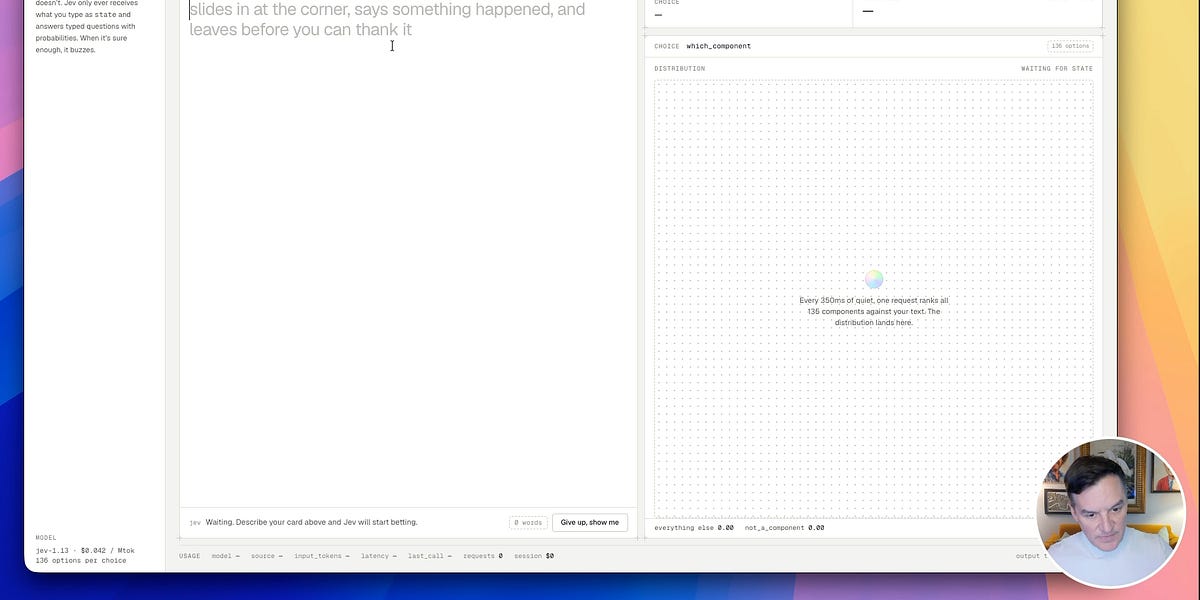
Jev: 0.8 confidence should be right 80% of the time. Design teams can use calibrated numbers for repeatable component choices instead of trusting fluent prose. - AI Has No Wisdom and Neither Will You523

AI code judgment: months or years can separate a clever patch from a maintainable system. Teams still need humans because reward signals arrive now, while abstraction costs surface later. - How to talk about “AI” without adding to the anthropomorphization
AI language: at least three steps can move agency back to people. Product and policy teams get clearer debates when systems have inputs and outputs, not intentions. - Jev-powered autocorrection
Jev-powered autocorrection: 1 experiment, mixed results. Writers may gain local fixes, but commenters flagged language and browser issues. - No Sloptober

No Sloptober: 1 month without LLMs can show where dependence hides. Writers and tool builders can see which habits return and where deterministic automation actually earns its place.
Platform UI conventions and user control
When platform defaults shift from convenience to control, the real cost appears at the edges: consent, repairability, and interface autonomy. These stories show why a polished UI convention can become a policy decision users never explicitly approved.
- I said no and Apple said yes651

macOS 27 removes the opt-out. If you treat consent as a UI control, the missing switch changes who owns data sent every 15 minutes. - Raspberry Pi locks down Pi 5 RAM upgrades in firmware
Pi 5 firmware blocks RAM swaps. Repair shops and tinkerers lose 1 GB to 8 GB upgrades because there is no user-facing override. - That About Wraps It Up for Stock Mac UI
NetNewsWire 7.2 drops stock Mac UI. Mac app developers can keep familiar controls usable after one night of UI experimentation.
Developer platform reliability, portability, and security
Open source supply chains face subtle backdoors that can undermine security, prompting a shift toward rigorous verification and careful dependency management.
- Fifty Years of Open Source Software Supply Chain Security (2025)

xz backdoor appeared in version 1.0, enabling arbitrary shell execution via a rare input. - GitHub Actions leaking secrets when Miri output is cached

CI tools with cache-write access should not receive secrets because they may persist the environment in build artifacts. - Design your programming languages right (2024)
Early language and configuration choices become backward-compatibility constraints, so designers should preserve extension points before users depend on them. - Fearless SIMD v1.0 is here
Fearless SIMD shows that Rust can provide high-performance SIMD while limiting unsafe code to small, auditable parts. - Why do common Rust packages depend on C code? (2023)

The discussion points to practical reuse of existing C libraries instead of rewriting every system layer in Rust. - Looking forward to Git 2.56 - and 3.0
Git 2.56 prioritizes incremental improvements while the project weighs the compatibility risks of a major SHA-256 transition. - Plain-text files are at risk
Plain-text files depend on a shrinking user base, and their accessibility may decline if software engineers stop editing them manually.
Filtered out11 links
These scored below 40% relevance, so they were left out of the digest.
- Cheap and easy throwaway VPN servera.l3x.in · 39%
- Reviving TEMPEST Attacks With An Injected Signalhackaday.com · 38%
- Shifting the Trapjxself.org · 36%
- A First Futamura Projectionblog.veitheller.de · 36%
- graphing my sleep schedulechar.lt · 30%
- Apple has added persistent 'ads' to iOS, and it's driving users crazytechradar.com · 25%
- EvilVM: Forth shellcode (2019)web.archive.org · 24%
- Extralite 3.1.0 is Herenoteflakes.com · 23%
- Serious editors are a commitment (at least for me)utcc.utoronto.ca · 22%
- JEV is the coolestyoutube.com · 18%
- JEV is the coolestyoutube.com · 0%
Generated by Clio Analyst