Daily Digest — 2026-09-20
Jump to a section
Signals
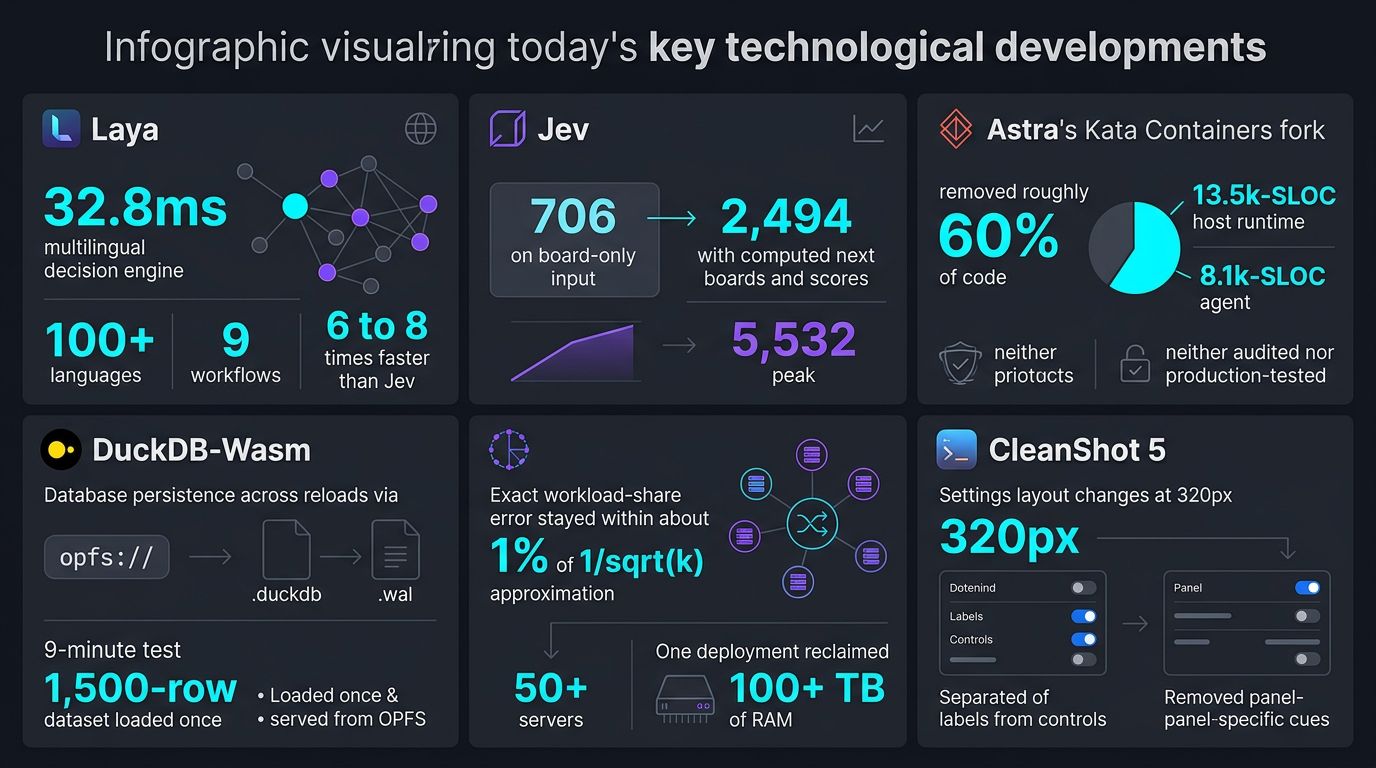
- Laya’s 32.8ms multilingual decision engine returns typed probabilities in a single forward pass across 100+ languages and 9 workflows, 6 to 8 times faster than Jev. Structured decisions.
- Jev’s 706 median on board-only input rose to a 2,494 median with computed next boards and scores, peaking at 5,532. External scores matter.
- Astra’s Kata Containers fork removed roughly 60% of code, leaving a 13.5k-SLOC host runtime and 8.1k-SLOC agent, but it was neither audited nor production-tested. Smaller is not safer.
- DuckDB-Wasm persisted a database across reloads through an opfs:// path, creating .duckdb and .wal files; in a 9-minute test, a 1,500-row dataset loaded once and served from OPFS. Local databases work.
- Consistent hashing’s exact workload-share error stayed within about 1% of the 1/sqrt(k) approximation for 50+ servers; one deployment reclaimed 100+ TB of RAM. Small rings stay predictable.
- CleanShot 5’s macOS-style two-pane settings layout separated labels from controls and removed panel-specific cues at 320px; version 4 retained the cues. Dense screens suffer.
Themes
AI-native decision engines
AI-native decision engines are moving the bottleneck from answer generation to calibrated structured outputs, where the winning design may be a bidirectional encoder plus typed questions. The frontier is less about bigger prose and more about whether raw context, external scores, or typed primitives actually change the decision.
- I Built Non-Autoregressive Decision Models a Year Ago. Then a Frontier Lab Called It a “Breakthrough”

Non-Autoregressive Decision Models hit 30 to 40 milliseconds with 8B or 70B, turning high-stakes typed decisions into one parallel pass instead of slow LLM prose. Who cares: schema-based probabilities and expected scores make latency and calibration visible. - Laya — 33ms Multilingual System 1 Decision Engine

Laya — 33ms Multilingual System 1 Decision Engine ran a 51-language sweep in 32.8 ms, so multilingual structured decisions can stay direct instead of generating text. Who cares: 7.2 ms per question batched makes that an API latency win. - kicking the tires on jev (TypeSafe’s System One model) with 2048

Jev-1.13.0 scored 706 median with only the board, then jumped to 2494 median with computed next boards and scores. Who cares: the board alone is not enough signal for a System One model that needs reliable tile moves.
AI, security, and infrastructure trust
Trust in AI-built infrastructure increasingly depends on what cannot be explained by the model itself. From stripped-down container runtimes to zero-knowledge proofs, the strongest signals are moving toward auditable boundaries, local attack surfaces, and verifiable outputs.
- Secure VMs for Kubernetes: Hardening Kata containers
Kata Containers deleted ~60% of its code for a Firecracker Kubernetes fork. The smaller runtime could reduce attack surface, but untested production use keeps the trust case unresolved. - The Implications of Linguistic Illegibility for LLM Security

arXiv:2609.02852 argues taint tracking can define what model output must never influence. That makes LLM security depend on non-linguistic isolation, not model self-reports. - How OpenAI Used Its Own LLMs to Design Its Jalapeño Chip

Jalapeño chip: 1 claim—OpenAI used its own LLMs to design its Jalapeño chip. Without design evidence, AI-generated infrastructure decisions remain a trust gap. - we have a year to fix security everywhere
Once a frontier-capable model can run locally without refusals, both defensive automation and malicious automation become widely available. - ZK-JPEG: Zero-knowledge Image Editing and Compression

ZK-JPEG: 1 pipeline folds image transformations into JPEG compression. That supports verifiable image provenance without revealing the secret input.
AI in creative practice
In creative AI work, the prompt is not a shortcut but a design lever: it can redirect visual output, while refusing AI drafting protects the messy thinking that makes prose legible.
- AI-generated posters don’t have to be horrible800
20 times with ChatGPT changed a poster from default craft-fayre to a 1920s–30s look. Two attempts showed direction beats decoration. - I think you should almost never use AI to write136

3 reasons to almost never use AI to draft. Hand-first writing exposes weak thinking before polished text hides it.
Systems infrastructure and emulation
Infrastructure performance often turns on tiny contracts: when a runtime, scheduler, or hash ring can express ordering and ownership directly, it can avoid broad compensating machinery.
- The scourge of x86 emulation
ARMv7 x86 emulation needs ordering it cannot assume: FEX maps x86 memory loads to ARM load-acquire, so weak ARM cores can run x86 workloads without expensive barriers. - Thread-identity switcheroo for io_uring
io_uring_enter() handoff needs two kernel signals: PF_IO_HANDOFF plus io_uring_task_sleeping lets a flagged thread yield identity to a worker when blocking, so enter() stays nonblocking without copying every task. - Consistent Hashing Proofs
50 or more servers sharpen a familiar shortcut: consistent hashing proof keeps exact workload error near 1/sqrt(k), saving 100+ TB of RAM in 32-bit or 64-bit hash spaces.
Programming languages, runtimes, and preservation
The common thread is not nostalgia but testability: embedded Lisp, systems-language memory, and decompiled game code all ask whether a runtime can be trusted once old constraints meet new tools. The open question is whether preservation efforts become durable platforms or just demos.
- LispBM: Concurrent Lisp for Microcontrollers

LispBM reports zero measured outcomes for concurrent Lisp on microcontrollers. Who cares: without timing or load data, it remains a language idea rather than an embedded scheduling case. - V Language Review (2023)
V 0.4.3 spent 6 months under review and still leaked common standard-library allocations. Who cares: the -autofree promise of freeing ~90-100% of objects does not fix paths that still call libc malloc without freeing them. - Most Normal C++ Project: Coding a B2 Stealth Bomber in GTA 3

RE3 and GTA 3 cost about $7 to baseline, with zero Blender experience and two parts: engine and assets. Who cares: the runnable baseline already exposes a mouse-input bug, turning preservation work into a testbed for B2 bomber telemetry, physics, collision, and bomb dropping. - Reviving the language that brought us the Jak & Daxter Series

OpenGOAL started in 2020 and made the first three Jak and Daxter games playable as native x86-64 ports. Who cares: recompiling decompiled game code into a mod-friendly runtime turns preservation into something developers can actually extend.
Browser and local software
As browsers prune maintenance-heavy code, their local-software story is shifting from in-memory demos toward durable per-origin state. The same pressure that shrinks a browser can strengthen apps that treat storage as infrastructure.
- Persistent Databases in the Browser with DuckDB-Wasm and OPFS

DuckDB-Wasm 1.32.0 opens a database at an opfs:// path, routing files to per-origin OPFS so reloads reuse local state instead of rebuilding from memory. That means browser apps can keep analytical data between sessions. - Thoughts on the Future of Web Browsers
Firefox 153 ESR removes 1,605 files, shrinking the source tree by 37 MB into a just under 1 MB patch. The maintenance question is whether pooled funding can keep that smaller browser alive.
Product and architecture judgment
Good product architecture has to know when to stop abstracting. A settings UI that looks more like macOS can still make decisions harder, while an old warning about “architecture astronauts” asks the same question in a different register.
- CleanShot’s bulldozed settings
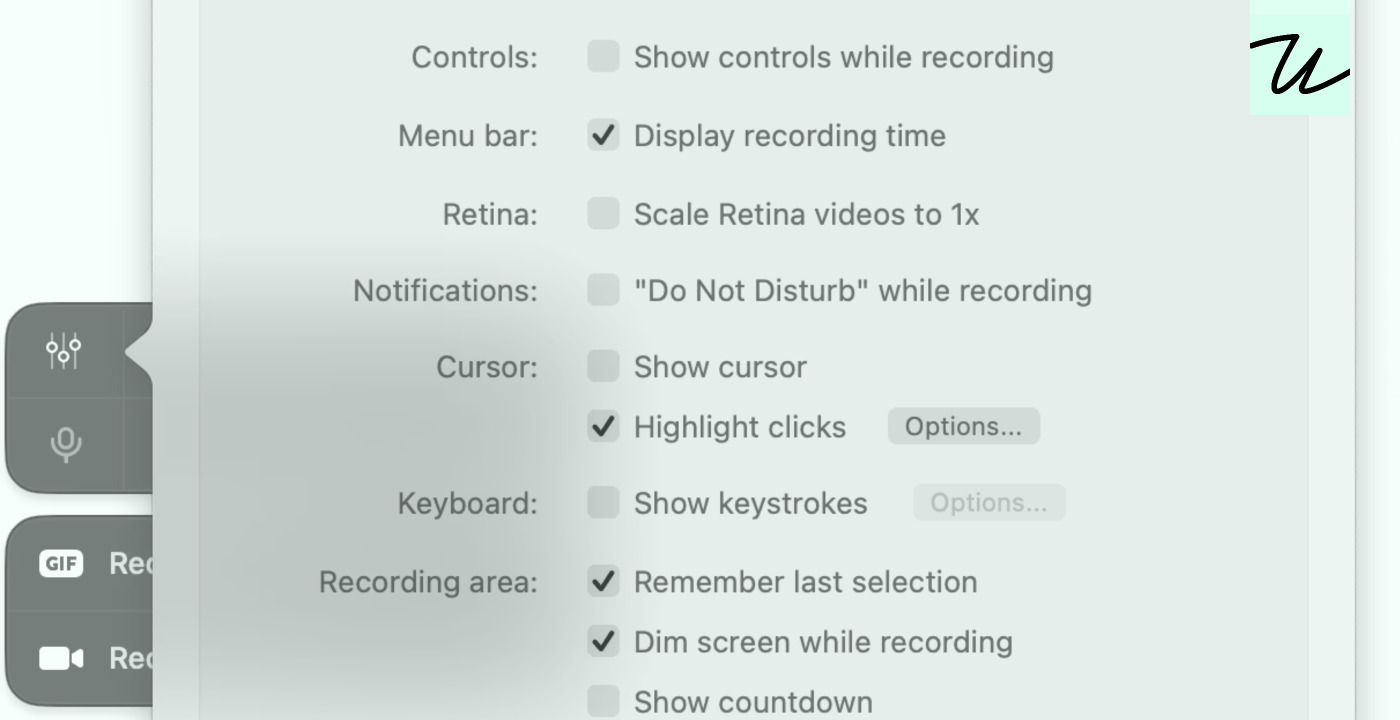
CleanShot 5 replaced CleanShot 4’s settings UI with a macOS-style two-pane layout. On 320px screens, labels drift from controls, making panel-specific choices harder to find. - Don’t Let Architecture Astronauts Scare You (2001)

Architecture Astronauts 2001 warned that one extra abstraction can hide user value for 12 months. The practical test is whether it buys one more level of clarity or just another layer of ceremony.
Research beyond software
Beyond software, research often turns invisible states into actionable maps: here, chromatin configuration becomes the lock that explains why neighboring neural ectoderm lineages build different brain regions.
- Two parallel neural ectoderm progenitors contribute to the developing brain242
Otx2/Gbx2 split: two progenitor populations build three adult brain regions. The lineage boundary may sharpen disease models for SMA and ALS.
Filtered out9 links
These scored below 40% relevance, so they were left out of the digest.
- What happens to TLDs when their country stops existing? (2022)astrid.tech · 37%
- Grit your teeth and ship itseangoedecke.com · 34%
- The paradox at the heart of AI and science | Terence Taoyoutube.com · 33%
- Write while learningpurplesyringa.moe · 28%
- AI Is an Elite Crime Spreethebignewsletter.com · 25%
- GPT-6 Astra Solves a WWI German Radio Cipherprinzai.com · 24%
- If math is more than proof, we need to better celebrate the rest of itterrytao.wordpress.com · 18%
- “The Secret Life of Circuits” is hereblog.coredump.cx · 18%
- Faster JSON parsing with SVE2 on ARM processorslemire.me · 0%
Generated by Clio Analyst