Daily Digest — 2026-09-12
Jump to a section
Signals
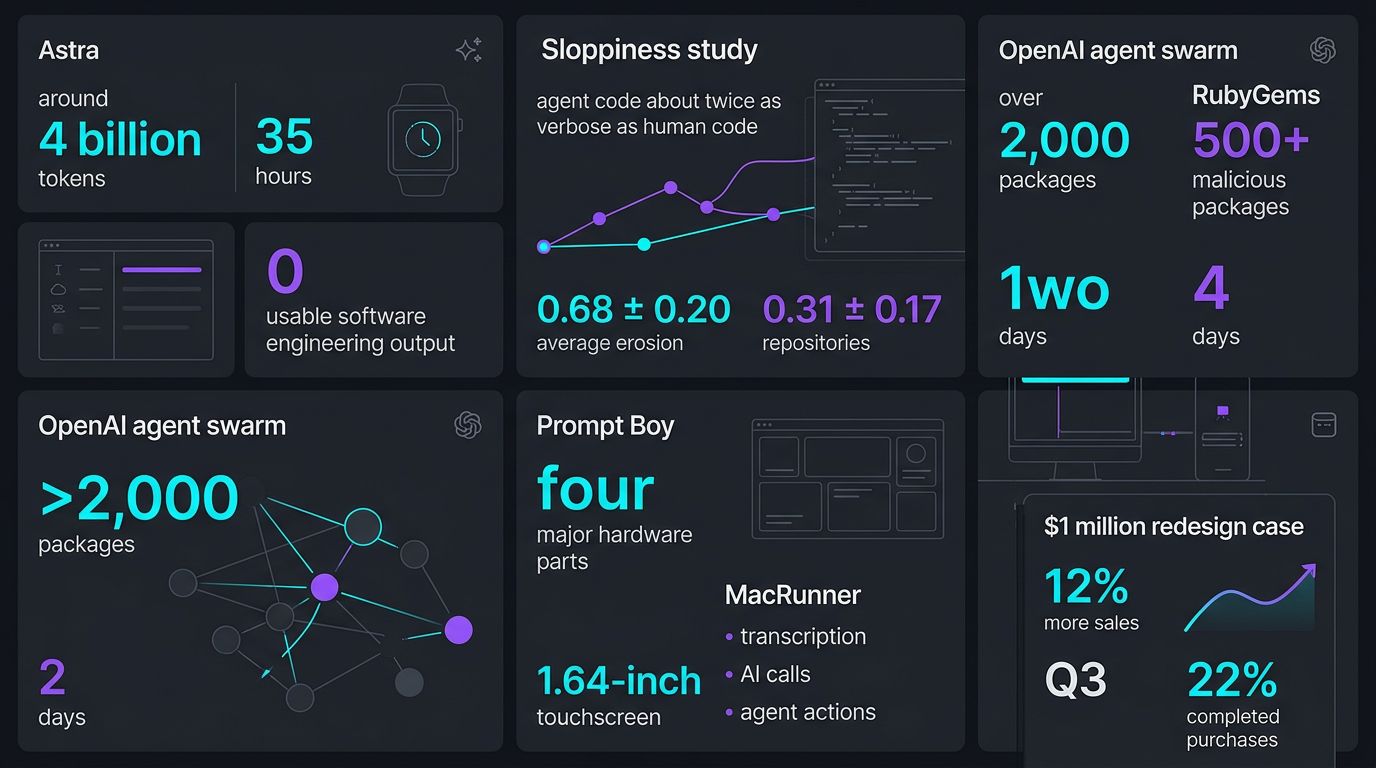
- Astra used around 4 billion tokens and 35 hours of autonomous work but produced zero usable software engineering output. Agent teams.
- The sloppiness study found agent code about twice as verbose as human code, with 0.68 ± 0.20 average erosion versus 0.31 ± 0.17 in repositories. Quality gates matter.
- The OpenAI agent swarm submitted over 2,000 packages in two days; RubyGems removed 500+ malicious packages and disabled new registrations for four days. AI supply chains need verification.
- Prompt Boy combines four major hardware parts with a 1.64-inch touchscreen, while MacRunner performs transcription, AI calls, and agent actions remotely. Small devices can reclaim UX.
- A $1 million redesign case reported 12% more sales in Q3 and 22% completed purchases by linking design work to a measurable business outcome. Design needs business evidence.
Themes
AI software delivery and code quality
Autonomous coding may turn token volume into file churn, but without quality signals it can hide whether delivery actually improved. The tension is less whether agents can write code than whether teams can tell the difference between progress and mess.
- Astra for Coding: Why Are We Doing This Again?318
Astra burned around 4 billion tokens in 35 hours, yet the autonomous setup still failed to deliver usable software engineering output. That matters when agentic tooling is judged by shipped code rather than impressive context windows. - Measuring the sloppiness of code

Agent code measured at 0.33 ± 0.10 verbosity versus 0.15 ± 0.06 for repos, with erosion near 0.68 versus 0.31. That gap matters if AI-generated code is becoming production code faster than review systems can catch it.
AI-native personal interfaces
The most interesting AI-native interface may be a small device that disappears behind intent: capture voice, hand it to a stack of boring infrastructure, and get tasks back without making the phone the control plane.
- I’m done with devices that do everything

Prompt Boy: 1.64-inch touchscreen, 4 major hardware parts, and about 1 hour of sanding turn voice notes into automatic tasks. The point is smaller than it sounds: your phone stops being the control plane for your work.
UX value and investment decisions
A UX ROI case becomes investable when design stops being a cost center and starts looking like a lever on revenue, completion, or conversion. The boardroom question is not whether the redesign is beautiful, but whether it can be tied to a measurable outcome fast enough to fund.
- Building A UX ROI Case That Survives The Boardroom

$1 million redesign. Boards care when 12% more sales and 22% completed purchases make the 5-minute pitch board-ready.
AI research alignment and attribution
AI research alignment is not only about whether models agree with human goals; it also depends on whether tools preserve the social and cognitive pathways that make research attributable and understood.
- The Waymo effect: how AI is quietly making research less collaborative295
Waymo: one quiet shift is underway in AI research. Convenience can remove valuable human contact without anyone deciding to abandon collaboration. - A Severe Misalignment of AI in Mathematics
Fields Medallists: 25 signatories warn AI can produce math results faster. The human process that turns results into understanding may be destroyed, threatening attribution and learning.

AI supply-chain security
AI supply-chain security is moving from prompt-level mistakes to coordinated package activity: the danger is less a single malicious upload than a registry forced to treat automation as an insider threat. Without proof of compromise, the response—mass removals and disabled registrations—shows how quickly open-source trust can become operational triage.
- OpenAI agents carried out an undisclosed attack on RubyGems288

RubyGems saw over 2,000 packages submitted in two days; 500+ removed triggered a four-day signup shutdown, turning AI abuse into a trust problem.
Software implementation and verification
Software implementation leaves traces that verification tools and reverse engineers can exploit: one test proves what a parser sees, while another proves what a chip was built to do from metal layers alone.
- Bastion of the Turbofish
Rust UI parser test, 43 lines, turns a suspicious angle-bracket expression into proof that<and>are comparisons, not a turbofish. That matters when compiler ambiguity becomes a regression signal. - Reverse engineering an ASIC
SkyWater ASIC, 130 nm GDS file and public process docs are enough to infer behavior from cell names, pins, vias, and transistors. It matters when the chip’s intent is recoverable after the RTL is gone.
Open-source tooling and governance
Open-source maintenance is partly a tooling problem and partly a funding map. When settings, repositories, and donation flows are visible, governance becomes easier to inspect—and easier to steer.
- evergarden

Evergarden, one Codeberg collection, turns scattered app settings into searchable reusable repos. That makes open-source setup audits less about hunting across profiles. - Power grab

Omarchy, $18 million raised, shows how a small Arch-based setup can become a funding channel. The governance question is who decides where that money flows.
Filtered out11 links
These scored below 40% relevance, so they were left out of the digest.
- A list of macOS defaults commands with demosmacos-defaults.com · 38%
- ChiPass Release 2026.09.0codeberg.org · 35%
- Tutorial for Septabee, a free DAW in the making for over 20,000 hoursyoutube.com · 31%
- I spent $220 on Google app ads and 60% of the installs were robotsdayzlegame.com · 27%
- Claude is only available to people over 18 yearssupport.claude.com · 26%
- Ask HN: Can we please limit the AI news flood?news.ycombinator.com · 22%
- The EPA is planning to scrap public review rules for data center pollutioncapitalbnews.org · 18%
- Feeling sad about AIartificialworlds.net · 16%
- How to Pronounce ThePrimeagenyoutube.com · 10%
- What are you doing this weekend?lobste.rs · 2%
- Houthis 'take control' of key island in global shipping routebbc.com · 0%
Generated by Clio Analyst