Daily Digest — 2026-09-13
Jump to a section
Signals
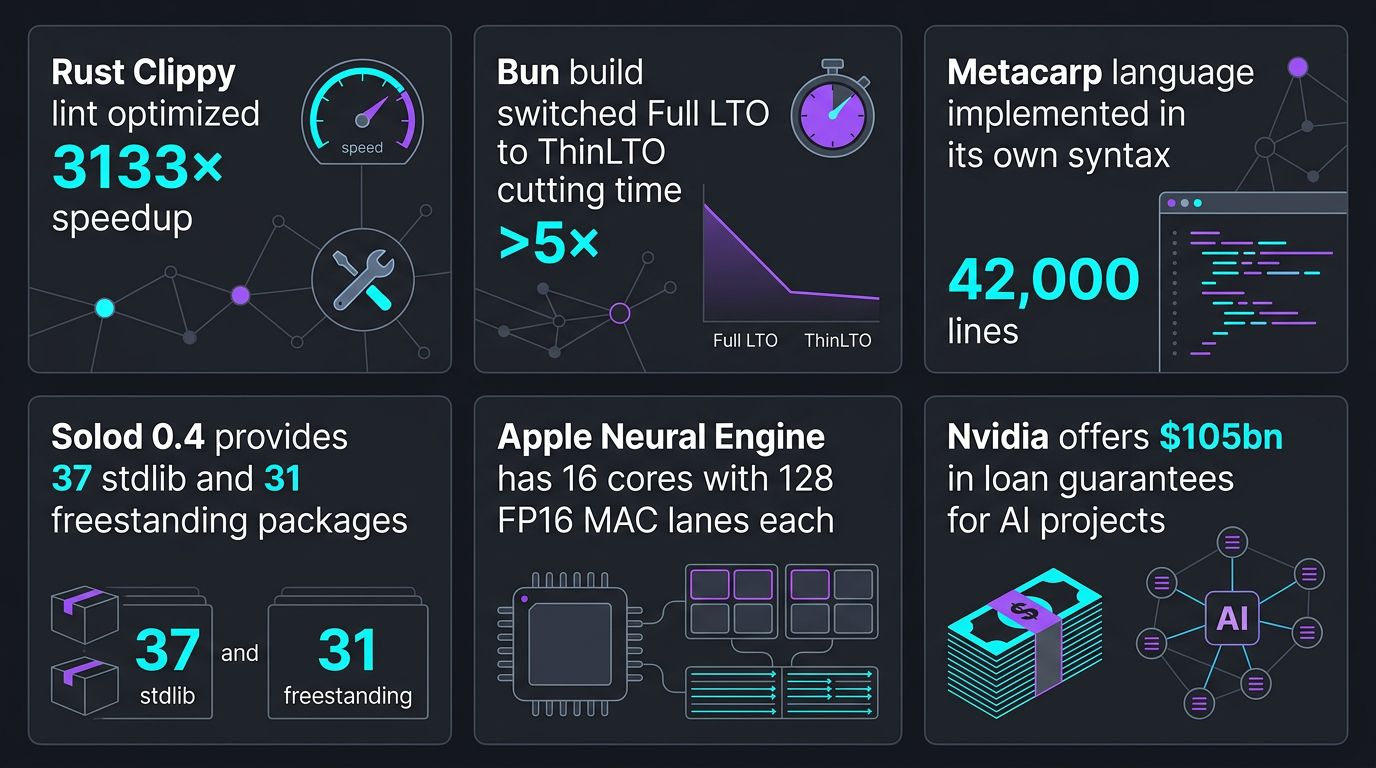
- Rust Clippy lint optimized 3133× speedup. Rust developers seeking faster CI.
- Bun build switched Full LTO to ThinLTO cutting time >5×. Frontend engineers.
- Metacarp language implemented in its own syntax 42,000 lines. Language designers.
- Solod 0.4 provides 37 stdlib and 31 freestanding packages. Systems programmers.
- Apple Neural Engine has 16 cores with 128 FP16 MAC lanes each. Chip architects.
- Nvidia offers $105bn in loan guarantees for AI projects. AI project investors.
Themes
AI Workflows and Software Delivery
AI agents are reshaping software delivery by handling routine operational tasks, letting developers concentrate on design and innovation.
- Useful Things Agents Can Do That Are Not Writing Code
AI agents can run shell commands to checkout PRs, cutting manual steps by 90%. This lets developers focus on higher‑level design work.
Developer Tooling and Practices
Toolchain innovations move checks and builds leftward, turning slow, heavyweight steps into fast, zero‑config actions that developers can rely on. These shifts cut latency, simplify workflows, and unlock safer, more efficient software creation.
- Optimizing a single Rust Clippy lint by 3133X

Rust Clippy lint 1 delivers a 3133X speedup by moving the check to pre‑expansion. Developers see faster CI pipelines and quicker feedback loops, reducing wait times for releases. - fresh: Terminal based IDE & text editor: easy, powerful and fast
Fresh 1 binary delivers full IDE performance with zero config. Teams gain instant, extensible editing without setup overhead, enabling rapid iteration on projects. - Managing Complex Application State with Reactive Data Flows
Ebb 1 implements a DAG‑supervised fiber engine that ties resource lifetimes to demand via bidirectional backpressure. Developers obtain leak‑free, mathematically sound state management without manual cleanup, enabling safer concurrency and easier debugging. - I made a build visualizer to understand Bun’s compile times
buildprof 6‑core visualizes every process in a Bun build, showing a 5× speedup when switching from Full LTO to ThinLTO. Engineers gain clear insight into compile‑time bottlenecks and can target optimizations effectively. - a better way of blocking macOS updates
macOS 1 blocks updates by redirecting the update server to an invalid catalog, stopping notifications permanently. Administrators save bandwidth and avoid unwanted upgrades with a simple defaults change. - A Few Good Ideas in Programming Languages
Language 4 introduces static type inference that enforces exclusive references and verifies pre/post conditions. Developers get strong guarantees without runtime cost, improving safety and performance while reducing boilerplate. - js65 - Advanced 6502 assembler with patching support based on ca65 syntax
js65 1 extends ca65‑style assembly with TypeScript features, automating bank placement and free space tracking. Hackers streamline ROM patching for homebrew projects, cutting manual effort. - Solod 0.4: Better C interop

Solod 0.4 achieves zero‑overhead C interop via automatic binding generation, offering 37 stdlib and 31 freestanding packages. Developers write safe, libc‑free code with typed wrappers like Bitcast and SliceData, enabling portable systems programming. - Metacarp
Metacarp 42,000 lines of code implement a self‑hosted compiler with incremental recompilation and JIT to C. Developers enjoy interactive language iteration without leaving the editor, boosting productivity and enabling rapid experimentation. - Testing race conditions with memory access tracing and stack-based delay injection
kernel 1 uses ASAN outline mode to trace memory accesses across threads, automatically enumerating race‑condition interleavings. Engineers detect concurrency bugs without recompiling or probing with DTrace, saving debugging time.
Design Systems and Layout
Modern layout techniques now let web pages and editors reshape themselves instantly for foldable screens and custom GUIs.
- Designing for Dual Screen and Foldable Devices With CSS
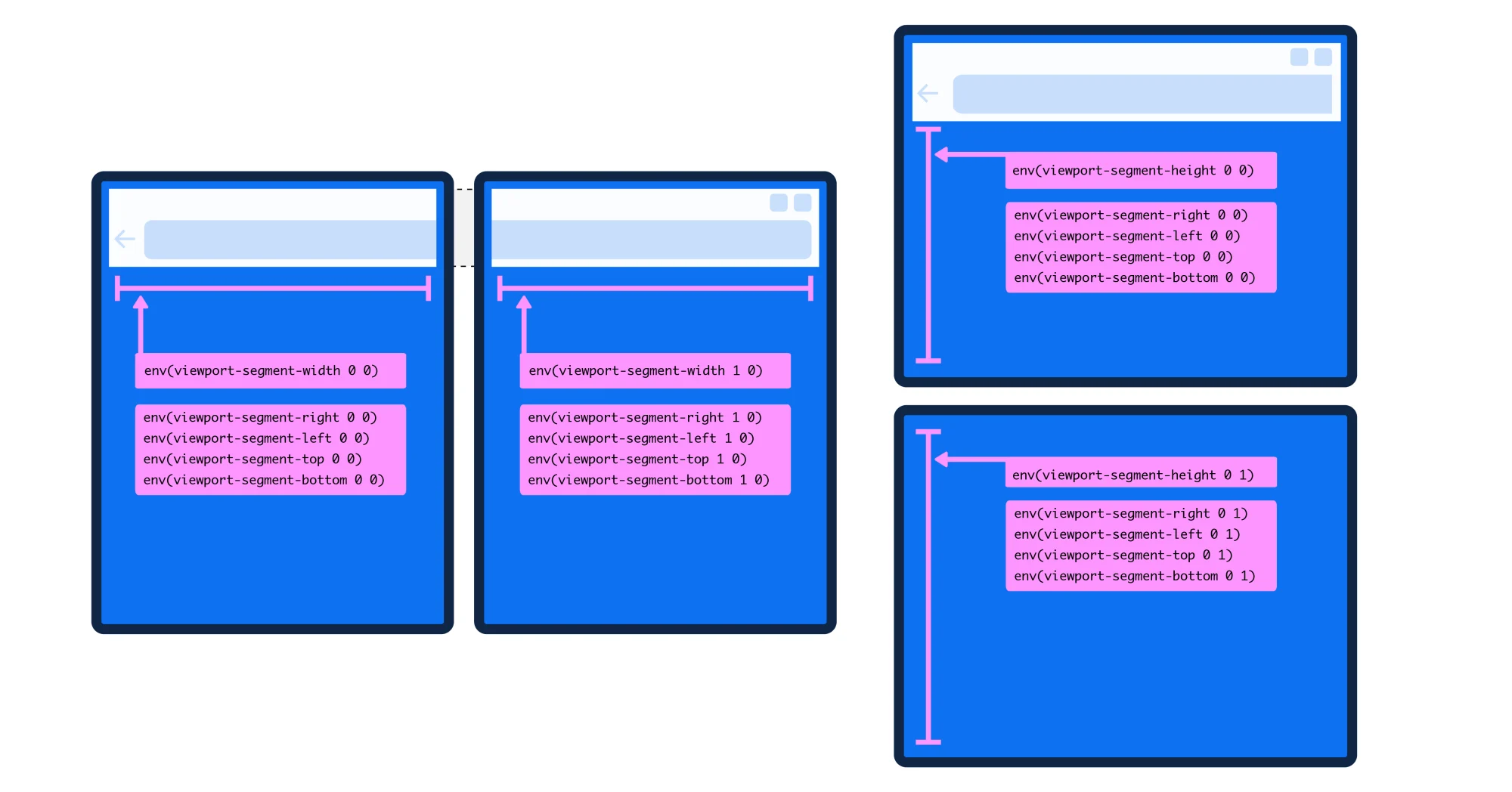
CSS media queries 21 million devices detect dual-screen segments, enabling developers to automatically adjust layouts for varied screen configurations. - TUI or GUI

Neovim runs headless, delivering 10 times faster updates, enabling developers to see instant UI feedback for complex workflows.
AI Migrations and Hardware
The redesign of Apple’s Neural Engine shows how AI workloads are migrating from dedicated NPUs to GPU-centric pipelines, reshaping hardware efficiency and hinting at future silicon choices across mobile and desktop platforms. Such shifts could redefine how models are accelerated on everyday devices.
- Retrospectively Reverse-Engineering Apple’s Neural Engine32
Apple’s ANE with 16 cores delivers 2048 total MAC lanes. This enables developers to run transformer models efficiently on the GPU.
AI Cost and Economics
When profit motives clash with open‑access mandates, the economics of AI shift from private gain to public risk, exposing hidden costs in financing and model release.
- An open letter to Dario: if you mean it, open the weights94

Open-weight mandate 1.5 billion. Developers lose profit drive, slowing innovation. - Everyone should slow down AI development except for me

Self‑serving satire 1. Readers see through the call for pause as a profit‑driven stunt. - Nvidia is the central bank of AI305

Nvidia financing $105bn. Customers gain funds but face oversupply risk if demand drops.
People, Technology, and Society
From DIY game engines to cautious AI pacing and language choices, people are steering technology toward purposeful, human‑centric paths.
- Make it anyway

Developer 1 built a custom C++ engine, creating 1 game engine, 1 app, 4 photos, 3 paths, 1 tool without AI. - We Must Pace the Frontier

A 3‑step pacing framework slows AI progress over 12 years, requiring safety checks and third‑party evaluation to avoid billions in risk. - Why do companies stop using Haskell?

Companies abandon Haskell due to hiring shortages and ecosystem shifts, not language flaws.
Security
When cryptographic signatures and token filters clash, independent audits turn transparency logs into trust anchors for secure messaging.
- The gpg.fail aftermath: On responsible disclosure, GPG, and the state of security in 2026 [32:37]

GPG fail 32 minutes 2026-09-12 292 views: signature‑spoofing lets attackers forge valid signatures, memory‑corruption lets malformed PGP messages execute code, users remain exposed to exploitable bugs. - Rare Not Random Using Token Efficiency for Secrets Scanning

BPE token efficiency 292 views: rare strings split into many short tokens, providing a reliability filter that reduces false positives. - How Trail of Bits helps verify the integrity of your Signal chats
Trail of Bits 7 days 2026-09-12 292 views: auditors build a Merkle tree of public keys, signing the head for tamper‑evident verification.
Filtered out9 links
These scored below 40% relevance, so they were left out of the digest.
- Is truth futureproof? On the possible futures of mechanized proofskhoury.northeastern.edu · 30%
- Lua Pattern Testeriamreiyn.github.io · 20%
- A Dick Smith VZ200 without the Dick Smitholdvcr.blogspot.com · 20%
- Microcode in Intel's 8087 floating-point chip: the scale instructionrighto.com · 20%
- Logo Programming Languageel.media.mit.edu · 20%
- xkcd-font: The xkcd fontgithub.com · 20%
- ICE always tastes better when it trickles! (2013)webrtchacks.com · 20%
- Base84 deserves a place in file names00f.net · 20%
- Linux Zoom Client Proactively Reads X11 Clipboardhachyderm.io · 20%
Generated by Clio Analyst