Daily Digest — 2026-09-11
Jump to a section
Signals
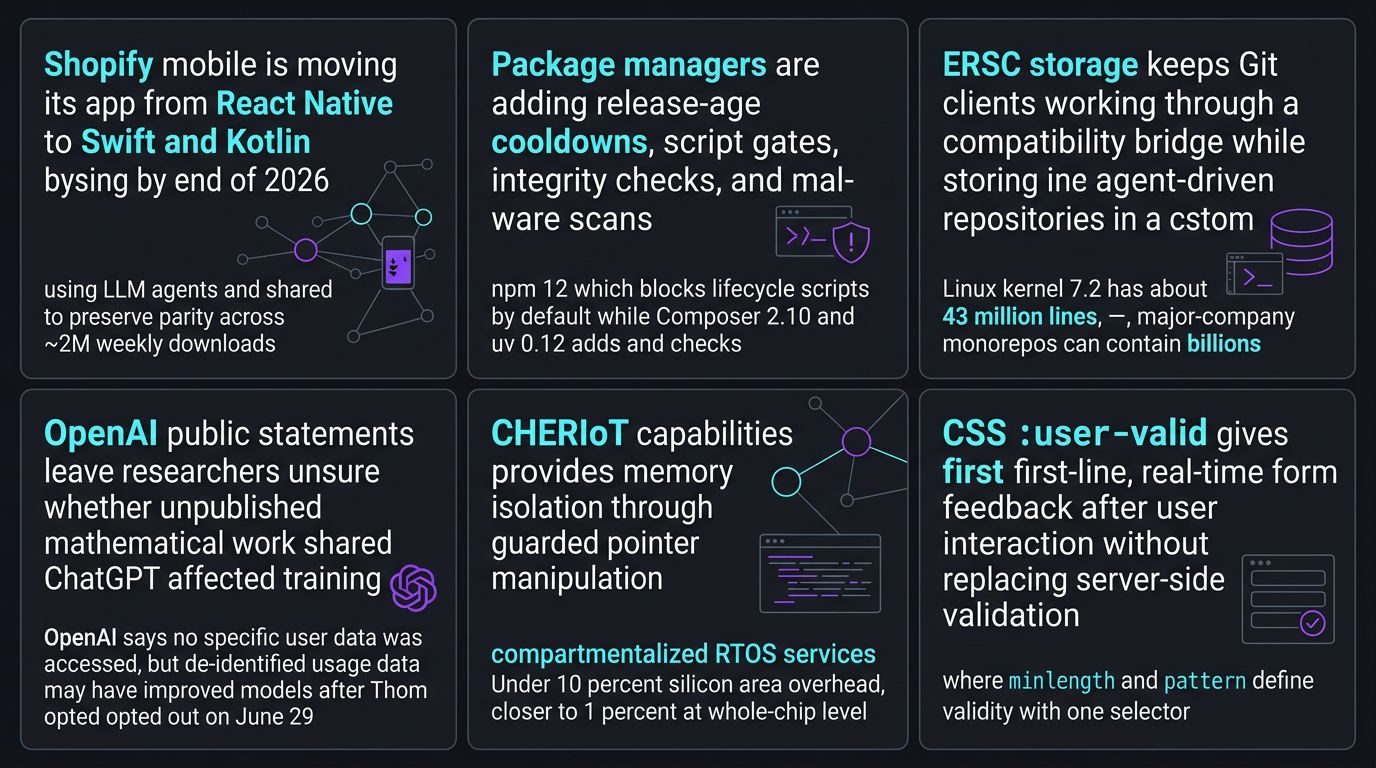
- Shopify mobile is moving its app from React Native to Swift and Kotlin by end of 2026, using LLM agents and shared specs to preserve parity across ~2M weekly downloads. Native app teams.
- Package managers are adding release-age cooldowns, script gates, integrity checks, and malware scans; npm 12 blocks lifecycle scripts by default while Composer 2.10 and uv 0.12 add checks. Dependency-security teams.
- ERSC storage keeps Git clients working through a compatibility bridge while storing agent-driven repositories in a custom non-Git engine; Linux kernel 7.2 has about 43 million lines, and major-company monorepos can contain billions. Agent-enabled developers.
- OpenAI public statements leave researchers unsure whether unpublished mathematical work shared with ChatGPT affected training or reasoning; OpenAI says no specific user data was accessed, but de-identified usage data may have improved models after Thom opted out on June 29. Research teams.
- CHERIoT capabilities provide memory isolation through guarded pointer manipulation, and compartmentalized RTOS services with under 10 percent silicon area overhead and closer to 1 percent at whole-chip level. Resource-constrained embedded teams.
- CSS :user-valid gives first-line, real-time form feedback after user interaction without replacing server-side validation; minlength and pattern define validity with one selector. Web form teams.
Themes
AI governance and trust
AI governance is becoming a question of who gets to opt out of systems that optimize us. Trust now depends less on model capability than on whether intention, data, and responsibility stay with people.
- AI and democracy: the right to resist optimization

AI 1: The right to resist optimization keeps human intention, responsibility, and accountability in the loop. Who cares: democracy depends on people being able to challenge systems that decide for them. - More questions about whether researchers can trust OpenAI with unpublished math692
OpenAI 3d: A commenter says the default improve-the-model setting can expose unpublished math to model improvement. Who cares: three results, including work on 3d incompressible Euler, may not be fully private.
Software culture, practice, and conversations
When tools make history easy to rewrite and ideas easy to ship, software culture starts measuring velocity while ignoring the social debt it leaves behind. The real question is whether teams can keep changing software without making the work itself feel cheaper than it is.
- Conversations with JJ
jj after about six months and two auto-snapshot issues: a Git-compatible PR cleanup habit with friction around branch behavior, log output, and snapshots. It matters if your pull requests are becoming archaeology instead of review. - Bad Vibes Coding

$5 Playdate, 99 cents of restraint, and free culture: the AI argument is really about what gets made when speed beats craft. It matters if you want tools to protect weird games rather than optimize them into sameness. - I have a theory that software drives people insane176

Software after an hour can hide dozens of future rewrites when every few days of edits accumulate into context switching and architectural erosion. It matters because cheap changes can quietly become urgent debt.
Developer tooling and ecosystems
Developer tooling is quietly re-architecting the invisible contracts that keep packages and repositories usable. The common thread is not a new VCS or registry format, but compatibility layers that preserve today’s clients while making the underlying systems safer and more scalable.
- What comes after git

Git 2005-style clients still speak Git, but ERSC can put a bridge between them and a custom storage layer built for larger, agent-driven development. That means teams can test 2025-era monorepo growth—like the Linux kernel’s 43 million lines—without forcing every tool to adopt ERSC today. - Package Manager Trends

npm 12 blocks lifecycle scripts by default, and pnpm 12, Bun 1.4, Composer 2.10, and uv 0.12 are adding cooldowns, malware checks, or integrity gates. That shifts supply-chain defense from optional hardening to the install path every new package touches.
Web/UI and standards
The thread is how interfaces move from browser-era workarounds and stubborn platform habits toward standards that feel native without breaking real users. The useful shift is not abandoning legacy instincts, but knowing which constraints still protect the experience.
- :invalid sorta sucks… but there’s an alternative now
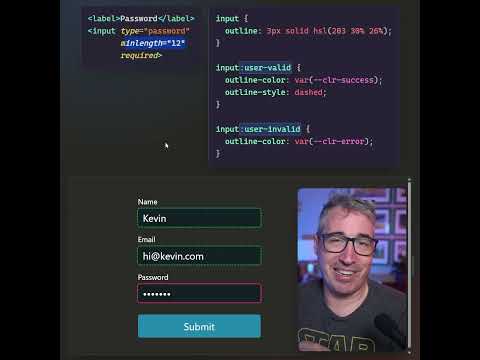
CSS :user-valid and :user-invalid add one feedback layer after interaction, so you can keep real-time form styling without replacing server validation or making clients guess what the backend will reject. - Antiquated CSS and why we needed it

IE5 to IE8 hacks exploited parser bugs to power clearfixes and height workarounds; they helped CSS layouts survive, but every new IE could turn those tricks into breakage. - The terrible menu bar in the Windows 11 Notepad

WinUI 3 MenuBar in Windows 11 Notepad carried seven weeks of complaints because a core app still mishandles menu interactions that Win32 mastered decades ago.
Language/runtime/platform evolution
Windows-native execution is being made portable by making runtimes speak common backend contracts: safer systems code can inherit enterprise tooling, while managed code can precompile itself into production-shaped native code. The common move is less about syntax than about negotiating when language choices become platform capabilities.
- Rust is tier-1 language at Microsoft364

Rust 1.90 at Microsoft reaches tier-1 on Windows by linking rustc to MSVC’s UTC backend. That lets Rust inherit MSVC ABI, hardening, debugging, profiling, and C++ interop without rebuilding the Windows toolchain. - JEP 544: Ahead-of-Time Code Compilation
JEP 544 puts HotSpot into three phases: startup, warmup, and peak performance. A training run seeds an AOT cache, so Java can start like native code yet adapt when production workloads change.
Native/mobile app architecture
Native app architecture is being reconsidered when AI lowers the cost of maintaining two platform codebases. The tradeoff is no longer just framework convenience; it is how much platform access a product can justify and how much abstraction it can afford.
- Shopify moves back to Native from React Native609

Shopify’s ~2M downloads/week app is moving to Swift and Kotlin. LLM-assisted parity makes native access cheaper, but the architecture bet is that fewer framework layers beat one shared UI bundle.
Security architecture
Security architecture keeps chasing a hard trade: stronger isolation without forcing every platform to carry a heavyweight memory-protection unit. CHERIoT turns that trade into a design question—can protected objects and compartmentalized services replace page-based trust?
- How CHERIoT Provides Strong and Usable Isolation Without an MMU

CHERIoT under 10 percent silicon area overhead for MMU-free isolation. That could make strong pointer protection viable in embedded RTOS designs that cannot justify an MMU.
Mathematics and theory
AI-assisted theorem proving is crossing into high-stakes math: a Lean-verified Navier–Stokes result can be read as both a breakthrough and a research-integrity puzzle.
- The Navier Stokes situation is insane

OpenAI’s 10,000 agents found a Lean-verified Navier–Stokes blow-up proof; the dispute is whether it reused prior work.
Filtered out26 links
These scored below 40% relevance, so they were left out of the digest.
- DeepSeek v4.1 Flashtwitter.com · 30%
- An untrusted site can freeze a Mac using WebGPUauberon.xyz · 20%
- Optimizing a Spin-Lockdavid.alvarezrosa.com · 20%
- Soft-deprecating re.match()hugovk.dev · 20%
- Julia 1.13 Highlightsjulialang.org · 20%
- Making Social Media Socialtante.cc · 20%
- Forgejo 16.0.4 has a critical security bug fix (RCE - Remote Code Execution)codeberg.org · 20%
- It's not the YAML spec's fault, butslugcat.systems · 20%
- My HTML Boilerplatevale.rocks · 20%
- Python sets and dictionaries can have quadratic-time performancelemire.me · 20%
- A quick overview of atomics in Clemire.me · 20%
- A rant about phishing: It's not the user's fault (and not DNS either)maurycyz.com · 20%
- Announcing the first Guix-Science releasehpc.guix.info · 20%
- It Breaks a Village: Bevy's 6th Birthdayblog.fallible.net · 20%
- Knowledge Retention & Sharing in DF/IRwindowsir.blogspot.com · 20%
- Absolutely Everything You Always Wanted to Know About Watermarks in Apache Flinkdeveloper.confluent.io · 20%
- Fastly Speedtest Testspeed.edgecompute.app · 10%
- phlex-hanami v0.2.0github.com · 10%
- List of references on Sony websites to players "owning" their digital gamesconsumerrights.wiki · 10%
- What algorithm did Windows XP use to choose your initial user picture?devblogs.microsoft.com · 10%
- Gleam Gathering 2027gleamgathering.com · 10%
- Automattic CEO Matt Mullenweg placed on leavetheverge.com · 10%
- Xteink X4 Pro reviewabstractnonsense.xyz · 10%
- The same nine streaming subscriptions cost $702/year more than in 2021honestlyranked.com · 10%
- Decoding the NEC V20 Microcodemartypc.blogspot.com · 10%
- How to avoid correctness space leaks on a lazy setting in Haskell (2023)epicandmonicisnotiso.blogspot.com · 10%
Generated by Clio Analyst