Daily Digest — 2026-10-20
Jump to a section
Signals
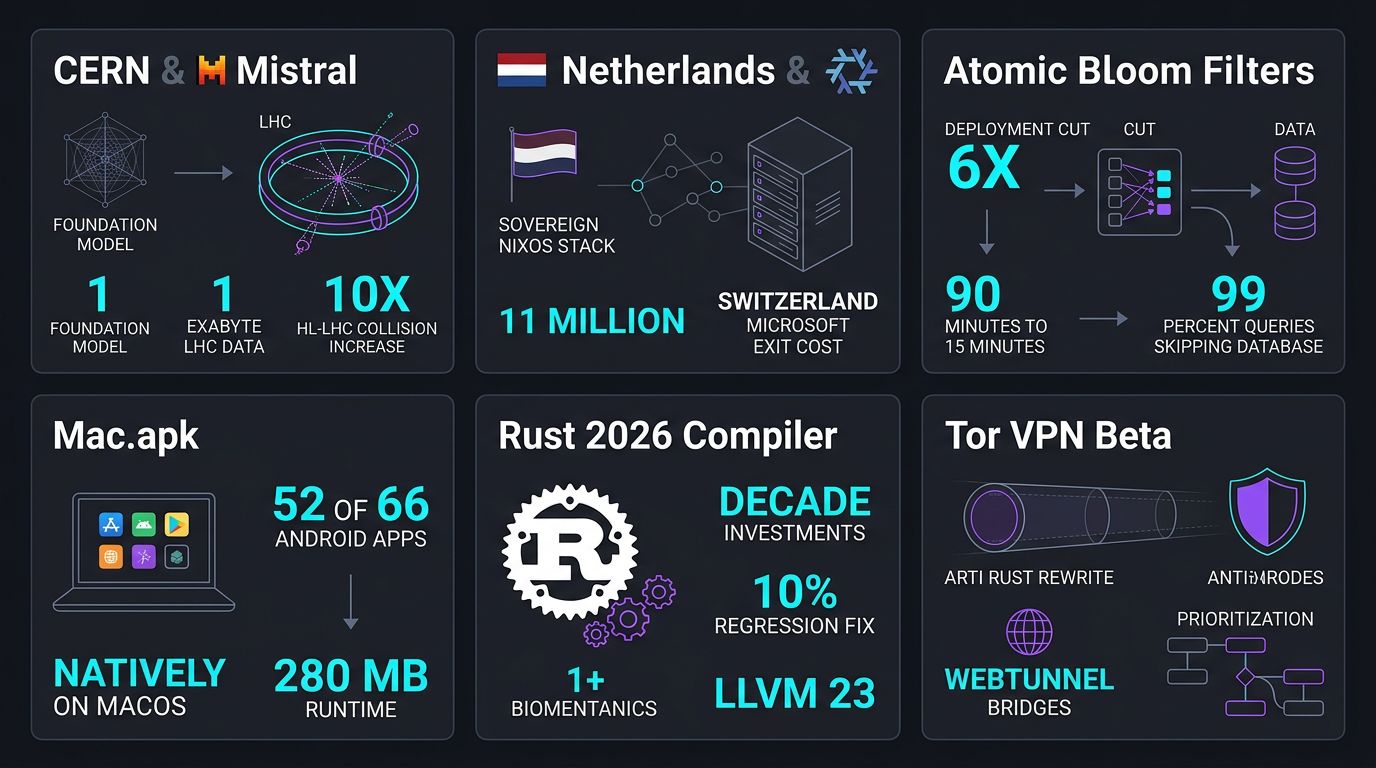
- CERN and Mistral train foundation model on 1 exabyte LHC data for 10x HL-LHC collision increase. Physics AI migration.
- Netherlands builds sovereign NixOS stack citing 11 million Switzerland Microsoft exit cost. Government technology independence.
- Atomic bloom filters cut deployment 6x from 90 minutes to 15 minutes with 99 percent queries skipping database. Infrastructure gain.
- Mac.apk runs 52 of 66 Android apps natively on macOS with 280 MB runtime and no virtualization. Framework migration.
- Rust 2026 compiler delivers decade investments with 10% regression fix via LLVM 23. Compiler maturity.
- Tor VPN beta prioritizes circumvention over privacy with Arti Rust rewrite and WebTunnel bridges. Censorship resistance.
Themes
Systems Programming & Compilers
Compiler and runtime teams are shipping decade-long investments that turn theoretical safety into measurable throughput. The pattern: encode invariants in the type system or instruction selection so the fast path stays fast without runtime guards.
- 2026 is an exciting year for the Rust compiler (and me)
Rust 2026 delivers parallel frontend, new trait solver, and Polonius borrow checker after nearly ten years of work. Compiler teams get faster builds and sounder types without changing code. - Borrow Checking Zero-Cost Cyclic Mutability

A shape-stability analysis lets the borrow checker allow shared mutability on cyclic data structures with zero runtime cost. Library authors can now expose safe APIs for graphs and doubly-linked lists without reference counting. - One Hash Bloom Filters
Atomic bit operations replaced mutexes in a bloom filter serving millions of queries per second, cutting deploy time from 90 to 15 minutes. The fix was contention, not hash speed. - Making dns_erlang Fast: Binary Tricks for the BEAM
Zero-copy parsing via BEAM match contexts and append-only binary building cut CPU per DNS query by 12%. Erlang now matches C throughput on binary protocols without NIFs. - Composite objects and C++26 the std::polymorphic type
std::polymorphic in C++26 gives value semantics to polymorphic types by auto-generating clone calls on copy. Framework writers delete boilerplate clone hierarchies and get const-correct deep copies. - Making all divisions slower to fix a bug in 0.000000000000000000542% of cases
Futhark adds a branch to every signed division to handle the one-in-2^64 case where C’s undefined behavior would miscompile. Correctness costs a check on the hot path. - Android apps running native on macOS155
Mac.apk runs 52 of 66 tested Android apps natively on Apple Silicon by reimplementing the framework layer on macOS. No VM, no emulator, just ARM64 code on Metal.
Developer Tooling & Runtimes
Runtime fragmentation accelerates as Deno pivots and forks emerge, while Cloudflare’s edge platform absorbs frameworks and inspires new isolate-based competitors. Meanwhile, TypeScript patterns and testing economics reveal the hidden costs of tooling choices.
- Everyone is hacking their TV ⟡ VoidZero Framework Open Sourced ⟡ OpenCode Hacked ⌁ Syntax Weekly ⌁

Cloudflare open-sourced VoidZero as a Vite plugin with zero-config ‘void deploy’ to Workers. Edge frameworks just got a Laravel moment. - Deno is extinct?!

Deno’s creator released Seldy after 50% of Deno commits shifted to Node compatibility. Self-hosted durable objects on V8 isolates arrive Apache 2 licensed. - Removing a Type Assertion with Object.assign
Object.assign(new Response(), { json() {…}}) removes unsafe assertions by intersecting runtime Response members with custom methods. TypeScript’s T & U return type does the heavy lifting. - Beginning of the Ende (a community Deno fork)

Community fork Ende strips Node compatibility from Deno after VC abandonment, adding per-module permissions and post-quantum crypto. ChronVer replaces SemVer for the December soft launch. - A Bazel Bard

Test investment should mirror failure cost, not fixed ratios—AI agents now over-generate mocked unit tests creating CI bloat. High-risk domains need more tests; most don’t.
Web Frameworks & Components
Framework authorities are quietly abandoning their own component models—Google sidelines web components in official guidance, while Hanami rejects ActiveRecord’s fused persistence for a three-layer separation.
- Do web components have a future if nobody is writing them?
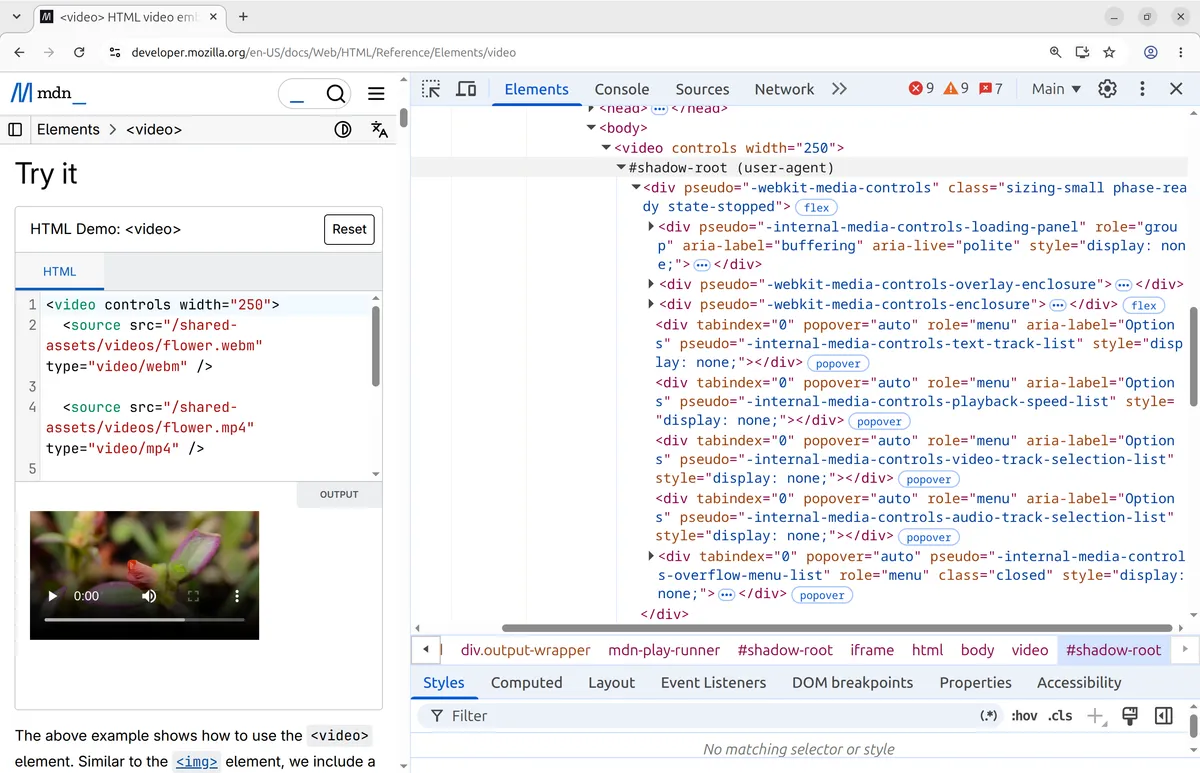
Google’s Modern Web Guidance omitted web components for six months, while Svelte and Vue achieve Shadow DOM style encapsulation through compile-time CSS scoping. - Hanami, Why?: Model Citizens

Hanami splits persistence from representation into three layers—Relations, Repos, Structs—using ROM and Sequel instead of ActiveRecord.
AI in Software Development
Across product teams and particle physics, the winning pattern is identical: humans own the architecture and abstractions, AI executes within those fixed boundaries.
- Ask HN: How to deal with shipping AI-written code you don’t understand?476
HN thread converges on UML-level design by humans, unit-level generation by AI — keeps the codebase explainable. - CERN and Mistral sign a statement of intent to establish a strategic partnership57
CERN and Mistral will train one foundation model on 1 exabyte of collision data to replace the entire reconstruction chain.
People, Technology & Society
Developers and governments are building sovereign technology stacks to escape vendor lock-in and AI-driven ecosystems, choosing human-centered tooling over automated convenience.
- Finding a home amidst the wreckage
Chimera Linux rejects LLM-generated code while its cbuild tooling accepts one new package and one update from contributors. - Tor VPN Beta: What we’ve learned building our own VPN for Android from scratch
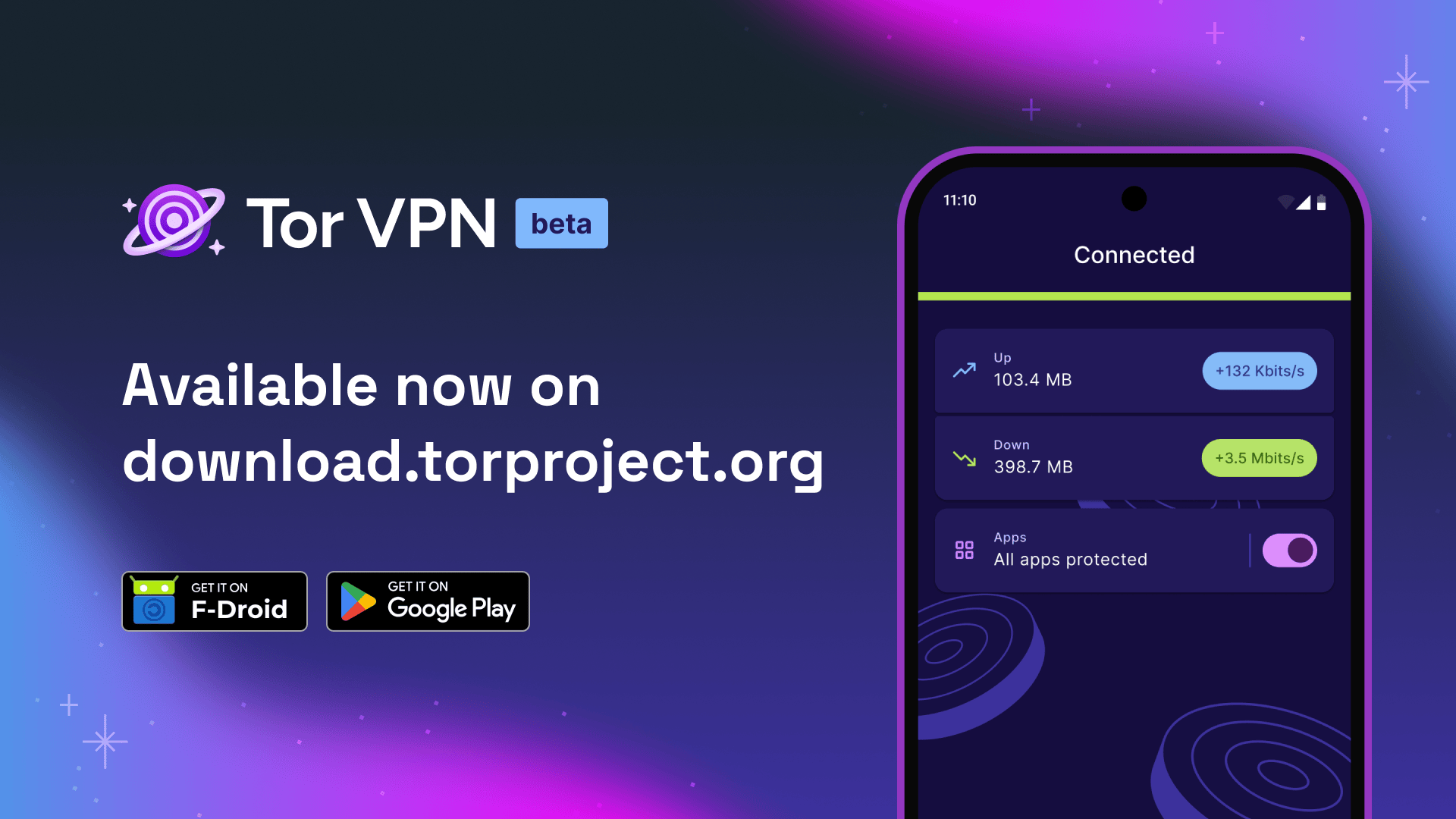
Tor’s Android VPN beta ships Arti Rust core and WebTunnel bridges for 1.4.0 release targeting censored regions this fall. - The Netherlands is building its own Linux OS to break free from Microsoft

The Dutch government funds a sovereign NixOS stack across all institutions after US sanctions risk and 11 million Swiss migration cost. - In Context

Static typing guarantees internal consistency but fails for information programming where correctness depends on external context and distributed state. - It’s still OK to enjoy programming
Programming for personal joy remains worthwhile regardless of AI capabilities or economic utility. - I no longer care to work on any Ruby gems so I’ve archived all my repositories425
A Ruby maintainer archives all gems refusing to feed human-written code into an ecosystem increasingly built for AI agents. - Crawlers, floods and fleets: a year of keeping our digital collections open

Thousands of crawler IPs flood search endpoints within minutes forcing June and September 2026 service failures for genuine users.
Filtered out17 links
These scored below 40% relevance, so they were left out of the digest.
- OpenBSD 8.0: releasedmarc.info · 35%
- OpenBSD 8.0openbsd.org · 35%
- Mercury 3: Diffusion at scaleinceptionlabs.ai · 35%
- Timestral: Mistral's time-series foundation modelsmistral.ai · 35%
- Programming Language Fundamentals in Agdaplfa.github.io · 35%
- MiniMax M3.1 Flashminimax.io · 30%
- Alternatives to animal testing are finally taking offspectrum.ieee.org · 30%
- Let's Encrypt is adding two additional remote perspectives for domain validationcommunity.letsencrypt.org · 30%
- Wine ported to OpenBSDmarc.info · 30%
- Linux 7.3lwn.net · 30%
- A5 v1.0a5geo.org · 25%
- I built a drone with only one motor [video]youtube.com · 20%
- FreshRSS 1.30.2github.com · 20%
- Lula supporters protest against Meta to denounce its 'electoral interference'efe.com · 10%
- Maybe There Was an Egg Cartel After Allpolitico.com · 10%
- Ousted Savannah police officer gave ICE agent husband access to Flock systemwjcl.com · 10%
- What are you doing this week?lobste.rs · 10%
Generated by Clio Analyst