Daily Digest — 2026-10-19
Jump to a section
- Signals
- Themes
- AI Workflows and Software Delivery (#ai-software-delivery)
- AI-Native Design and Interfaces (#design-tools-webmcp)
- Design Systems and Tooling (#design-tooling)
- CSS Engineering (Servo Internals) (#css-engineering)
- FPU Hardware Deep Dives (#deep-hardware)
- C++ Safety & Adoption Challenges (#safety-cpp)
- Borrow Checking Theory (#borrow-checking)
- Open Source Contribution / Community Reports (#community-reports)
Signals
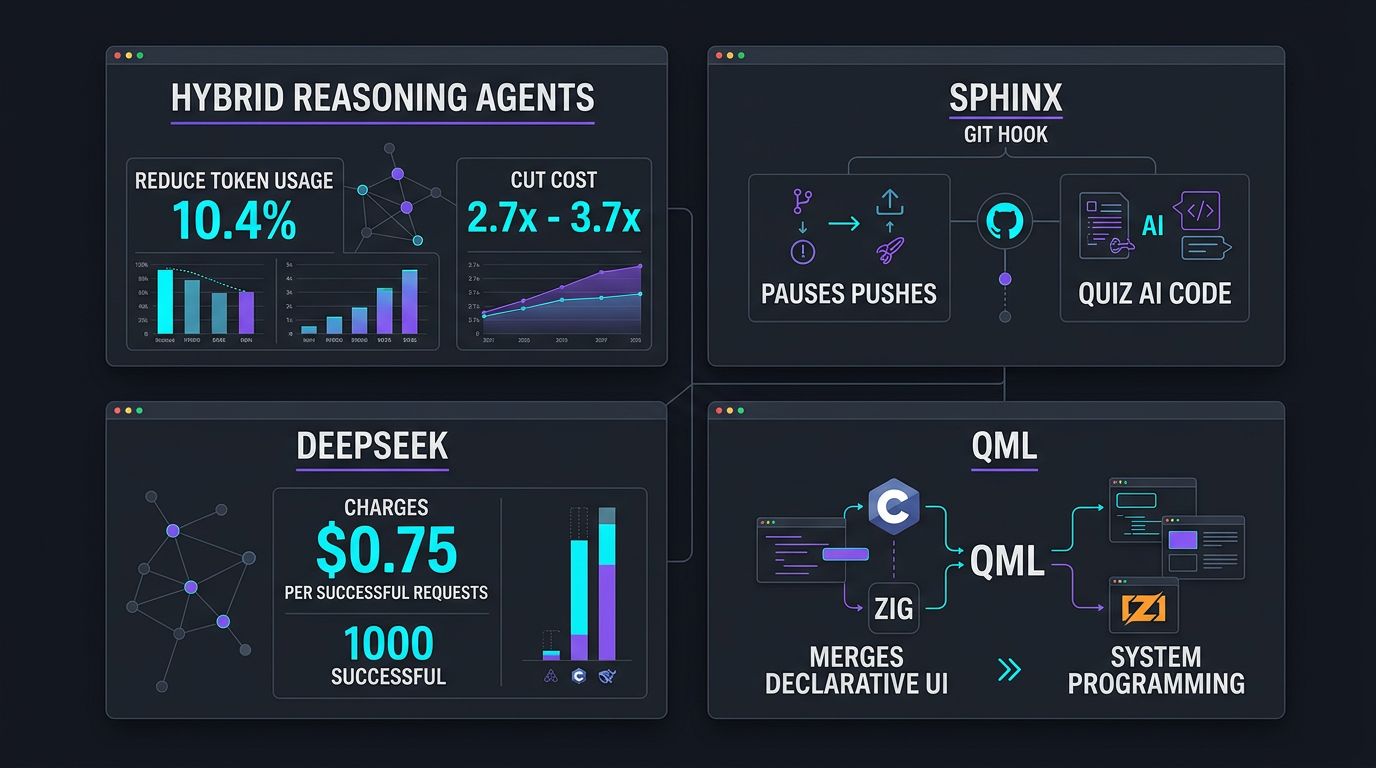
- Hybrid Reasoning Agents reduce token usage by 10.4% and cut cost by 2.7x-3.7x
- Sphinx git hook pauses pushes to quiz AI code before shipping
- DeepSeek charges $0.75 per 1000 successful requests
- QML for C & Zig merges declarative UI with system programming
Themes
AI Workflows and Software Delivery (#ai-software-delivery)
Hybrid reasoning agents slash token usage and accelerate inference by merging latent thought with text actions, delivering clear cost and performance improvements.
- Hybrid Reasoning Agents: LLM agents that think in latent space, act through text157

A lightweight HybridLink switches between latent reasoning and text mode, cutting tokens by over ten percent and halving inference time. - Show HN: Sphinx – A hook that quizzes you on your AI’s code before shipping85
Developers often don’t understand AI-generated code well enough, risking deployment of broken or insecure logic without realizing it. - My obituary for programming
Excessive reliance on AI risks turning programming into a passive activity and compromising long-term code health. - DeepSeek search and fetch – $0.75 per 1000 successful requests263
DeepSeek launched raw JSON APIs for live web access, making it easier for agents and RAG applications to pull real-time web content.
AI-Native Design and Interfaces (#design-tools-webmcp)
AI-native design tools are moving away from traditional editor paradigms toward inline, script-driven rendering that keeps markup readable while executing complex dynamic logic directly in the document. This shift enables tighter coupling between AI-generated content and the DOM, reducing indirection and latency.
- Inline rendering with document.currentScript
Inline rendering with document.currentScript replaces script tags with computed values at runtime, enabling AI-native design tools to inject complex dynamic markup without bloated template layers.
Design Systems and Tooling (#design-tooling)
Declarative UI frameworks are merging with systems programming languages, letting teams compose existing C/Zig code with declarative interfaces in a single workflow. The tradeoff is a steeper learning curve, but the payoff is portable device development without sacrificing low-level control.
- QML for C & Zig

QML now compiles alongside Zig for embedded devices. Teams gain declarative UI while keeping C-level control of hardware drivers.
CSS Engineering (Servo Internals) (#css-engineering)
CSS layout engines are being rewritten from scratch in Rust, with grid and text-selection improvements now shipping by default. The shift from legacy C++ layout code to compiled runtimes is reshaping how browsers handle the most expensive parts of rendering.
- August in Servo: CSS Grid, text selection, and more

Servo enabled CSS Grid by default after 417 commits. Sites relying on grid layouts now render faster without any author-side changes.
FPU Hardware Deep Dives (#deep-hardware)
FPU hardware deep dives reveal two distinct approaches to floating-point computation: one that brute-force searches for minimal operation formulas, and another that reverse-engineers undocumented classic silicon to expose foundational arithmetic logic.
- Superoptimizing an FPU emulator

A search algorithm found a 4-operation formula for FPU emulation that no human expert could derive by hand. The result is a general technique for discovering clever bit manipulation tricks automatically. - Inside the Intel 8087 chip: floating-point addition and subtraction
The Intel 8087’s undocumented addition circuit was reverse-engineered from microcode to show how early floating-point arithmetic actually worked under the hood.

C++ Safety & Adoption Challenges (#safety-cpp)
Even after regulatory pressure, memory-unsafe C++ remains a liability, prompting stricter standards across major browsers.
- The Problem with C++ Safety: Why “It Works” Isn’t Good Enough
Apple 18% reduction in crashes, improving user retention. - What requirements don’t you have?
Systems that relax requirements naturally outperform systems that try to satisfy everything.
Borrow Checking Theory (#borrow-checking)
Borrow checking is usually taught as a forward-pass verification tool, but reversing the walk lets the checker validate references as it consumes the function from end to start, handling loops and branches more naturally in a single pass.
- A New Way to Think About Borrow Checking (In Reverse)
Walking the borrow checker backwards lets a single-pass check handle loops naturally. Validity is determined as each reference is consumed from end to start.
Open Source Contribution / Community Reports (#community-reports)
External issue trackers often resolve complex bugs faster than corporate escalation paths, as shown by rapid fixes to a TouchExplorer pointer problem. This demonstrates how open‑source communities accelerate support resolution.
- Outside the Scope of Our Support
Display, four minutes to restore stability quickly without any issues.
Filtered out20 links
These scored below 40% relevance, so they were left out of the digest.
- Updates to site guidelines and AI/LLM tagslobste.rs · 30%
- Speeding up code review with `small-change`lethain.com · 30%
- How Discover-Tech turned targeted ads into a pipeline for zero-click spywarescitizenlab.ca · 30%
- Parser Combinatorst3.at · 30%
- Using timers to perform weekly tasksmbork.pl · 30%
- BBC Master Pi 1MHz Domesdayyoutu.be · 20%
- Dynamic Packagesgetlazarus.org · 20%
- Open MicroManipulator – A sub-micrometer 3D motion control plattformgithub.com · 20%
- Namecheap just seized and disabled all my domainsreddit.com · 20%
- macOS 15.8.2 Breaks OpenGLdeveloper.apple.com · 20%
- Legal experts warn Meta's new terms still grant broad scraping permissionsniemanlab.org · 20%
- Real-time Software On Linux: How Hard Can It Be?youtube.com · 20%
- RepRapMicrongithub.com · 20%
- Ghidra + CBMC = Assembly Model Checkerphilipzucker.com · 20%
- High performance policy routed IPsec mesh SD-WANranet3.com · 20%
- ARP! Tell your network to explain itselfbenjcal.space · 20%
- Algorithmic Sound Design with L-Systems and Granular Synthesisnathanho.me · 20%
- Un-hanging the HP Envy 17-DA0013dx for OpenBSDdarwinsys.com · 20%
- Men in tech #YesAllMenmedia.ccc.de · 0%
- It's enough - vibecoding tag crossed from useless to harmfullobste.rs · 0%
Generated by Clio Analyst