Daily Digest — 2026-10-07
Jump to a section
Signals
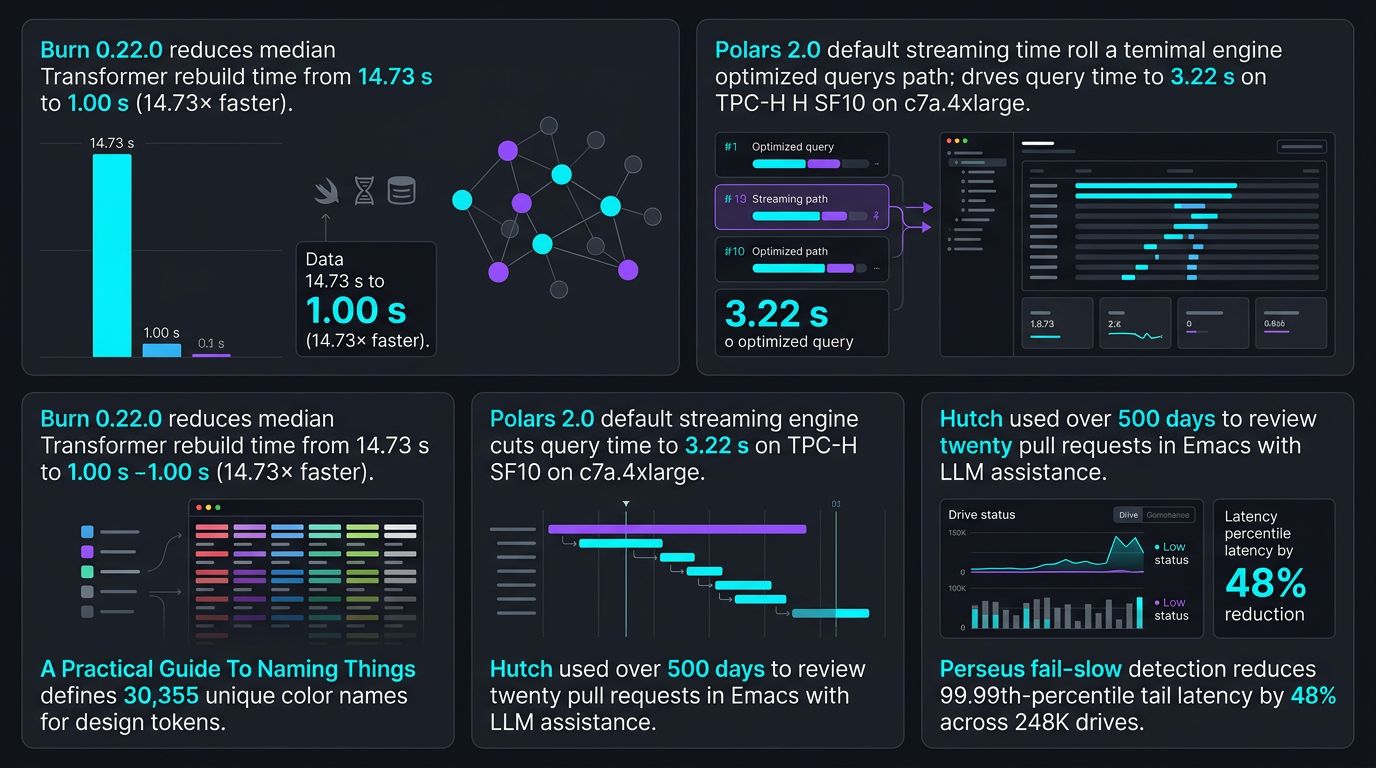
- Burn 0.22.0 reduces median Transformer rebuild time from 14.73 s to 1.00 s (14.73× faster). AI developers building models.
- Polars 2.0 default streaming engine cuts query time to 3.22 s on TPC‑H SF10 on c7a.4xlarge. Data engineers processing large datasets.
- A Practical Guide To Naming Things defines 30,355 unique color names for design tokens. UI designers building scalable design systems.
- Hutch used over 500 days to review twenty pull requests in Emacs with LLM assistance. Developers seeking lightweight code review.
- Perseus fail‑slow detection reduces 99.99th‑percentile tail latency by 48% across 248K drives. Storage operators managing cloud workloads.
Themes
AI Development Tools & Frameworks
New releases strip away unnecessary complexity—Burn erases backend generics for quicker compiles, while Polars makes streaming the default for massive data crunching. Together they hint at a shift toward leaner, faster tooling for AI workloads.
- Burn 0.22.0: Faster Builds, Easier Extensions, and Smarter Autotuning
Burn 0.22.0 cuts CNN rebuild time from 28.4 s to 4.6 s, a 6.2× speedup. Teams shipping ML models see faster iteration cycles. - Polars 2.097
Polars 2.0 processes TPC‑H SF10 in 3.22 s on a 16‑vCPU instance, beating prior baselines. Analysts get quicker insights on large datasets.
AI Hardware
As AI models grow, the race to build efficient, open hardware accelerators intensifies, promising to close the gap between software flexibility and silicon performance.
- OpenTPU – An open-source AI accelerator, developed by AI320
OpenTPU achieves 85% of DDR3 memory bandwidth. Designers seeking near‑hand‑tuned AI accelerator performance can now prototype without costly ASICs.
AI Model Releases
When open‑weight models start matching closed‑source giants on enterprise benchmarks, the balance of control and performance shifts. This release hints at a future where companies can tailor AI without vendor lock‑in.
- Mistral Large 4: “Le Chonk”5
Mistral Large 4 packs 1 trillion parameters, yet only 49 billion are active during inference. Enterprises gain frontier‑level performance with full deployment control.
AI & Society
As AI tools become more powerful, users juggle controlling model deployment, guarding against privacy breaches, and trusting machine‑generated mathematics. These tensions shape how we adopt, secure, and verify AI‑driven innovations.
- Pared - remove unwanted Apple Intelligence models without disabling SIP
macOS 14 users can delete unwanted Apple Intelligence models via Pared. Privacy‑conscious users keep SIP intact while trimming bloat. - Meta’s Muse is an adorable privacy and security dumpster fire261

macOS 14 users exposed Muse’s zero‑day exploit that reads private messages. Developers and users now face stricter full‑disk access prompts after Apple’s patch. - Sharing AI progress in mathematics567

OpenAI 10 summaries of model reasoning show novel math results in ~3 hours each. Researchers can verify proofs via Lean and reuse the compute estimates.
Software Engineering Practices
When code relies on hidden assumptions—whether about dependencies, types, or randomness—small shifts can unlock big gains in reliability and speed.
- Why We Should Inject Dependencies

Dependency injection reduces test setup steps by 50%. Teams spend less time mocking and more time shipping features. - Bidirectional Type Slicing
Type slicing explains 3 typing outcomes. Developers debug faster when type errors are pinpointed. - When random is not actually random enough
Random selection uses 10 equally weighted options. This eliminates bias and makes code clearer.
Developer Tools & Productivity
Sandboxed code execution and lightweight LLM‑assisted review are reshaping how developers automate and validate work locally. These patterns let teams push richer automation and catch bugs earlier without heavyweight infrastructure.
- What is Codemode
Codemode handles 5‑10 items, executing JavaScript in a WASM sandbox. Teams get richer automation without bloating the LLM’s context. - hutch: local code reviews in emacs for the mildly disenfranchised

Hutch 500 days runs an LLM on selected Emacs scopes to flag issues before remote review. Developers queue suggestions withmand apply all withA, patching staged files directly.
Design Systems & UI
A shared naming language lets teams reuse tokens across products. Instant UI controls turn those tokens into live, cohesive experiences.
- A Practical Guide To Naming Things

30355 unique color names give teams a shared vocabulary that speeds up component reuse. - Is COSMIC DE mogging KDE Plasma?
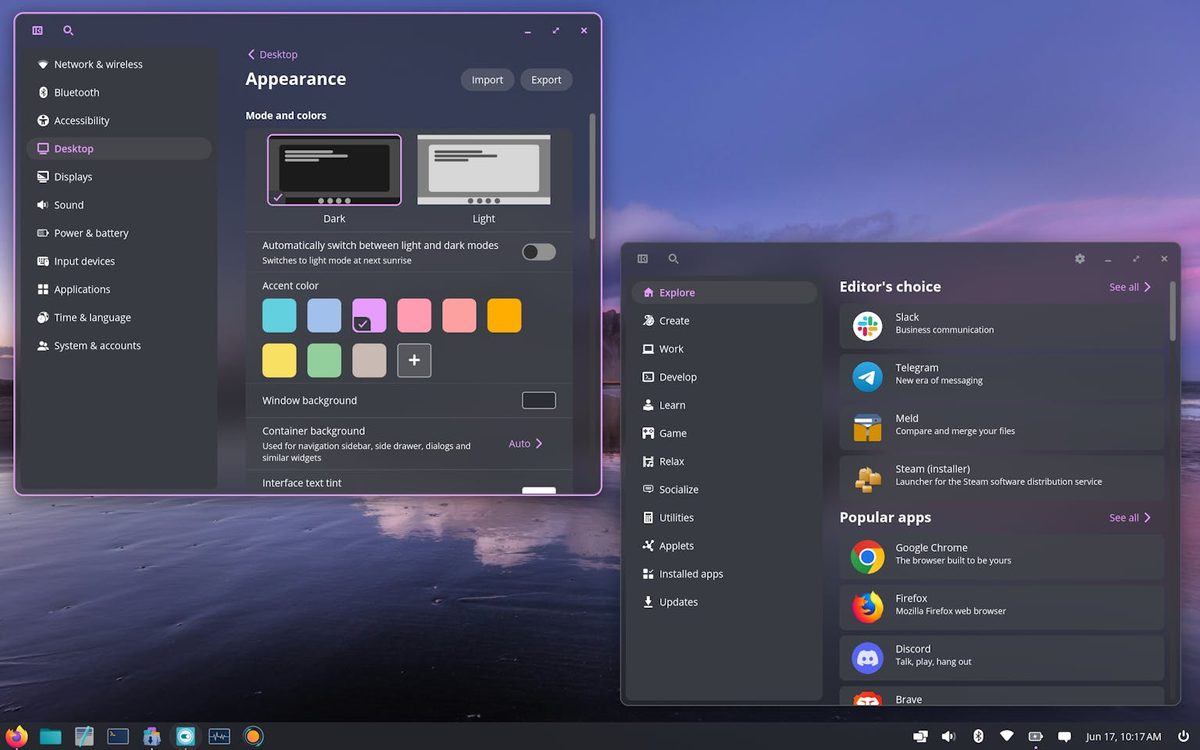
KDE Plasma 25 years of development struggles to match COSMIC’s instant UI tweaks.
Cloud Storage Reliability
As cloud workloads push storage hardware to its limits, subtle drive degradations can silently inflate latency tails. Detecting these fail‑slow conditions early lets operators reclaim performance without costly over‑provisioning.
- Perseus: A Fail-Slow Detection Framework for Cloud Storage Systems (2023)
Perseus detected 304 fail‑slow drives. Storage engineers can cut tail latency by half.
Filtered out19 links
These scored below 40% relevance, so they were left out of the digest.
- A Terminal Protocol for Program Status (OSC 7501)mitchellh.com · 30%
- How to fix a bug in a fixprojectzero.google · 30%
- kahawai - an open source, modular media systemgithub.com · 30%
- Raspberry Pi Desktop now available for PC and Macraspberrypi.com · 20%
- Gleam doesn't compile to Erlang source anymoregleam.run · 20%
- Janet on x32: 32-bit Pointers, 64-bit Speed, 25% Less RAMalexalejandre.com · 20%
- Inside the Windows I/O Manager: Deep dive into how read I/O requests are initializedwinware31.blogspot.com · 20%
- Chrome's Response to Recent ccTLD Registry Hijacksblog.google · 20%
- Last rites for Gentoo's Chromium packagelwn.net · 20%
- Brut, the Brutal Router for Unix Toolsbrut.sh · 20%
- JetBrains reports revenue growth, net financial loss for 2025helgilibrary.com · 20%
- Extend Lua with Zig 1: Hello Worldrobbielyman.com · 20%
- Montray - a tray icon for systemd service healthgithub.com · 20%
- Email Self Hosters - what are you using?lobste.rs · 20%
- Two arm64-specific miscompiles induce bugs in curlmastodon.social · 20%
- Nature's capacity to 'bounce back' when species are lost is overestimated: studyphys.org · 0%
- That Time I Worked With a Laptop Thief (2025)blog.pipetogrep.org · 0%
- Nobel Prize in Physics 2026: Francis Halzennobelprize.org · 0%
- Astra Ultrafastyoutube.com · 0%
Generated by Clio Analyst