Daily Digest — 2026-10-06
Jump to a section
Signals
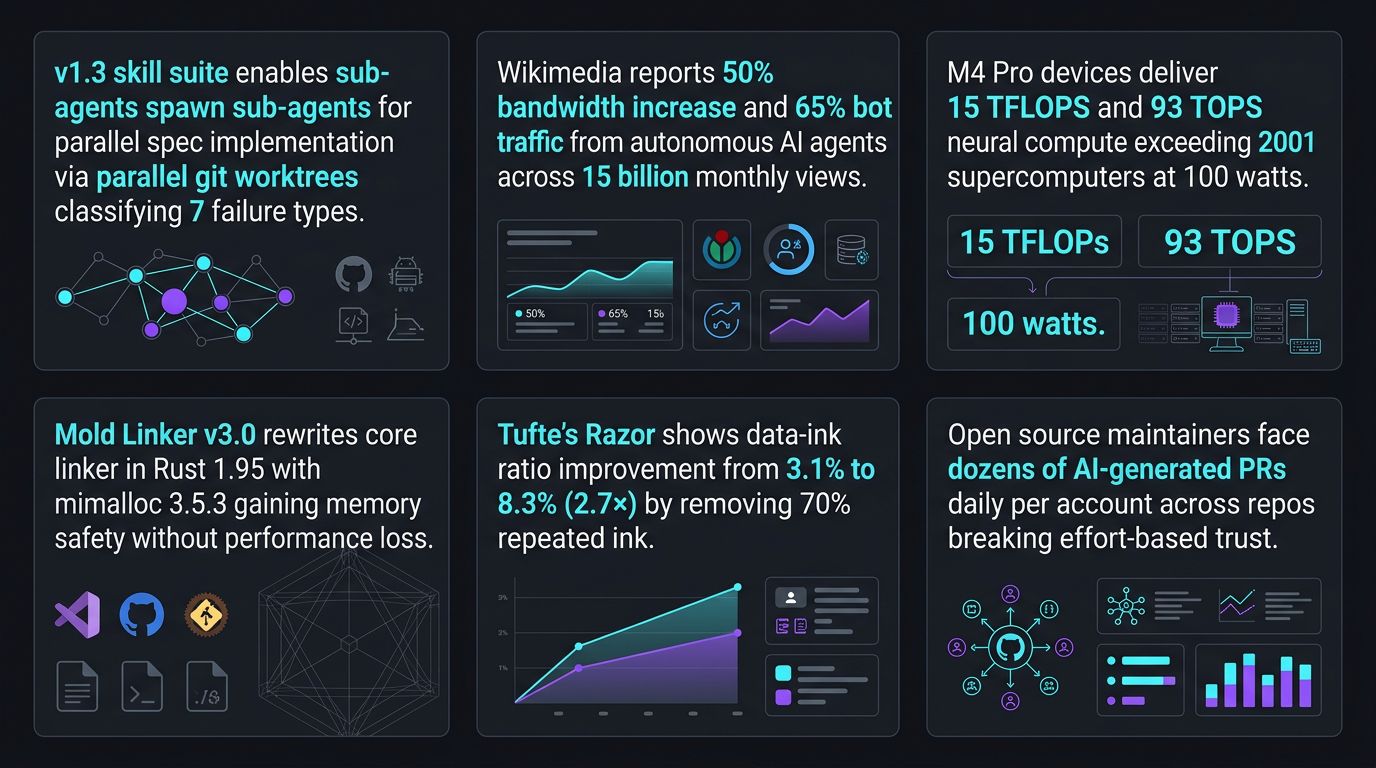
- v1.3 skill suite enables sub-agents spawn sub-agents for parallel spec implementation via parallel git worktrees classifying 7 failure types. AI workflow engineers.
- Wikimedia reports 50% bandwidth increase and 65% bot traffic from autonomous AI agents across 15 billion monthly views. Platform operators.
- M4 Pro devices deliver 15 TFLOPS and 93 TOPS neural compute exceeding 2001 supercomputers at 100 watts. AI infrastructure architects.
- Mold Linker v3.0 rewrites core linker in Rust 1.95 with mimalloc 3.5.3 gaining memory safety without performance loss. Systems engineers.
- Tufte’s Razor shows data-ink ratio improvement from 3.1% to 8.3% (2.7×) by removing 70% repeated ink. Data visualization designers.
- Open source maintainers face dozens of AI-generated PRs daily per account across hundreds of repos breaking effort-based trust. Project maintainers.
Themes
AI Development Workflows
The v1.3 skill suite turns spec-to-PR into an autonomous loop: parallel subagents implement tickets via TDD, a structured PR body classifies merge risk, and a retro skill feeds struggle points back into the environment instead of the codebase.
- The /implement-spec Skill

/implement-spec runs parallel subagents in separate git worktrees, merging into one integration branch. Cuts sequential spec work to a single automated run. - New Skills! v1.3 brings /pr, /implement-spec, and /retro

v1.3 lets sub-agents spawn sub-agents for fully AFK spec implementation. One orchestrator reads tickets, creates PR via TDD loops. - v1.3: /implement-spec, /pr, /retro, and GLOSSARY.md
v1.3 adds three skills—/implement-spec, /pr, /retro—to automate spec-to-PR with integration branch and GLOSSARY.md lookup. Reduces manual steps. - The /retro Skill

/retro reads session records and proposes environment fixes—navigation, checks, standards—categorized by failure type. User picks candidates before changes apply. - The /pr Skill

/pr generates structured PR bodies with visual summary, before/after evidence, and one-way vs two-way risk classification. Guides reviewer focus. - Opus 5.5 agents discover two room-temperature magnetic semiconductor candidates186

Opus 5.5 agents found two room-temperature antiferromagnetic semiconductors with 1000x faster switching. Spin window exceeds 26 meV thermal energy. - Claude Says
Claude recommended forking and maintaining every dependency instead of using repo features. Ten developers lost critical thinking to AI complexity.
AI & Society: Open Culture & Creative Rights
The rise of autonomous AI is transforming open culture, from code sharing to creative authorship, and raising new legal questions.
- Open Source as We Know It Is Dead
Open source faces 300 lines of AI-generated changes. This erodes trust in community contributions. - OpenAI “rogue” agent activities found on Wikimedia projects180

OpenAI’s rogue agents target 67 million Wikimedia articles. This strains volunteer-run infrastructure. - Anthropic reported diary entry to police, woman faces felony charge508

Anthropic’s AI triggers 1 felony charge after flagging a diary entry. This raises privacy concerns. - ChatGPT is adding real cartoonists’ signatures to fake New Yorker cartoons264

ChatGPT impacts 100 artists by adding signatures to fake cartoons. This undermines creative rights. - PewDiePie is setting AI free… and OpenAI is furious

PewDiePie creates a 3.59 billion parameter model without safety filters. This challenges AI governance.
AI Economics & Infrastructure
AI infrastructure is shifting toward unified abstractions that hide provider complexity while pushing compute closer to where data lives — whether that’s a search API billing layer, a client device with 15 TFLOPS, or a database rearchitecting its index hierarchy.
- Web Search API235

Cloudflare’s Web Search API unifies three search providers at their public API prices with zero markup, billing through AI Gateway credits. Search becomes a utility, not a vendor decision. - You’re Leaving Compute on the Table
Your desk holds 15 TFLOPS and 93 TOPS neural compute — more raw power than a 2001 supercomputer. Most apps still ship that work to the cloud anyway. - RIP, vector database

The vector-primary design is being retired; ANN moves to a secondary index to enable broader query types, fundamentally rewriting how documents are laid out, written, compacted, and queried.
Language & Runtime Evolution
Runtimes and languages are converging on practical simplicity—Node catches up to Deno’s ergonomics, Gleam drops source transpilation for faster IR compilation, and Elm adds distinct types for correctness—while Rust’s async pain points persist unchanged for years and one team finds effect systems unnecessary.
- Friendship ended with Deno, now Node is my best friend

Node now matches Deno’s ergonomics with 15% faster builds. The author migrated fs and serve APIs to Hono’s node adapter. - Async Rust: Where does the scheduler live?
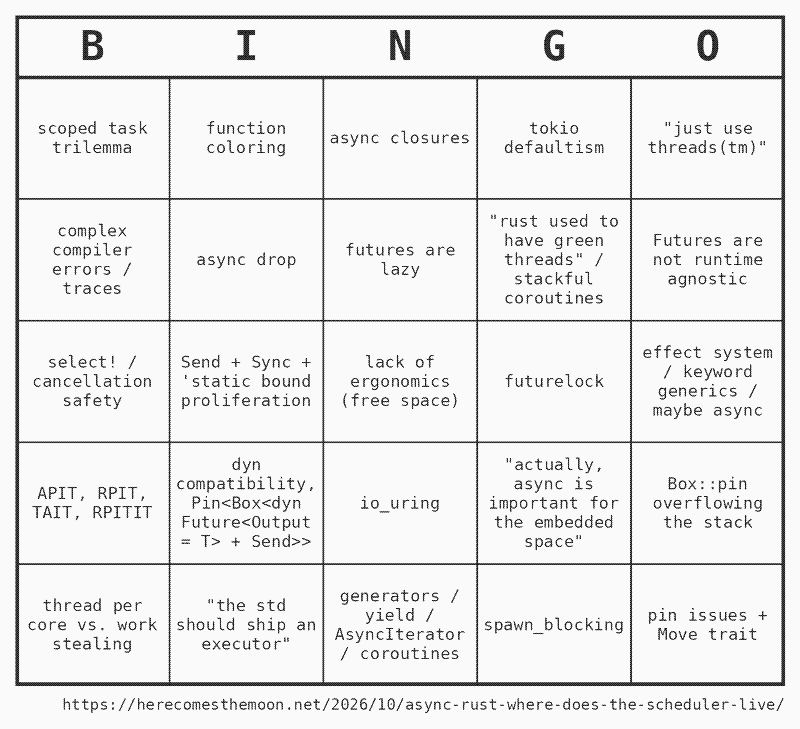
Async Rust’s same 25 complaints persist across 6 years in a 5x5 grid. Scheduler location remains the core tension. - Another step towards elm v1
Elm adds distinct types from Acadia compiler to eliminate invalid data bugs. Dealiasing ensures correctness by construction. - You don’t need an effect system
Custom Early type with exceptions replaces effect system entirely. Bracket pattern ties resource usage to type level. - Gleam doesn’t compile to Erlang source anymore

Gleam emits Erlang abstract forms instead of source code. Builds faster with precise debug info, no longer a transpiler.
Systems & Infrastructure Tooling
In systems tooling, rewrites in safe languages and declarative integrations are transforming how we build and manage infrastructure.
- Flirt is now Open-Source
Flirt is now open-source, inviting early contributors. Its per-patch state diffing could reduce review conflicts in kernel development. - Ephemeral testing

Ephemeral testing builds temporary layers to accelerate development. AI agents create and discard test code quickly, revealing foundation quality. - spoonful: static site generator written in Nix
Spoonful, a Nix-based static site generator, has 6 stars and 94.6% Nix code. Its Tangled integration could simplify CI for declarative sites. - A new, bespoke static site generator to replace Jekyll
The bespoke C++ generator achieves 150ms generation times, while Jekyll requires 2 seconds. Its 8KLoC source ensures simple deployment. - Using docker-compose with Podman rootless

Podman rootless enables docker-compose without root access. The DOCKER_HOST setup points to a user-namespace socket. - Mold Linker Version 3.0.0 Release – Rewritten in Rust167
Mold linker 3.0.0 is rewritten in Rust for memory safety. With 17 commits since release, it improves linker script compatibility. - Dostoevsky: Better Space-Time Trade-Offs for LSM-Tree Based Key-Value Stores via Adaptive Removal of Superfluous Merging
Dostoevsky adapts LSM-tree merges for better space-time trade-offs. Lazy Leveling skips unnecessary merges, reducing storage costs. - Nix on the Steam Frame
Nix on the Steam Frame uses a user-space store to survive OS updates. Home manager via flake manages packages declaratively.
Design Principles & Developer Experience
Designers trim visual clutter while engineers embed intelligent undo, showing how thoughtful constraints shape both clarity and usability.
- Tufte’s Razor: an interactive guide to the data-ink ratio
Tufte’s Razor calculates data-ink ratio at 3.1% initially, achieving a 2.7× improvement by cutting 70% repeated ink. - Implementing Undo

Undo 5 tracks state changes at user actions and background processes, preventing memory exhaustion.
Personal & Miscellaneous
- Becoming a photographer

AI agents help photographers ship tools in hours not weeks.
Filtered out18 links
These scored below 40% relevance, so they were left out of the digest.
- Beam: Reflection's 501B open-weight modelreflection.ai · 35%
- Golang tool to check SPF, DKIM, TLSA, and TLS settings for mailserversgit.sig-io.nl · 35%
- How Cloudflare addressed a cross-tenant data exposure vulnerability in Containersblog.cloudflare.com · 30%
- Plain text is still one of the best technologies we havedeadparrotbbs.com · 30%
- The Pi Updates are insane ⟡ Pull Requests are Dead ⟡ Turso Joining Supabase ⌁ Syntax Weekly ⌁youtube.com · 30%
- Denmark data breach exposes 8.8M people's personal datacpr.dk · 30%
- From: anyone@icloud.com - Spoofing Arbitrary Apple iCloud Identitiessec-consult.com · 30%
- Apple and a hacker's futurestratechery.com · 25%
- Pixel 11 doesn't yet meet the GrapheneOS security standards and may be skippeddiscuss.grapheneos.org · 25%
- Making a GTK application in Haskell, part 1floreal.tech · 25%
- Qualcomm licenses patents on Huawei’s LogicFolding chip techbloomberg.com · 20%
- Germany’s RobCo hits $1B valuationtechfundingnews.com · 20%
- Factor Overviewre.factorcode.org · 20%
- FreshRSS 1.30.1github.com · 15%
- Reverse Engineering Comanche Terrain Mapspikuma.com · 15%
- US closely monitoring case of lab worker who possibly died of plague in Siberiatheguardian.com · 10%
- What are you doing this week?lobste.rs · 10%
- WTF Microsoftyoutube.com · 10%
Generated by Clio Analyst