Daily Digest — 2026-09-18
Jump to a section
- Signals
- Themes
- AI agents, benchmarking, and frontier models
- AI infrastructure and model efficiency
- Provably correct programming
- AI, programming, and society commentary
- Security vulnerabilities and trust
- Open-source stewardship and software ownership
- Programming language revival
- Developer tools and local software
Signals
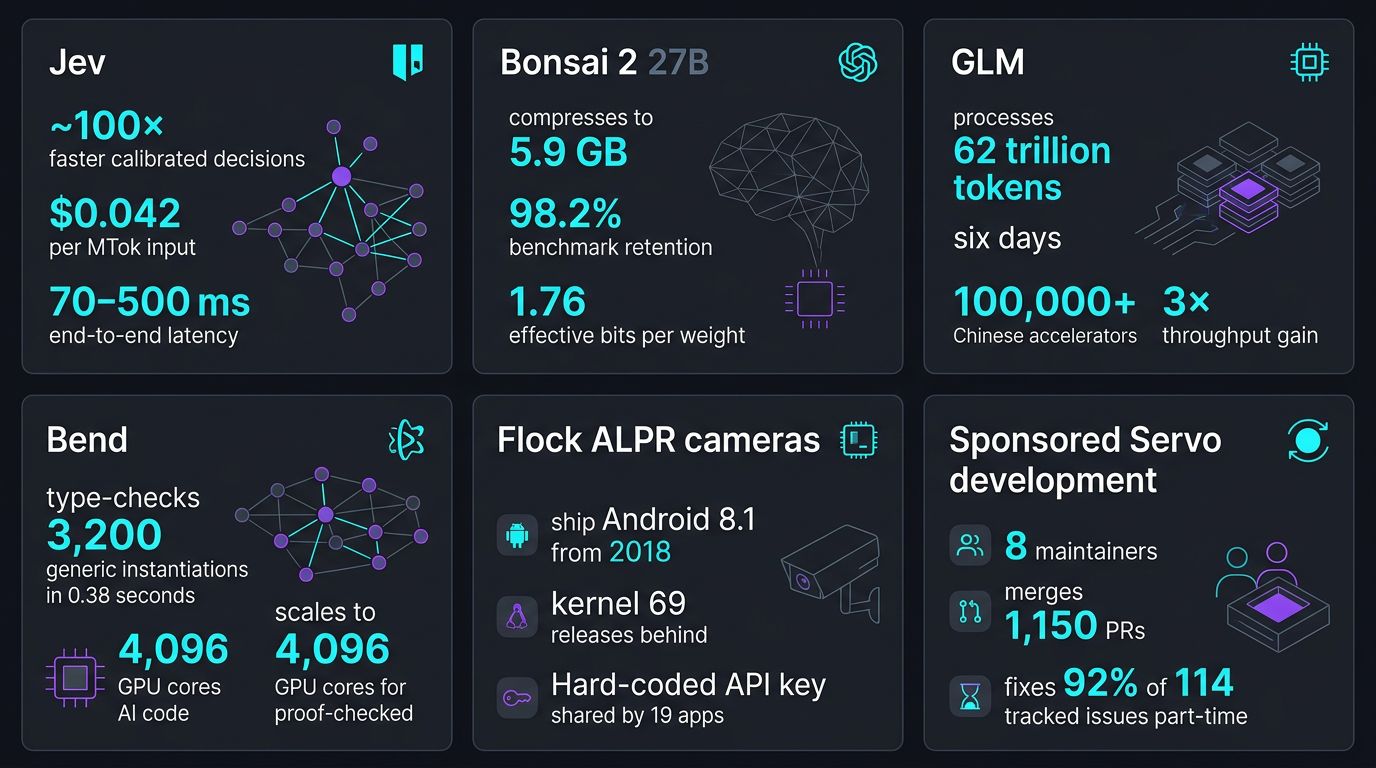
- Jev delivers ~100× faster calibrated decisions at $0.042 per MTok input with 70‑500 ms end‑to‑end latency. AI cost watchers.
- Bonsai 2 27B compresses to 5.9 GB with 98.2% benchmark retention at 1.76 effective bits per weight. Local deployment teams.
- GLM processes 62 trillion tokens in six days across 100,000+ Chinese accelerators with 3× throughput gain. Inference infrastructure builders.
- Bend type‑checks 3,200 generic instantiations in 0.38 seconds and scales to 4,096 GPU cores for proof‑checked AI code. AI workflow guarders.
- Flock ALPR cameras ship Android 8.1 from 2018 with a kernel 69 releases behind and a hard‑coded API key shared by 19 apps. Device trust auditors.
- Sponsored Servo development adds 8 maintainers, merges 1,150 PRs, and fixes 92% of 114 tracked issues part‑time. Open‑source sustainers.
Themes
AI agents, benchmarking, and frontier models
Across these pieces, the frontier is shifting from bigger models to better control loops: benchmarks that prove hot paths, bespoke harnesses that organize agent labor, cached policy search that multiplies research attempts, and calibrated decision models that plug into software. The tension is whether these systems earn trust through measurement and process—or expose how much human judgment remains in the loop.
- Trust, but benchmark: How we let an AI agent optimize Elasticsearch

Three task types and one referee put Elasticsearch optimization behind a benchmark that must prove a real hot path. Who cares: the agent can explore freely, but only changes that survive microbenchmarks and the real workload stick. - The Shape of Things to Come, Part 1: The Continuous Thunderdome
Over half of a 100-year work backlog becomes agent work only when a bespoke harness supplies taste and direction. Who cares: Gas Town shows that endless ‘just two more things’ can fail where convergence and human judgment matter. - Did Google just kickstart the intelligence explosion?

33 researchers and five stages turn thousands of cached policy tries into faster discovery without changing Gemini’s weights. Who cares: the system learns what to try next while keeping the model fixed. - I expected better from Google

Three names in mobile-use became an open-source attribution dispute after an August force push replaced the author list. Who cares: if credit disappears, the incentive to share agent research gets weaker. - Introducing System One Models & Jev
Jev at 70-500 ms end-to-end latency turns calibrated decisions into a direct software layer. Who cares: ~100× faster outputs at $0.042 per MTok input may fit inside latency-sensitive workflows.
AI infrastructure and model efficiency
AI efficiency is converging on two levers: squeezing every token through custom runtime choices, and shrinking models until they can run locally. The trade is revealing: one side accelerates large clusters, while the other turns model density into practical deployment.
- How GLM built its own inference infrastructure265

GLM shipped with more than 100,000 Chinese-made AI accelerators and a 1M-token context window, turning autonomous infrastructure work into a production throughput story. Its Encode-Prefill-Decode split and W8A8 quantization matter because inference cost is often won in the serving stack. - Bonsai 2 27B: Near-Lossless Compression in a 9x Smaller Footprint106

Bonsai 2 27B lands at 5.9GB with 98.2% aggregate benchmark performance retained, making near-lossless compression practical for local deployment. Its ternary weights and 1.76 effective bits per weight matter because smaller models can now run faster on consumer GPUs.
Provably correct programming
Provably correct programming is becoming a development gate, not just a math exercise: proof obligations can be checked before commit, and declared laws can become automatic guards against AI mistakes.
- Bend – A language that blocks AI mistakes via proof, on CPU and GPU185
Bend type checking takes at most one second, so AI mistakes can be caught before commit while scaling to 4,096 GPU cores. - Developing provably correct Rust code with Verus

Verus prover checks Rust proofs, so safety-critical bugs can be rejected before release instead of shipped.
AI, programming, and society commentary
LLMs are narrowing the path from idea to software, but the next bottleneck may be ownership, trust, and patching rather than raw code generation. Taken together, the articles ask whether faster construction is creating a society of people who can launch systems they cannot understand, secure, or maintain.
- On learning programming in an age of LLMs
30 years of programming plus one year of LLM-assisted coding: the idea-to-system gap shrinks, but developers may build software they cannot own or maintain. - Everybody’s Lost Their Minds254

75% of the author’s time goes to AI: pipelines surface thousands of vulnerabilities, yet patching still consumes millions and threatens the promised 30 days of uptime. - I Don’t Like LLMs

LLMs, one pattern: useful models can still feel unreliable, so AI coding help becomes frustrating when trust matters most.
Security vulnerabilities and trust
Trust can fail at two very different edges: a polished conversation that convinces a maintainer to run code, and a device that quietly ships secrets and stale kernels. In both cases, the breach starts by lowering the cost of believing the wrong thing.
- Be alert: targeted attacks on prominent Rustaceans
Targeted attacks on prominent Rustaceans use professional-looking calls to push fake audio codecs and clipboard commands. A trusted maintainer can accidentally become the supply-chain path. - Flock cameras are riddled with security vulnerabilities and hard-coded credentials
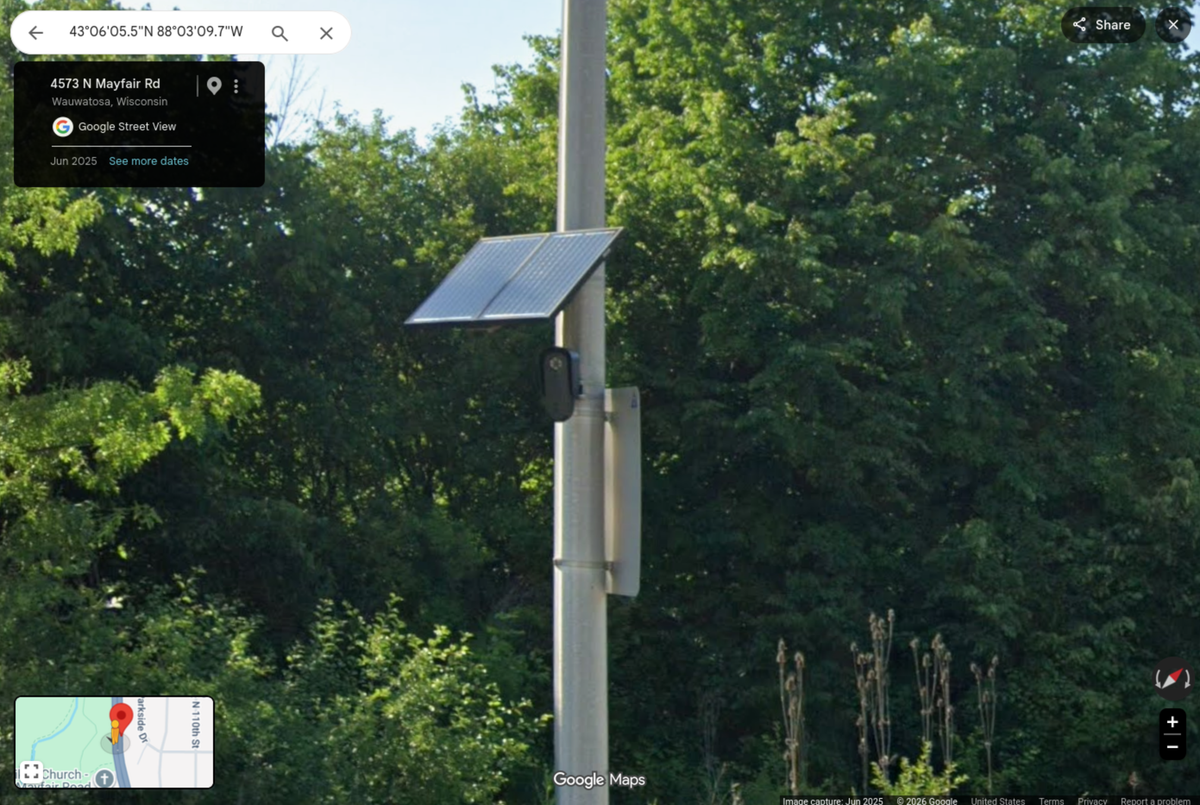
Flock cameras ship with Android 8.1, a 2018-06-05 patch level, and Linux 3.18.71. That stale stack plus a reusable backend credential turns ordinary camera trust into a standing access problem.
Open-source stewardship and software ownership
Open-source stewardship is less about who holds the code than who can keep it usable when incentives shift. The contrast between a deliberately tiny static stack and a sponsored browser-engine maintenance push shows that ownership is a living operating model.
- Who owns my stack?
2023 Macbook Pro site runs on Python, SQLite, and no JavaScript, with Pipenv replaced by uv. It matters because free tools can still hide organizational dependencies when priorities change. - One year of sponsored Servo development144

Sponsored Servo development added 8 new maintainers in one year. The part-time push reviewed 1150 pull requests, filed 114 issues, and fixed 92% of them, which matters when browser-engine contributors need faster triage.
Programming language revival
Language revival can become practical when a project stops treating legacy as an archive and starts making it interoperate with the systems people actually ship.
- The Golden Spike, and Resurrecting the Vale(n) Programming Language
Valen has a 17.6-karat golden spike. If Rust interop works, revived languages can borrow modern safety tools without being trapped by their own compilers.
Developer tools and local software
The strongest pattern is local control: teams are replacing third-party assumptions with tools that measure, index, mock, and tune behavior closer to the machine. That shifts developer-tooling value from novelty to feedback speed and predictability.
- What unit do devs use the most often? | Front-end Family Feud

CSS units: 91.7% of production styles use pixels, so rem-vs-em debates may miss the units developers actually ship every day in real codebases. - Hister: A private search engine for the pages you visit and the files you keep141
Hister: 127.0.0.1:4433 runs a private search index for pages and files you keep local, so web answers stop becoming a telemetry tax. - bonobomock: A GoogleTest-compatible C++ mocking library
GoogleTest-compatible C++ mocking library: 0 virtual interfaces required, because monkey patching can replace function behavior without reshaping production classes. - Labeled matches: why is this not in every regex engine?

Labeled regex: 4500x faster scans can replace neural NER when exact entity patterns fit regular languages. - jemalloc 5.4.0 release
jemalloc 5.4.0: over 160 commits prioritize correctness while pinned-memory stats expose a real allocation tradeoff developers may feel in latency-sensitive services. - XApp — Apps that work everywhere
XApp: one goal is making Linux apps behave consistently across distributions, so developers spend less time on desktop-specific polish.
Filtered out11 links
These scored below 40% relevance, so they were left out of the digest.
- Neovim have a ~$800k Bitcoin donation sitting untouched since 2023news.ycombinator.com · 39%
- Telstra outage: The night a network decided the year was 2006netnod.se · 32%
- Astra for Lawopenai.com · 28%
- Another Great Day of Software Engineering #adyoutube.com · 22%
- We Must Create the Shit Machinemcsweeneys.net · 20%
- AI safety is mostly a sex cultskywriter.blue · 20%
- Iran school bombing: grounds to believe US was behind atrocity, UN findstheguardian.com · 20%
- CCC invites all model citizens to 40C3events.ccc.de · 20%
- Canada welcomes EU proposal to become 'associate member'bbc.com · 20%
- how to pronounce "omarchy"youtube.com · 20%
- The Date Hackyoutube.com · 20%
Generated by Clio Analyst