Weekly Digest — 2026-W36
Jump to a section
Signals
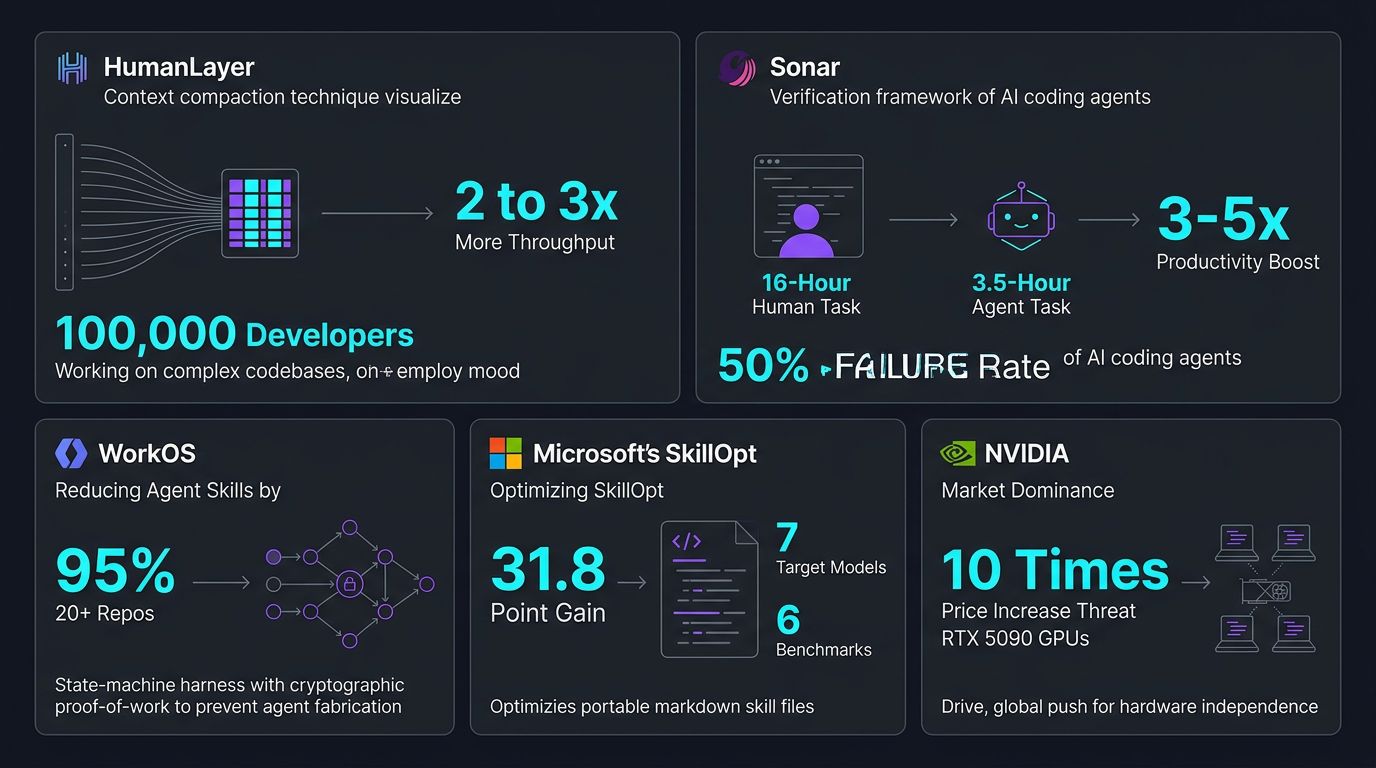
- HumanLayer’s context compaction technique achieved 2 to 3x more throughput for 100,000 developers working on complex codebases. AI coding teams.
- Sonar’s verification framework addresses the 50% failure rate of AI coding agents, turning a 16-hour human task into a 3.5-hour agent task with a 3-5x productivity boost. Engineering leaders.
- WorkOS reduced agent skills by 95% across 20+ repos, using a state-machine harness with cryptographic proof-of-work to prevent agent fabrication. AI platform teams.
- Microsoft’s SkillOpt achieved a 31.8 point gain across 7 target models and 6 benchmarks by optimizing portable markdown skill files. AI agent developers.
- NVIDIA’s market dominance faces a 10 times price increase threat on RTX 5090 GPUs, driving a global push for hardware independence. AI infrastructure teams.
Themes
AI Agent Architecture and Engineering
What separates AI agents that ship from those that fail? The answer lies in mastering verification, loops, and context engineering.
- Ex-NASA dev reveals his Agentic Engineering Workflow

Ex-NASA dev’s agentic workflow handles tens of thousands of lines in four months. This enables automated PRs and faster delivery. - The Agent Development Lifecycle: Build, Test, Deploy, Monitor | Interrupt 26

Interrupt 26 promotes early shipping in agent development. This leads to continuous improvement and reliable agents. - The Multi-Agent Architecture That Actually Ships — Luke Alvoeiro, Factory

Luke Alvoeiro’s architecture uses four multi-agent patterns for autonomous systems. This enables coherent work over days without manual intervention. - In the Land of AI Agents, the Verifiers Are King — Tariq Shaukat, Sonar

Tariq Shaukat emphasizes verification where agents achieve 80% accuracy. This ensures AI-generated code is reliable and trustworthy. - Harness Engineering is not Enough: Why Software Factories Fail — Dex Horthy, HumanLayer

Dex Horthy argues that harness engineering fails 75% of the time due to model issues. This shows the limitations of current AI approaches. - My agent hallucinated - what do I do?

Context management controls agent hallucination rates. This monitoring maintains faithfulness in LLM outputs. - LLM vs AI Agent: The actual difference explained

The difference between LLM and AI agent is tool integration. This transforms static models into interactive systems. - Loop Engineering explained in 8min..

Loop Engineering explained in 8 minutes shows how stacking loops overcomes context limits. This enables longer task durations for agents. - Harness Engineering: How to Build Software When Humans Steer, Agents Execute — Ryan Lopopolo, OpenAI

Ryan Lopopolo from OpenAI describes harness engineering with 4X productivity gain. This shifts focus to high-leverage system design. - No Vibes Allowed: Solving Hard Problems in Complex Codebases – Dex Horthy, HumanLayer

Dex Horthy optimizes context windows for 100,000 developers, achieving 2-3x throughput. This reduces rework in complex codebases. - Everything We Got Wrong About Research-Plan-Implement - Dexter Horthy

Dexter Horthy highlights RPI mistakes with 200 slides affecting 10,000 people. This underscores the need for code review to prevent rework. - How I deleted 95% of my agent skills and got better results — Nick Nisi, WorkOS

Nick Nisi deleted 95% of agent skills and implemented a state machine with 5 agents. This ensures proof-of-work and prevents context switching. - I Open-Sourced My Own AFK Software Factory

Open-sourcing an AFK Software Factory enables safe parallel execution of AI agents. This avoids permission conflicts and external dependencies.
AI Development Tooling and Skills
The landscape of AI tooling is evolving towards modular skills and lean context usage. This transformation enables more efficient and portable AI agents.
- Don’t Build Agents, Build Skills Instead – Barry Zhang & Mahesh Murag, Anthropic

Thousands of skills can be built instead of agents. This decouples domain expertise for efficient reuse. - 6 Ways to Enhance Developer Productivity with AI

Strategic AI integration boosts productivity by 100-150%. Teams automate tasks while preserving deep work. - Claude Code’s system tools are SO BLOATED

Removing unused tools reduced tokens from 25K to 8K. This improves model performance significantly. - RAG for Your Docs

RAG retrieves relevant passages from documents. It enhances AI responses with dynamic context. - I Built an LLM From Scratch

Building an LLM requires billions in investment. It uses statistical patterns from vast datasets. - Microsoft Just Open-Sourced a Cheat Code for AI Agents (SkillOpt) #microsoft #ai #aiagents

SkillOpt trains portable skills across 7 models. It achieves a 31.8 point gain in benchmarks. - Building Great Agent Skills: The Missing Manual

A structured checklist addresses skill quality gaps. Developers can build effective skills with guidance. - How To Use AI Skills Like A Senior Developer

Custom-written skills outperform generic ones. They deliver better code quality for developers. - Introducing the VS Code Agents Window (Preview)

The VS Code Agents window centralizes parallel agents. Teams manage sessions with ease. - Introducing /visual-plan - a skill to generate rich, visual plans for Claude Code and Codex

Visual plans make reasoning intuitive. MDX documents with diagrams improve agent reliability. - Learn anything with the /teach skill

The /teach skill is stateful, tracking progress. It customizes learning for effective instruction. - Stop stuffing your context window (here’s why)

Reducing context usage prevents information loss. Models stay accurate by avoiding overload. - This Tool Forces AI To Write Good Code

Static analysis removes hundreds of lines of bad code. This tool ensures cleaner software. - 9 Things People Get Wrong With My /grill-* skills

Matching question complexity to resources prevents failures. Scope should stay within 120k tokens. - Full Walkthrough: Workflow for AI Coding — Matt Pocock

Breaking tasks into phases keeps work in the smart zone. Performance is maintained up to 100K tokens. - github/spec-kit: 💫 Toolkit to help you get started with Spec-Driven Development
Spec Kit 1.0.0 shifts focus to adaptability. AI agents make spec-driven development efficient.
AI Code Quality and Software Fundamentals
Can AI agents deliver fast development without sacrificing code quality? The answer may lie in revisiting software fundamentals like deep modules and clear documentation.
- LIVE: Uncle Bob on Software Fundamentals in the Age of AI

After 50 years of software practice, AI agents like Grock code rapidly but often leave messy code, slowing teams. Better processes are essential to maintain productivity. - Why AI Agents Can’t Replace Your Taste in Code

AI agents given minimal prompts produce generic code, yet human taste and architectural direction are crucial for high-value software. This gap highlights human importance. - How To De-Slop A Codebase Ruined By AI (with one skill)

41.5k codebases damaged by AI have been restored using deep module architecture, where seams enable localized changes. This skill improves maintainability. - Do software fundamentals still matter?

AI agents make errors in poorly organized code, but software fundamentals like testing and modularity ensure reliable operation. Investing here is key. - How to force AI coding agents to write clean code

Explicit prompts and accessible documentation, such as a docs folder, force AI agents to write cleaner code. This approach enhances maintainability.
AI Cost, Economics, and Infrastructure
The AI sector is evolving rapidly, yet cost pressures and vendor lock-in are driving a shift towards edge and alternative hardware.
- POV: Your AI Models change faster than JS Frameworks

AI models now update every 3 months. This pace outstrips JS framework evolution. - Why AI Tokens are so Expensive - Computerphile

100,000 tokens per model are processed sequentially. This drives up AI costs. - The Hidden Cost of AI Coding That’s Destroying Engineering Teams

211 million lines of AI code are generated yearly. Hidden costs harm engineering teams. - Gemma 4 Just Released - Whats In? In 2026!

Gemma 4 supports 140 languages offline. This enables private AI agents. - NVIDIA Just Lost Their Lead - YouTube

RTX 5090 prices have surged to $4,500. This threatens NVIDIA’s lead.
AI-Native Interfaces and Design Systems
AI-native interfaces are emerging through agent-driven interactions, generative UI, and robust specs, promising a future where design systems are more dynamic and code-free.
- WebMCP now in ChatGPT

ChatGPT integrates 4 website tools through WebMCP, enabling AI agents to interact directly with web pages. This provides a more flexible user experience beyond traditional chat. - The Weird Future Of User Interfaces

Over 15 years, AI agents have attracted billions in investment as users prefer direct machine control over conventional interfaces. This trend indicates a significant shift in UI design. - Beyond Components: Designing Generative UI for MCP Apps — Ruben Casas, Postman

In 3 years, generative UI for MCP apps has allowed LLMs to generate UI code directly, eliminating the need for manual component coding. This enables dynamic, high-quality interfaces. - Claude Fable 5 UI/UX One-Shots - 5 Tests

Fable 5’s 5 one-shot tests demonstrate its ability to generate interactive UI designs from text prompts, producing functional web interfaces quickly. Designers can accelerate prototyping with this tool. - Spec-Driven UI Component Development - Nathan Curtis
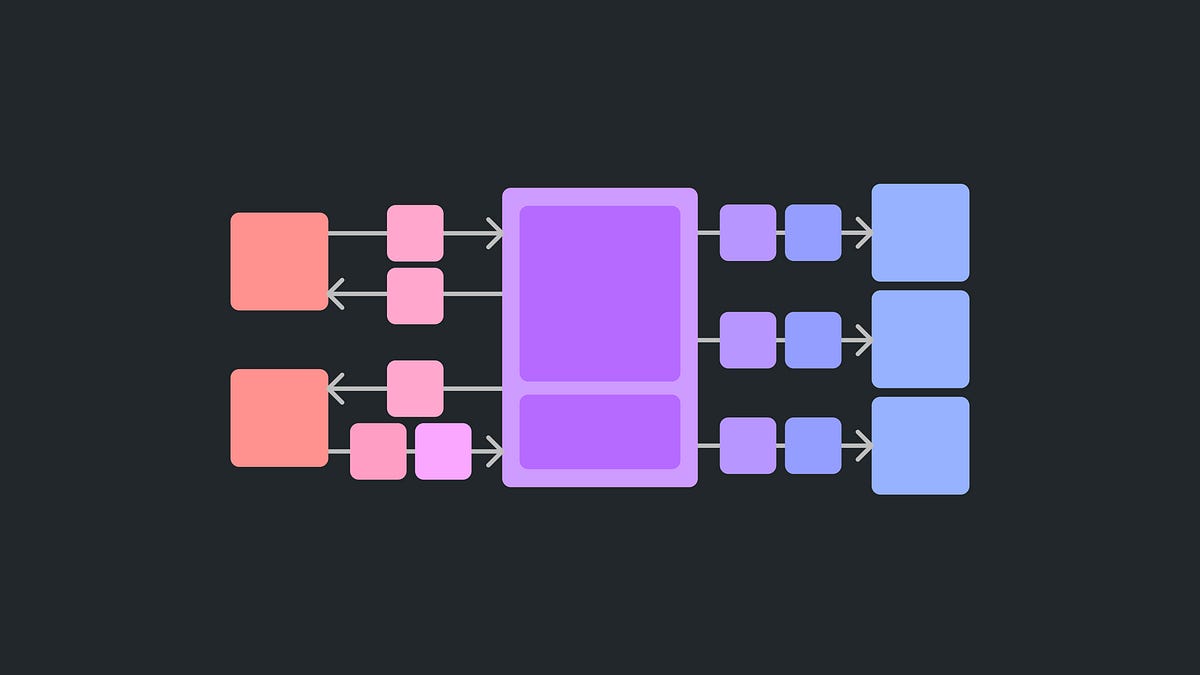
Specs tooling with 2 design flavors normalizes intent from Figma components, acting as a hub for design and code synchronization. This improves coordination across development surfaces. - What Component Specs Leave Behind - Nathan Curtis

Component spec contracts serve 1,000+ subscribers, emphasizing the need for exhaustive design intent. Round-trip testing exposes gaps in transformations, ensuring robustness.
AI and People, Skills, Society
AI is transforming work and education by automating tasks, but it’s also eroding the learning processes that build expertise. The cognitive fatigue and skill gaps highlighted in recent studies suggest that AI’s integration must be balanced to preserve human capabilities.
- Coding Agents Don’t Scale Themselves. Neither Do Your Teams. — Patrick Debois, Tessl

AI coding agents need context engineering to scale. This approach re-ignites developers’ engineering identities. - Why Your Enterprise Tech Stack Isn’t Ready for AI Agents — Christopher Lovejoy & Saul Howard

Enterprise tech stacks fail for AI agents due to compliance gaps. POCs lack audit trails and data governance. - AI Is Stealing From You

Studies with nearly a thousand students reveal AI reduces learning. 48% experienced skill loss, risking dependency. - AI Coding is exhausting

AI coding exhausts developers by demanding high mental energy. Fatigue sets in despite less repetitive tasks. - What AI does to the minds of novice coders
Research with 21 students shows AI harms novice coders. Two students exhibited superficial mastery, widening skill gaps. - AI Writing Has a SHAPE! #ai #chatgpt #claude
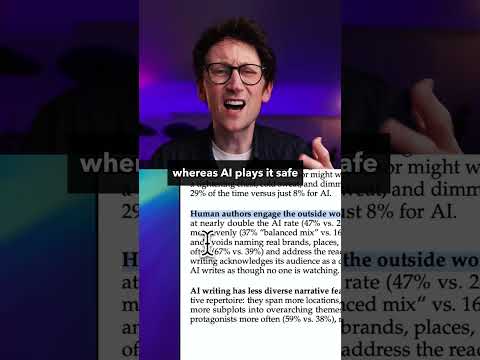
93% of AI writing samples share a uniform structure. This SHAPE makes AI text easier to detect.
Generated by Clio Analyst — Weekly