Daily Digest — 2026-10-22
Jump to a section
Signals
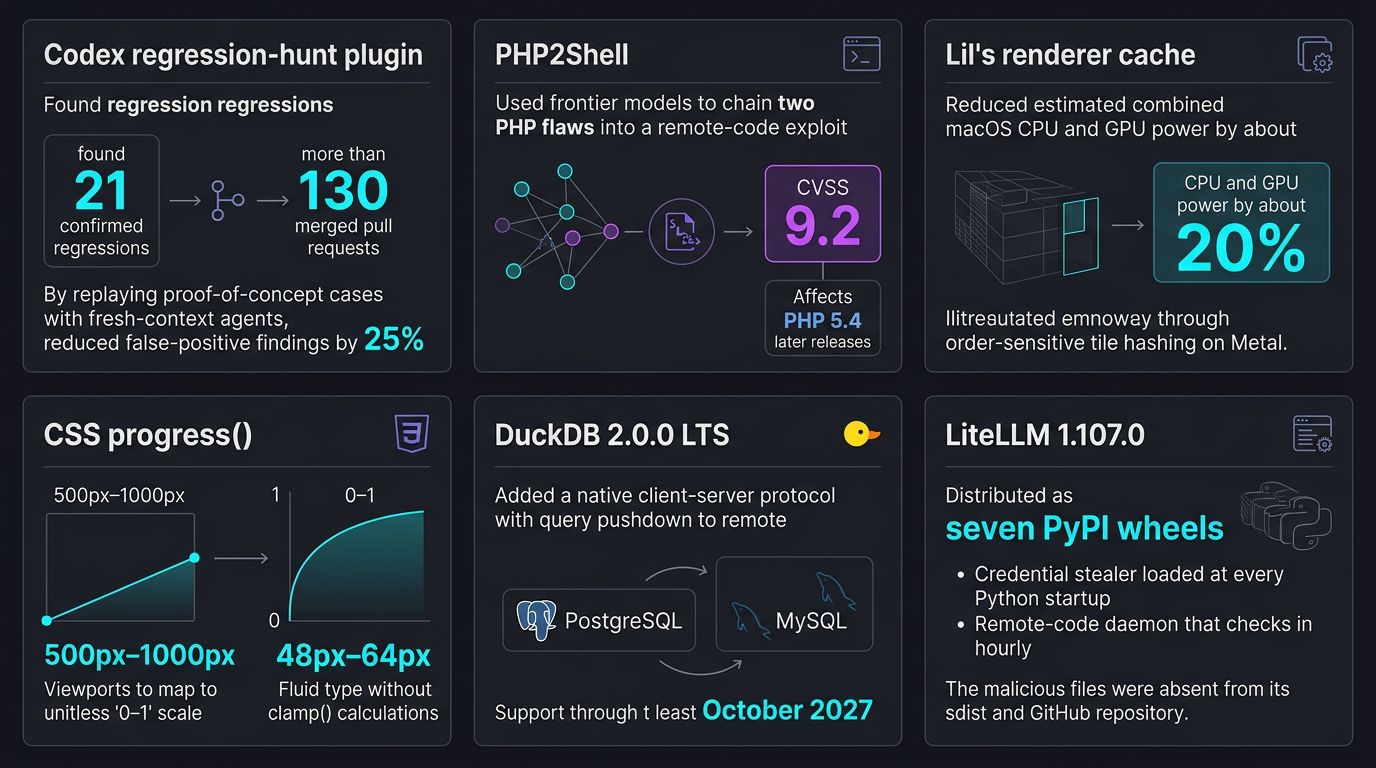
- Codex regression-hunt plugin found 21 confirmed regressions across more than 130 merged pull requests by replaying proof-of-concept cases with fresh-context agents, reducing false-positive findings by 25%. Agentic code reviewers.
- PHP2Shell used frontier models to chain two PHP flaws into a remote-code exploit rated CVSS 9.2 that affects PHP 5.4 and later releases. PHP security teams.
- Lil’s renderer cache reduced estimated combined macOS CPU and GPU power by about 20% through order-sensitive tile hashing on Metal. Interface engineers.
- CSS progress() maps 500px–1000px viewports to a unitless 0–1 scale, yielding 48px–64px fluid type without opaque clamp() calculations. Design system teams.
- DuckDB 2.0.0 LTS added a native client-server protocol with query pushdown to remote PostgreSQL and MySQL, with support through at least October 2027. Data platform teams.
- LiteLLM 1.107.0 was distributed as seven PyPI wheels carrying a credential stealer loaded at every Python startup and a remote-code daemon checking in hourly, while the malicious files were absent from its sdist and GitHub repository. AI platform teams.
Themes
AI-Assisted Software and Security Workflows
Software is moving from one-shot AI code generation toward durable, supervised workflows, but the same models also accelerate the path from obscure flaw to working exploit. The pivotal question is how to preserve independent verification as machines take on more end-to-end work.
- Your AI agent fixed the bug, but what else did it change?
Codex’s regression-hunt plugin found 21 confirmed regressions across more than 130 merged PRs and thousands of analyzed sessions. Engineering teams care because a fixed bug can hide new breakage elsewhere. - PHP2Shell: AI uncovers critical RCE in PHP173
PHP2Shell’s 2 CVEs form a remote-code-execution chain rated CVSS 9.2, and every PHP version from the past decade is affected. Security teams care because AI is eroding the expertise barrier to exploitation, even as PHP powers 70% of websites. - WTF is a Software Factory?

Swamp Club turns 1 natural-language task into typed components, repeatable workflows, API integrations, and a queryable shared-memory data lake. Engineering leaders care because durable execution makes AI-built software reusable instead of a one-off chat.
Browser Platform and Accessible Web Design
Browser capabilities are reshaping both design control and developer workflow, making adaptation less about one-size-fits-all defaults and more about tunable, preference-aware systems. The deeper opportunity is a web platform that stays flexible without treating accessibility as an afterthought.
- No more clamp() magic numbers

CSS progress() maps 500–1000px viewports to 0–1, so a 16px base can fluidly reach 48–64px. Design-system teams get a legible scale without making contributors reverse-engineer clamp() magic numbers. - Improving accessibility with CSS media queries (2025)

CSS preference queries support 4.5:1 small-text contrast, 3.0:1 large-text contrast, and a motion-free alternative to a 1-second jello animation. Interface teams can honor reduced motion, dark mode, and reduced transparency without discarding their visual system, provided accessible defaults remain in place. - Firefox Local Mode
Firefox 153 Local Mode can give a local folder an isolated HTTPS origin without a separate server, configured through three mapping preferences. Front-end teams get safer origin testing, but the workflow still depends on open DevTools.
Interface and Vector Production Tooling
The common thread is less micromanagement: structured geometry can make authoring expressive, while renderer-managed reuse can make iteration cheap. The open question is whether these abstractions continue scaling without hiding the costs of transformation and repainting.
- Vector Graphics in Lil
Lil uses 2 numbers per point; a stroke with N points contains N-1 connected lines. Vector artists and tool builders care because nested lists make scaling, mirroring, translation, and shearing concise without repetitive per-point code. - Don’t throw it all away: Caching an immediate-mode UI
A renderer-side cache produces about 20% lower combined macOS CPU and GPU power estimates across thousands of interface elements. UI engineers care because tile hashes preserve immediate-mode simplicity while repainting only changed regions, with 64-byte Metal GPU commands enabling GPU-side work.
Software Supply Chain and Security Process
Software supply-chain security has two hidden clocks: what enters the package users install, and when vulnerability evidence becomes public. Build provenance and staged disclosure can leave blind spots when teams trust either control without examining the other.
- Compromised LiteLLM 1.107.0 on PyPI Installs a Credential Stealer and Backdoor

LiteLLM 1.107.0 shipped 7 compromised PyPI wheels, with 3 added files per wheel despite a clean source distribution and GitHub tree. The 2 startup hooks launched a credential stealer and an hourly code-execution daemon, so users of those wheels need to rotate secrets and inspect Python startup paths. - Firefox security patch tests are now private for at least a week
Mozilla now withholds Firefox security regression tests for at least 1 week before landing them. Downstream packagers and security researchers lose early visibility into fixes, while potential attackers get less time to circulate exploit details.
Language Runtimes and Developer Tooling
Language runtimes and developer tools increasingly depend on layers outside the language itself, shifting authority into shared rules, background machinery, and networked services. The harder design question is where control actually lives once those boundaries are crossed.
- Google’s Rust Style Guide
Google’s Rust Style Guide spans 7 rule areas, from code organization and formatting to ownership, borrowing, function interfaces, types, and traits. Rust maintainers and API designers get a shared baseline for decisions that reach well beyond formatting. - Announcing the GPU notification group and Linker Working Area

LLVM’s compiler team launched 2 groups: the GPU notification group and the Linker Working Area. Compiler contributors can focus GPU issues and linker integration in dedicated Zulip streams, joining either group through membership pull requests. - zls 0.17.0
ZLS 0.17.0 adds alias-aware symbol renaming and updates 4 locations in its symbol-renaming example, but Zig 0.17’s build-system changes leave 3 known regression areas. Zig developers get better renaming, but import resolution and Windows file watching still need attention. - DuckDB 2.0.0 LTS “Cinnamon Teal”49

DuckDB 2.0.0 LTS “Cinnamon Teal” adds native client-server mode after close to 20,000 commits, with 2.0 support through at least October 2027. Data teams can use CONNECT to switch to remote PostgreSQL or MySQL databases, while supported queries push down to the server. - ConcurrentML: Improving on Go’s concurrency model
ConcurrentML, introduced in the mid-1990s, represents communication operations as values, unlike Go’s select, which completes at most one channel operation. Go developers can wrap and compose those values to implement choice, cancellation, concurrency, and encapsulation, while garbage collection prevents goroutine leaks.
Reproducible and Minimal Software Infrastructure
Reproducible dependency graphs and minimal runtimes suggest infrastructure that is easier to trust and operate. The open question is whether deployment and observability can keep pace without adding back the complexity these approaches remove.
- Understanding Nix flakes
Nix flakes support more than 100,000 packages and lock inputs to exact revisions. Teams chasing reproducible builds across Linux distributions get a known-compatible dependency set, but the experimental status leaves the stabilization path uncertain. - Unikernels in OCaml
Solo5 compiles a single OCaml application into an isolated unikernel image for direct hypervisor execution. Teams chasing smaller footprints and faster startup get a lean path to production, but operators still need workable deployment and observability.
Filtered out17 links
These scored below 40% relevance, so they were left out of the digest.
- Meta ordered to pay $25B penalty in New Mexico Cambridge Analytica casecnbc.com · 36%
- Passkeys Attestation Trapmjtsai.com · 35%
- Security Disclosureblog.railway.com · 34%
- Flow Typing, A New Lens on Linearityjaredforsyth.com · 31%
- Eight Bits of Trust; eMudhra's CA keys cracked in millisecondsscotthelme.co.uk · 30%
- GitLab Critical Patch Releasedocs.gitlab.com · 29%
- The No Kings Takedown Is Why You Shouldn't Rent Your Megaphone from Zucktechdirt.com · 27%
- Node.js — Wednesday, October 21, 2026 Security Releasesnodejs.org · 24%
- Embedding EYG in Erlang programseyg.run · 23%
- Today's PHP security release, and how we're strengthening securitythephp.foundation · 20%
- PHP 8.2.35github.com · 20%
- CVE-2026-107891: musl libc: multiple integer overflow in regcomp, possibly leading to incorrect allocation sizes and out-of-bounds heap writesopenwall.com · 14%
- Programmers vs Dream's Fake Manhunts | TheStandupyoutube.com · 14%
- FreshRSS 1.30.4github.com · 12%
- FreshRSS 1.30.3github.com · 12%
- EA is shutting down BioWaretheverge.com · 7%
- The 1.5°C goal of the Paris Agreement is no longer viableunric.org · 7%
Generated by Clio Analyst