Daily Digest — 2026-10-17
Jump to a section
Signals
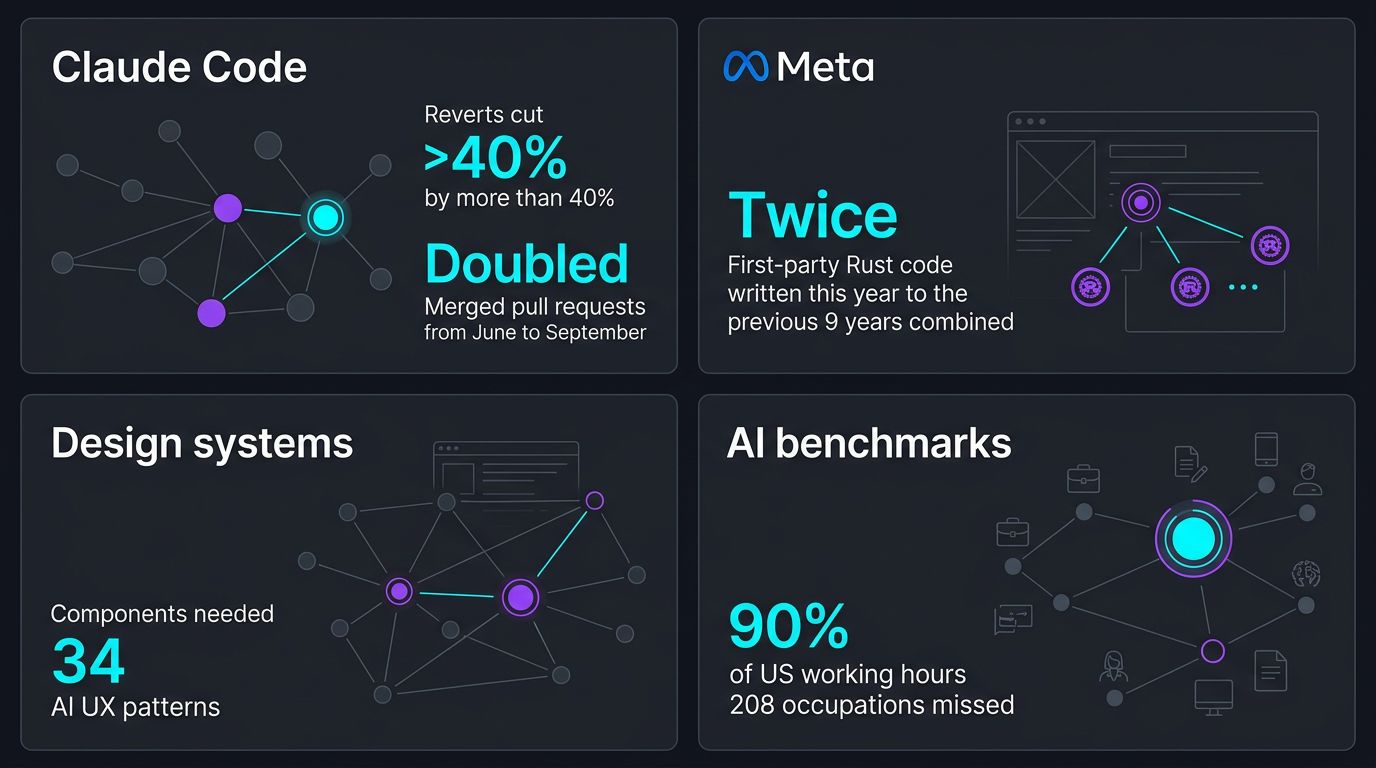
- Claude Code cut reverts by more than 40 percent while doubling merged pull requests from June to September. Engineering teams.
- Meta engineers wrote twice as much first-party Rust code this year than in the previous nine years combined. Rust adopters.
- Design systems need components for 34 AI UX patterns. Design teams.
- AI benchmarks miss 90 percent of US working hours across 208 occupations. Workforce planners.
Themes
AI Coding Workflows
- How the Claude Code team does code review265
Claude Code lands more than 30,000 changes per day, up from 2,500 in May, with at most one human in the loop for most pull requests. Reverts fell by more than 40 percent as machine-led review absorbed the surge.
Agentic Development
Agents demand precise control over memory and execution, while Rust’s low-level knobs empower developers to build autonomous systems safely. Together they push the boundary of what can be engineered without sacrificing reliability.
- What agents mean for Rust (and vice versa)
Rust 2024 delivers low level memory control for agents. - Your agent is a tactical tornado
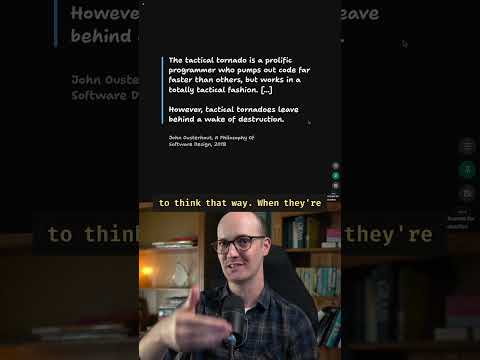
Developers must act as strategists for AI agents, or the agents will degrade the codebase with fast but short-term code. - The secret to building robust frontend apps with agents

Centralizing frontend state in reducers makes code easier to test, change, and understand, producing more robust apps.
Development Tooling
The next generation of developer tools stops assuming it knows what you want. Instead, editors and language servers negotiate changes before touching a single line.
- Interactive refactoring in gopls
gopls enables one standard LSP mechanism for interactive refactoring input. Teams avoid editor-specific workarounds when applying custom tag combinations.
AI-Native Design
Design systems are scrambling to define components for interfaces that act on their own, while local ML runtimes are putting model execution directly on the desktop. The gap between static component libraries and agentic behavior is widening faster than most teams can patch it.
- 34 AI UX patterns most design systems have no components for yet
34 AI UX patterns lack components in most design systems. Teams shipping agentic features will build custom sparkle menus and command palettes from scratch. - Apple ML Research: Muse Spark Open with MLX on Mac Studio141

Apple ML Research open-sourced Muse Spark with MLX on Mac Studio. Local model execution keeps sensitive data on-device and removes API latency.
AI Cost and Economics
The cheapest AI interaction is often the one you skip, yet the most expensive noise is the one you cannot filter. Teams are learning to price intelligence by task size before the signal disappears.
- When should you NOT use /grill-me?

Zero interrogation for small changes. One decision tree sends low-risk work straight to implementation so teams avoid paying agent costs on trivial fixes. - The Decoherence Trap: When AI slop drowns out the signal in an endless sea of noise
One signal drowns in endless AI slop. Systemic collapse follows when intelligence explosions hit noise floors they cannot cross.
People, Technology, and Society
AI benchmarks measure a sliver of real work, yet organizations keep rolling out models as if culture were a settings menu. The gap between what machines are tested on and what people actually do all day is where adoption either stalls or quietly rewrites how teams collaborate.
- 90% of US working hours are spent on tasks not covered well by AI benchmarks391

90% of US working hours sit outside the tasks AI benchmarks actually measure. That gap means most productivity claims rest on a sliver of real jobs. - Is Your Organization Messing Up AI Adoption?
AI adoption succeeds only when organizations treat it as a cultural shift, not a technology deployment. Staff fears and workflows decide if the rollout sticks or stalls. - Mull: note-taking with a language server / vscode extension
Mull runs a single-file wiki where links replace files and directories. One Home page orders everything by link reachability, so your notes stay connected without folders.
Filtered out20 links
These scored below 40% relevance, so they were left out of the digest.
- There's never been a better time to go into mathyoutube.com · 30%
- The NIST Elliptic Curves Seeds Bounty Has Been Claimedwords.filippo.io · 30%
- Claude reveals ECDSA curve originsanthropic.com · 30%
- Getting Canceledyoutube.com · 30%
- Matt Mullenweg Orders Accessibility Reverttherepository.email · 30%
- Why are we even doing all this?terrytao.wordpress.com · 30%
- Waymo in Torontowaymo.com · 20%
- Ubuntu 26.10 (Stonking Stingray) releasedlists.ubuntu.com · 20%
- I Love Software Renderingjamesfmackenzie.com · 20%
- Introducing GNOME OS Previewblogs.gnome.org · 20%
- We're sunsetting Codeberg Pages v2blog.codeberg.org · 20%
- Thirty Years of KDEblog.cornelius-schumacher.de · 20%
- Big Fish: Exploiting a 37-Year-Old Kernel Bug in OpenBSDcalif.io · 20%
- The road to iroh 1.0iroh.computer · 20%
- You need to check out Pi Durableyoutube.com · 20%
- Making a 88x31 button book using ImageMagickk.sosnierz.me · 20%
- Writing stateful effect handlers in EYGeyg.run · 20%
- coopiano: A physically modelled piano synthesizer in C++17github.com · 20%
- Folders Esoteric Languagedanieltemkin.com · 20%
- What are you doing this weekend?lobste.rs · 20%
Generated by Clio Analyst