Daily Digest — 2026-10-13
Jump to a section
Signals
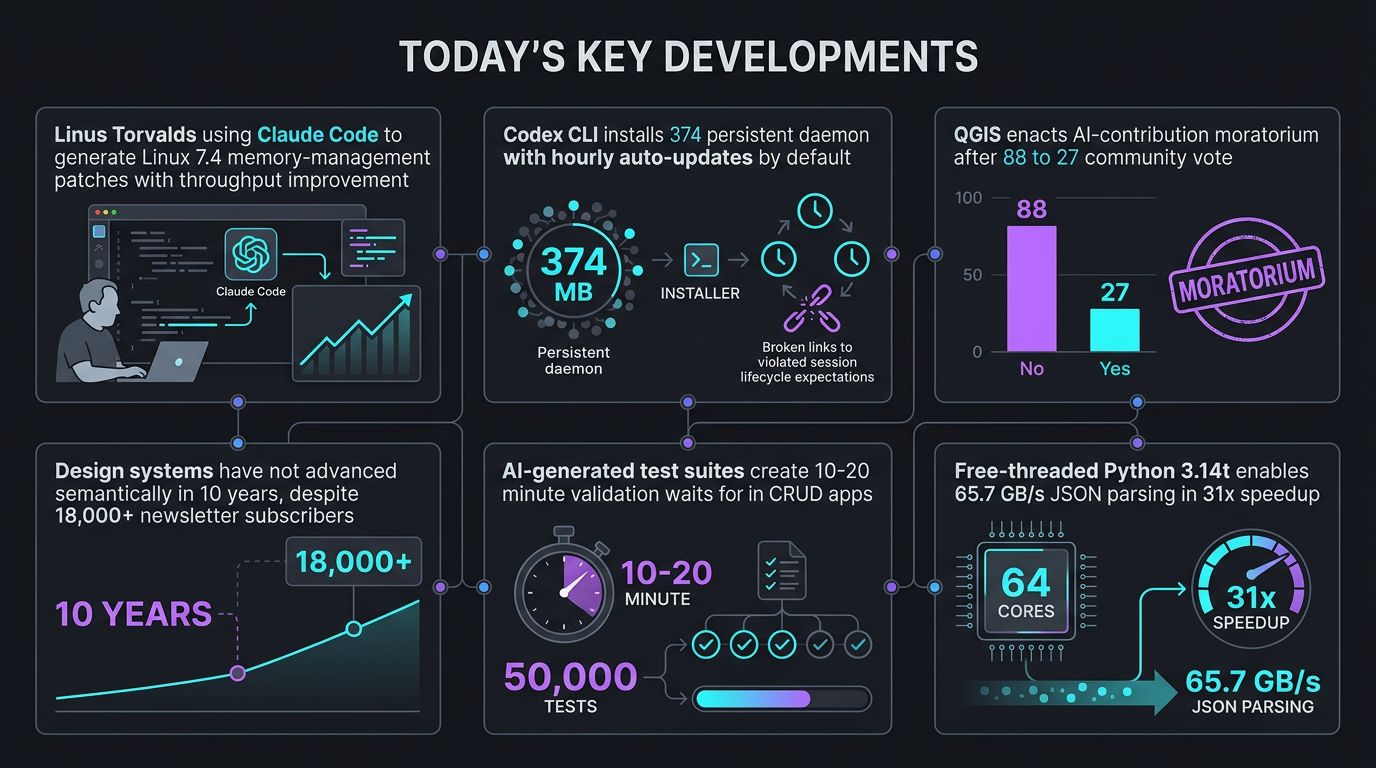
- Linus Torvalds used Claude Code to produce Linux 7.4 memory-management patches with significant throughput improvement. Kernel maintainers.
- Codex CLI installs a 374 MB persistent daemon with hourly auto-updates by default, violating session lifecycle expectations. CLI users.
- QGIS enacted an AI-contribution moratorium after an 88 to 27 community vote. Open-source maintainers.
- Design systems have not advanced semantically in 10 years despite 18,000+ newsletter subscribers. Design engineers.
- AI-generated test suites create 10-20 minute validation waits for 50,000 tests in CRUD apps. Development teams.
- Free-threaded Python 3.14t enables 65.7 GB/s JSON parsing with 31x speedup on 64 cores. Data engineers.
Themes
AI-Assisted Development
AI coding agents are crossing from autocomplete into infrastructure ownership and kernel maintenance, while reverse-engineering pipelines promise to clone any binary — yet the resulting artifacts still miss the hardening that decades of production use provide.
- Codex CLI installs a persistent, self-updating background daemon by default255
Codex CLI installs a 374 MB persistent daemon that auto-updates hourly, inheriting your shell’s proxy settings without asking. - Linus Torvalds Working On A Hefty Linux Kernel Improvement With Claude Code
Linus Torvalds merged Claude Code patches that cut lock contention in the page cache, targeting Linux 7.4. - Every app on Earth is now open source… whether it likes it or not

REA decompiles 30-year Adobe binaries via Ghidra and AI, but the Rust clones still lack production hardening.
Debugging & Code Comprehension
AI agents now debug unfamiliar codebases faster than humans can read them, yet their sheer output volume creates validation bottlenecks that stall comprehension.
- How to effectively debug when you no longer understand the code

Claude agents debug unfamiliar codebases in 63-minute workflows across four parts. - It’s not just you

AI generates 50,000 tests for a CRUD app, forcing 20-minute validation waits that break focus.
Design Systems & Tooling
- Building blocks for design systems are still in 2016.

Design systems remain stuck in 2016 after 10 years. AI trained on Tailwind UI and Claude outputs identical dashboards.
Open Source AI Governance
QGIS formalized a ban on AI-generated contributions through its governance process, reflecting a growing maintainer movement that treats unreviewable code volume as an existential threat to project health. The lopsided community vote reveals how sharply contributors are split on whether AI assists or erodes open source trust.
- QGIS enacts moratorium on AI contributions398
QGIS passed a formal ban on AI-generated code via QEP vote (88–27), making it the first major GIS project to treat synthetic contributions as a governance risk. Maintainers say review capacity, not code quality, drove the decision.
Software Industry Commentary
A quiet rebellion against AI-generated mediocrity is forcing developers to justify every design choice and rebuild foundations by hand.
- What I’ve been seeing lately (in software)

2.3 million developers flock to a Helix fork running handmade Forth instead of AI slop. - Nobody is reading anything

12-hour daily coding sessions end unless engineers pass whiteboard defense on every design choice.
Performance Engineering
Python’s new free-threaded runtime turns the GIL from a hard ceiling into a tunable parameter, letting lazy parsers scale linearly to memory bandwidth limits. This shifts the performance conversation from ‘Python is slow’ to ‘which parser architecture fits your access pattern?’
- Parsing JSON at tens of gigabytes per second… in Python

fastsimdjson lazy on 64 cores hits 65.7 GB/s parsing GitHub events — 31× the single-core speed and 2.7× faster than msgspec. Teams processing NDJSON at scale can now stay in Python without C++ rewrites.
Filtered out27 links
These scored below 40% relevance, so they were left out of the digest.
- Type-safe HTML templating in Ziglalinsky.com · 35%
- nobloat/poll - designing a minimal poll toolnobloat.org · 30%
- (Post-Quantum) Cryptographic Right Answerswords.filippo.io · 30%
- A modern web app in cprophitt.me · 25%
- Muse Wonderresearch.meta.ai · 25%
- Speeding up the Unreal editor by… not using unnecessarily secure hash methodslarstofus.com · 20%
- GLM-Legalz.ai · 20%
- Why aren't AI companies being charged for hacking?mortoray.com · 20%
- Fingerprints are the new cookiesroyfish.dev · 20%
- Implementing kubernetes node bin packingblog.costgraph.ai · 20%
- Vi Hart's Big Navier-Stokes Postpatreon.com · 15%
- Hackers activate automatic defrosting in supermarket fridges across Europetomshardware.com · 15%
- your c is not standard csebsite.pw · 15%
- Finding a $90,000 Remote Code Execution Vulnerability in Googlesimonkoeck.com · 15%
- French supermarket chains say cyberattack forced refrigerator shutdownafp.com · 15%
- ESP32 As Your Raspberry Pi’s Linux Wireless Co-processorhackaday.com · 10%
- 512 bytes at a time: reconstructing IBM i save-file checksumsblog.silentsignal.eu · 10%
- Research Firm Calls Anthropic's IPO 'Unprecedented Test of Investor Gullibity'cnbc.com · 10%
- Will Linux phones become a viable alternative to the Android/iOS duopoly?amosbbatto.wordpress.com · 10%
- Living in the Weimar era of Rubyblog.julik.nl · 10%
- Yandex bot traffic down 99% after data center attackradar.cloudflare.com · 10%
- Linux boots on iPhone 11patreon.com · 10%
- We Put Fighting Game Netcode in Brood Waryoutube.com · 10%
- What are you doing this week?lobste.rs · 5%
- Writing a Demoscene Intro for the ZX Spectrummarkround.com · 5%
- Deloitte falsified documents to evade tax on Abramovich's wealthbbc.com · 0%
- PK-88 TNC Hardware Modificationsblog.thelifeofkenneth.com · 0%
Generated by Clio Analyst