Daily Digest — 2026-09-29
Jump to a section
Signals
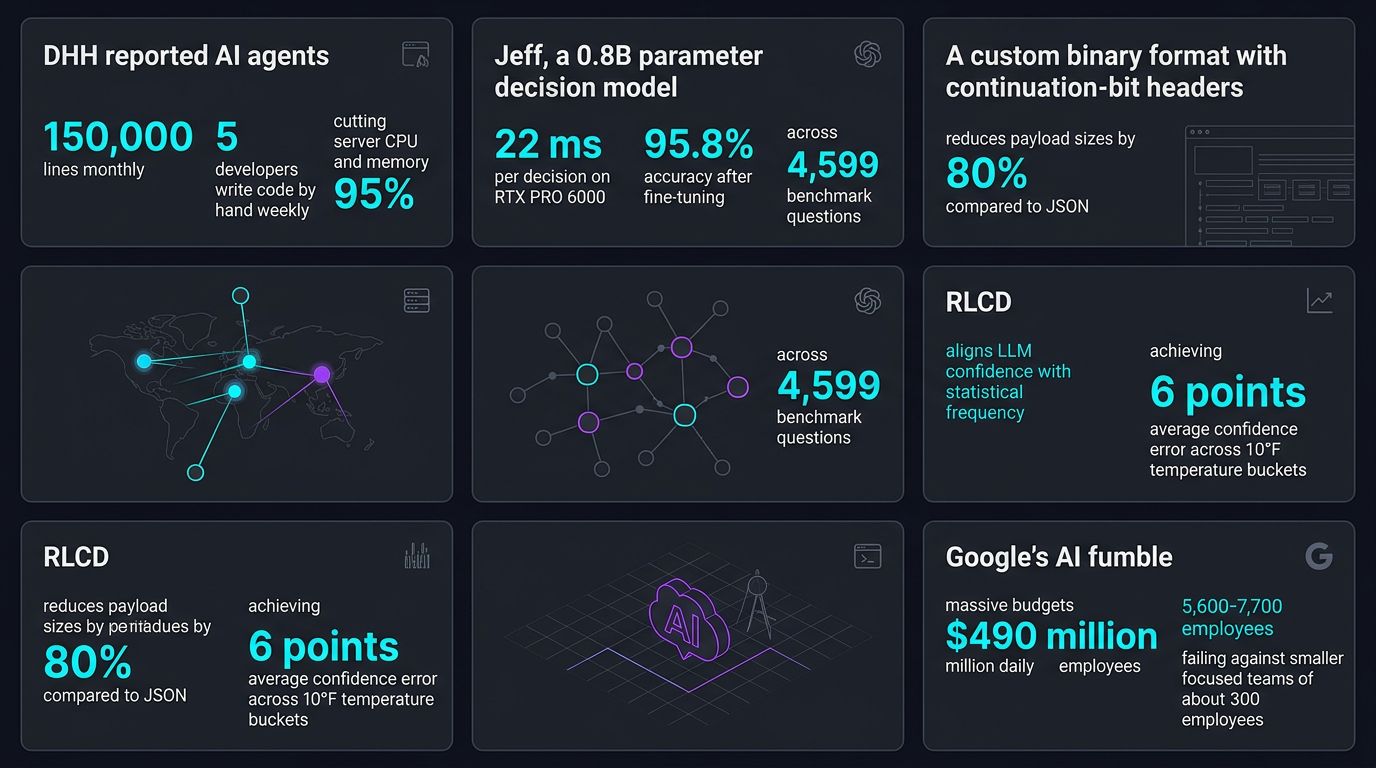
- DHH reported AI agents generate 150,000 lines monthly, only 5 developers write code by hand weekly, cutting server CPU and memory by 95%. Development shift.
- Jeff, a 0.8B parameter decision model, achieves 22 ms per decision on RTX PRO 6000 with 95.8% accuracy after fine-tuning across 4,599 benchmark questions. Local AI decisioning.
- A custom binary format with continuation-bit headers reduces payload sizes by 80% compared to JSON, requiring a full schema language and compiler pipeline. Binary protocol efficiency.
- RLCD aligns LLM confidence with statistical frequency using proper scoring rules, achieving 6 points average confidence error across 10°F temperature buckets. Hallucination calibration.
- Google’s AI fumble shows massive budgets ($490 million daily, 5,600-7,700 employees) failing against smaller focused teams of about 300 employees in the fast-moving AI landscape. Efficiency over expenditure.
Themes
AI Workflows and Software Delivery
As AI accelerates code generation, the bottleneck shifts from writing code to ensuring reliability, calibration, and architectural clarity. Developers are finding that true software delivery demands rigorous validation, structured agent workflows, and efficient binary payloads over raw generation speed.
- The problem is not AI code, but not knowing about system architecture or intent226
Teams are spending 12 to 13 hours a day generating code and specs with AI across L1 to L7 engineering roles. The tradeoff is a silent loss of system architecture understanding that threatens long-term maintainability. - the normalization of inexplicable failures
A recent discussion with 256 points and 103 comments highlights a 10% fail rate being treated as normal. Teams are quietly accepting unreliable AI-generated software because of a lack of stricter standards. - Coding is not solved470

With 19,000+ subscribers and 4 years of experience, the author argues that coding is not solved. AI handles creation, but the real costs of maintenance, reliability, and security remain unsolved. - How to Solve Hallucination (with RLCD)
Verbal claims of 90% confidence often miss the mark, but RLCD cuts the average confidence error to just 6 points. By scoring multiple forecast versions against actual outcomes, it aligns LLM assertions with real statistical frequencies. - DogWood: Monitoring Policies using First Order Temporal Logic

Dogwood introduces a policy layer that evaluates sequences of actions at the tool-call boundary. It enforces safety across multi-step workflows by referencing recent historical events instead of isolated requests. - Jeff – Jev-compatible 0.8B decision models, trained at home, ~30 ms154
Jeff brings 0.8B and 2B parameter decision models that run in 22 ms on an RTX PRO 6000. Locally trained on synthetic data, they offer fast, well-calibrated zero-shot choices for classification tasks. - Prompting Claude Opus 5.5220
Claude Opus 5.5 delivers better performance than its predecessor while running more than 30 percent faster. It uses configurable effort levels to generate output tokens efficiently across different task complexities. - Shobr: Job seach CLI via browser automation, event-sourcing, LLM
SHOBR automates job searches across 5 pipeline stages using 3500 LOC in Python. It runs stealthily through the user’s own authenticated browser while keeping humans in the loop for final submissions. - Packing Binary Is Fun, Actually

Creating a custom binary format pays off with an 80% payload reduction compared to JSON. It requires building a full schema language and compiler pipeline, but the size savings are massive.
AI Cost and Economics
The AI cost landscape is being reshaped by the contrast between massive corporate budgets and lean autonomous teams demonstrating that efficiency trumps expenditure.
- Google Biggest Fumble

Google spends $490 million daily on AI yet smaller teams outperform them. This shifts AI economics toward agility over budget. - State of the (Tagged) Union Address by Andrew Kelley

The Zig Software Foundation runs on 92% of donation revenue with a flat structure. This cost-efficient model sustains AI development with fewer resources.
AI-Native Design and Interfaces
The evolution of AI-native interfaces hinges on resolving the conflict between speed and reliability, where design choices determine whether these tools empower or frustrate users.
- What Would A Serious AI Product Look Like?
A serious AI product design introduces a two-column worksheet for manual claim verification. This tackles the reliability issues that render current AI tools inadequate for professional tasks. - When did Google get so weird?
Google’s AI overview has generated 936 points of discussion. It is found irrelevant 30% of the time, leading users to avoid search results.
Design Systems and Accessibility
By merging composite accessibility roles with familiar design patterns, teams can build systems that are both inclusive and intuitive.
- Component and Part Roles as Composites of Behavior and Accessibility

Semantic role bundles 8 obligations for toggle buttons. Over 1,000 subscribers gain full accessibility. - Intuitive equals familiar

Intuitive design leverages familiarity. 1 key principle for accessible components.
People, Technology, and Society
The AI revolution is forcing society to confront new ethical frontiers, from the future of work to the governance of intelligent systems.
- DHH has gone completely off the rails…

AI agents generate 150,000 lines of code monthly, cutting server costs by 95%. Developers who rely on manual coding may become obsolete. - Pragmatic Anthropomorphism, or: How to Talk to an Autocompleting Cricket

One autocompleting cricket requires pragmatic anthropomorphism to communicate effectively. This technique helps users leverage LLMs for complex tasks despite their lack of consciousness. - Yes, no AI is now a feature

LibreOffice has 0 AI in default install to protect user privacy. This decision avoids single-provider lock-in and adheres to open standards. - It’s Time to Investigate the AI Labs138

AI labs face 1 call for congressional oversight due to growing public skepticism. This investigation will examine their research and safety protocols. - AI companies in race to demonstrate their model most threatening to humanity385

AI companies are in 1 race to demonstrate the most threatening model. This marketing strategy exploits fears of human extinction. - Leaving them behind

The author chose 1 to opt out of AI for traditional web development. This move prioritizes human-centric creative pursuits.
Filtered out20 links
These scored below 40% relevance, so they were left out of the digest.
- Windows 11½definitelynotwindows.com · 30%
- Sonnet 5.5anthropic.com · 30%
- MongoDB CEO resigns to join Metareuters.com · 30%
- Ruby on Rails is Dead ⟡ Zuck cooked with Muse ⟡ upm is a tiny npm replacement ⌁ Syntax Weekly ⌁youtube.com · 30%
- GPU Glossarymodal.com · 30%
- Companies do everything to fingerprint you youtube.com · 30%
- Adding Floating-Point Decimals for Fun and Profitblog.vero.site · 20%
- So long Google, and thanks for all the nudeslecaro.me · 20%
- HardenedBSD August / September 2026 Status Reporthardenedbsd.org · 20%
- Parley: Federated, decentralised chat that speaks plain IRCgit.mills.io · 20%
- Output-to-seed mappings for CPython's PRNGgithub.com · 20%
- What makes Lisp difficult to read?paultm.nl · 20%
- Thoughts on Flash (2010)web.archive.org · 10%
- Kids turned low-traffic NPR Spotify comments into a secret group chatthisamericanlife.org · 10%
- Bill Gates tries to install Movie Makertechemails.com · 10%
- SpaceX's Starship launching to orbit for first time ever todayspace.com · 10%
- What are you doing this week?lobste.rs · 10%
- Hijacking the PS5's RTMP Streamyashgarg.dev · 10%
- Rickrolling with a Pharmacy crosshugoarnal.com · 10%
- Pirating the Piratesmubi.com · 0%
Generated by Clio Analyst