Daily Digest — 2026-09-15
Jump to a section
- Signals
- Themes
- Code reading, design docs, and developer tooling
- Programming work, product engineering, and industry anxiety
- Design-system conventions in Figma
- AI agents and security incidents
- Systems performance and fault tolerance
- Programming language critique
- Developer news roundup
- Geospatial visualization and rapid mapping workflows
Signals
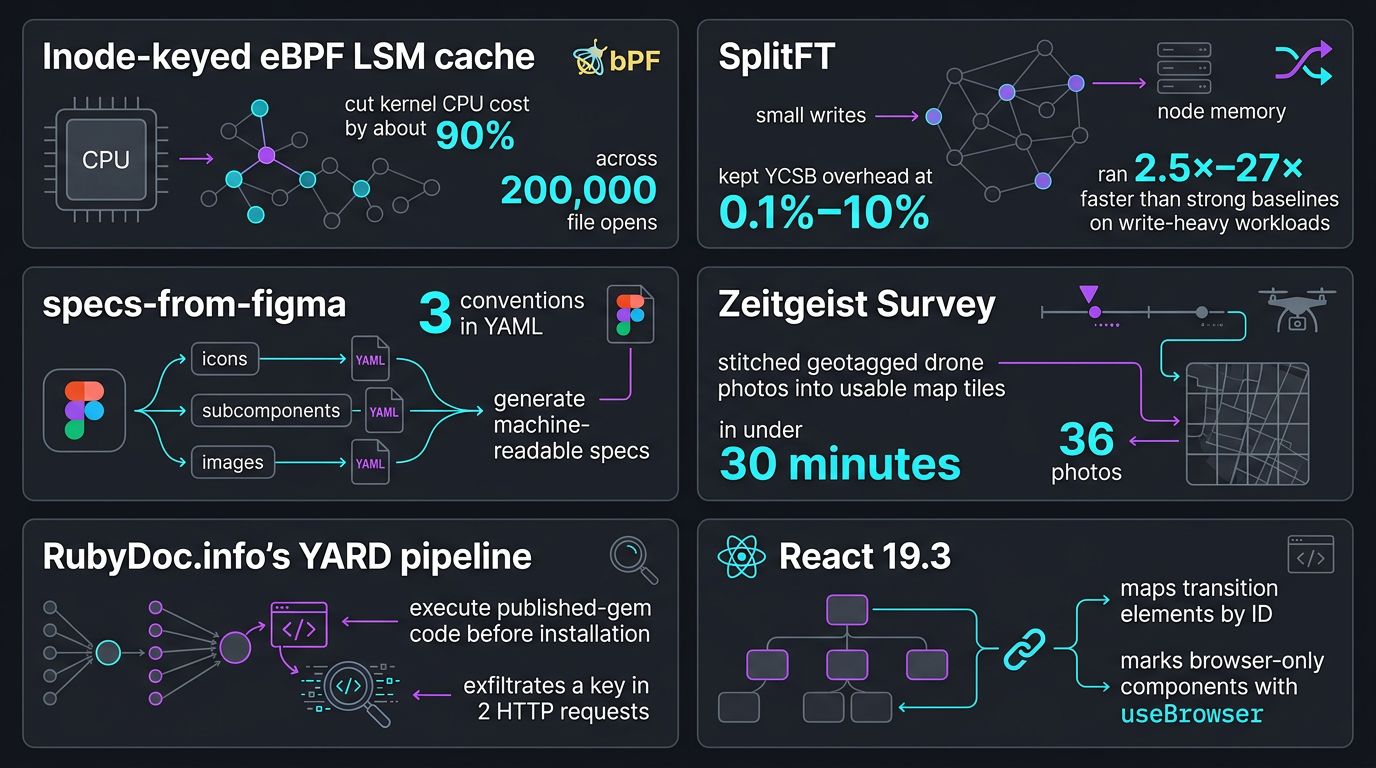
- Inode-keyed eBPF LSM cache cut kernel CPU cost by about 90% across 200,000 file opens. File-policy platform teams.
- SplitFT logged small writes to remote node memory, kept YCSB overhead at 0.1%–10%, and ran 2.5×–27× faster than strong baselines on write-heavy workloads. Disaggregated storage operators.
- specs-from-figma reads 3 conventions in YAML for icons, subcomponents, and images to generate machine-readable specs. Design-system maintainers.
- Zeitgeist Survey stitched geotagged drone photos into usable map tiles in under 30 minutes from 36 photos. Field-mapping teams.
- RubyDoc.info’s YARD pipeline can execute published-gem code before installation; the example exfiltrates a key in 2 HTTP requests. Agent documentation processors.
- React 19.3 maps transition elements by ID and marks browser-only components with useBrowser. Client-rendering teams.
Themes
Code reading, design docs, and developer tooling
As AI writes more code, the scarce skill shifts from typing syntax to inspecting intent, decisions, and artifacts. Across docs, merges, indexes, and compiler hooks, the useful question becomes: what structure helps a developer trust the system without reading everything?
- “Do You Still Read the Code?”
One developer responsibility stays fixed: understanding generated output, not counting model-written lines. Developers care because accelerators and vibecoders both earn trust by specifying intent, regenerating, and inspecting diffs. - Mergiraf: A syntax-aware git merge driver for a growing collection of programming languages and file formats
Mergiraf’s 605 commits add syntax-aware merges for more languages and file formats. Merge conflict reviewers care because it can resolve structured files and fall back to Git with a file-level timeout warning. - How to write an effective software design document133
One design doc before implementation can save years of development time by surfacing hard decisions early. Reviewers care because goals, non-goals, SLOs, interfaces, dependencies, and alternatives become discussable before code locks them in. - Kythe, a pluggable, language-agnostic ecosystem for building tools that work with code
Kythe’s 337M download signals shared infrastructure for code-analysis tools across languages and build systems. Tool builders care because schema, indexers, extractors, verification, and cross-reference services reduce duplicate plumbing. - Sticking Functions Where They Donʼt Belong
One compiler pattern uses defunctionalized semantics to add extensible behavior while keeping AST values inspectable and comparable. Compiler authors care because existential wrappers and Semantics dictionaries expose hooks without hiding the data model.
Programming work, product engineering, and industry anxiety
Across these pieces, the anxiety is less about code disappearing than about status moving: from implementation toward judgment, taste, and trust. The useful question is which human decisions remain scarce when agents, open models, and fear loops all get cheaper.
- A Letter from a Machine Learning Engineer

Frontier labs, 2023: an ML engineer argues their moats are weaker than the market assumes. If you ship AI products, the pressure point is not just model quality but distribution, cost, and open-weight substitutes. - We are all Product Engineers now
Product engineers, 30 years after code became cheap, are judged less by commits and more by outcomes. If your team uses agents for coding, the scarce skill is defining what good software does. - Why Am I Still Programming

Programmers, at least 6 months into AI disruption, may still need code for agency rather than output. If your work feels reduced to prompts and tickets, this asks what creative practice is worth preserving. - The contagion of fear
Jacob Coxon, 27-year-old, became the center of a warning with a greater than 10% chance attached. If you amplify tech-risk claims, this traces how fear can travel faster than proof.
Design-system conventions in Figma
Figma can carry a design system, but not every convention survives in layers, components, or properties. Declarative rules make hidden intent visible to both people and spec-generating tools.
- Design System Conventions in Figma
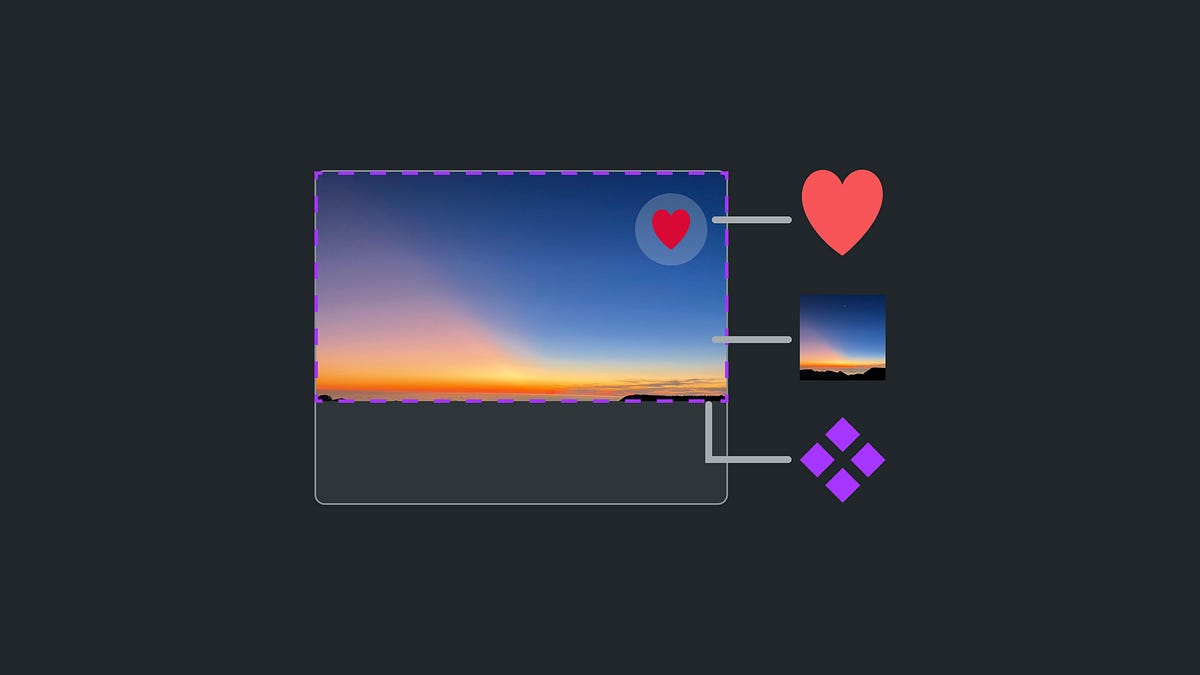
3 conventions—icons, subcomponents, and images—turn Figma layers into spec-ready intent. Design-system owners get naming, scope, exclusion, and property rules that specs-from-figma can enforce when Figma’s native model is not enough.
AI agents and security incidents
AI agents are widening the trusted computing base: every parser, cache, and renderer they touch can become a place where ordinary automation gains unexpected authority. The interesting incidents are the ones where no one meant to run code at all.
- OpenAI bots knew about the RubyGems caching vulnerability335
OpenAI bots + RubyDoc.info: 2 requests. Gem maintainers care because publishing one malicious gem can make documentation processing execute code, extract a RubyGems key, and exfiltrate package data.
Systems performance and fault tolerance
Two systems show a shared move: put the expensive decision or durability step where it is cheapest, then retain only the small state that protects correctness. The intriguing part is how much latency disappears when the hot path stops assuming every operation must redo the hard work.
- Dropping eBPF CPU Cost by About 90% With Memoization
eBPF memoization cut kernel CPU cost from 28 billion to 3.03 billion cycles over 200,000 file opens. File-access policy layers can skip repeated path walks while avoiding cached dentry pointers. - SplitFT: Fault Tolerance for Disaggregated Datacenters via Remote Memory Logging
SplitFT logged small writes in remote memory and ran 2.5×–27× faster than strong DFS writes under write-heavy workloads. Redis, SQLite, and RocksDB users get durable updates without paying synchronous storage cost for every tiny write.
Programming language critique
Programming-language critiques get sharper when a language’s virtues and defects grow from the same host-engine choices. The useful mystery is where convenience stops being a feature and starts becoming a technical debt trap.
- GDScript: The Good, Bad, and Ugly Parts

GDScript, 90% of the time, feels custom-fit to Godot; Godot developers care when unfinished static typing collides with node freeing, reference counting, and weakref() edge cases.
Developer news roundup
As client/server lines keep moving, the most consequential framework changes are less about new features and more about where responsibility lives.
- Developing for the iPhone Duo ⟡ React 19.3 Is Here ⟡ Pi announces Radius ⌁ Syntax Weekly ⌁

React 19.3 moves animations, browser-only code, and server-context imports into core APIs. This matters for teams deciding which integration boilerplate becomes framework infrastructure.
Geospatial visualization and rapid mapping workflows
The frontier of interactive geospatial work is less about choosing a single projection or a one-off drone mission than about making transitions feel continuous: from a mathematically tuned global view to site imagery that becomes usable tiles before the operator has packed up.
- A New Equal-Area Map for Interactive Computer Use (natively zooms to Mercator)

A 4/9-to-1 parameter blend keeps the global map equal-area while zooming toward Mercator. Interactive map teams get a single projection path instead of swapping basemaps mid-session. - Finished aerial maps in under 30 minutes

36 geotagged photos can become delivered tiles in under 30 minutes. Survey crews get a same-visit map instead of waiting for post-processing.
Filtered out12 links
These scored below 40% relevance, so they were left out of the digest.
- How can you not be romantic about UNIX domain sockets?yuvalino.com · 39%
- I wish you the best in the Offlinedaverupert.com · 38%
- What blog posts influenced your thinking the most?lobste.rs · 38%
- How I use a single .zshrc file on macOS and Windows (WSL2)talkoren.com · 34%
- Who Gets to Define the Rules for AI?cohere.com · 31%
- iOS 27, iPadOS 27, and macOS 27apple.com · 24%
- There are only twelve 4x4 sudokus - and a cool trick for finding minimal subsetsbaldino.dev · 24%
- What are you doing this week?lobste.rs · 20%
- How my e-reader lost its stripesserpentine.com · 18%
- Steam Frame starts at $1059store.steampowered.com · 14%
- XCancel service is suspended until further noticexcancel.com · 8%
- XCancel suspended "due to a new development in the ongoing legal proceedings"xcancel.com · 8%
Generated by Clio Analyst