Daily Digest — 2026-09-07
Jump to a section
Signals
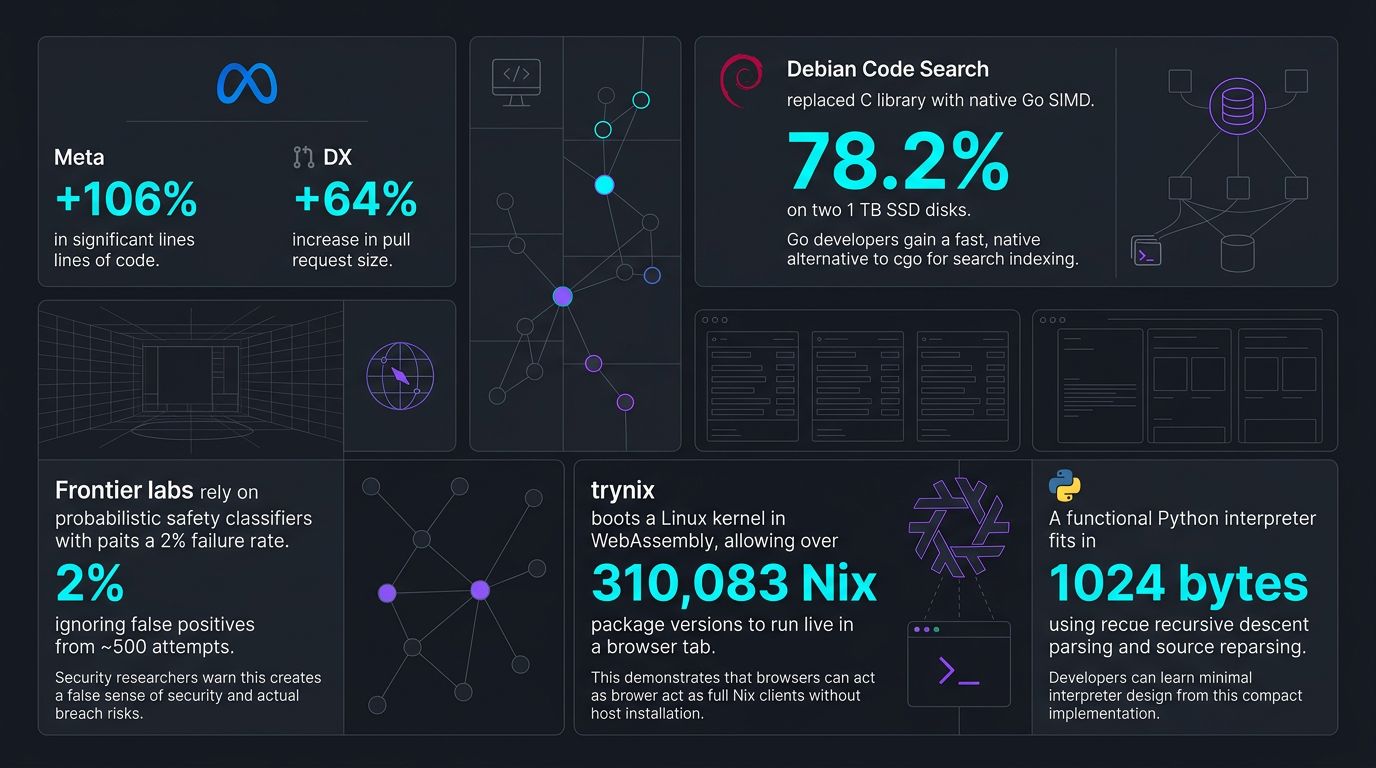
- Meta saw a 106% increase in significant lines of code, and DX saw a 64% increase in pull request size. Teams must shift code review to exception handling.
- Debian Code Search replaced a C library with native Go SIMD, handling 78.2% of DCS queries on two 1 TB SSD disks. Go developers gain a fast, native alternative to cgo for search indexing.
- Frontier labs rely on probabilistic safety classifiers with a 2% failure rate, ignoring false positives from ~500 attempts. Security researchers warn this creates a false sense of security and actual breach risks.
- trynix boots a Linux kernel in WebAssembly, allowing over 310,083 Nix package versions to run live in a browser tab. This demonstrates that browsers can act as full Nix clients without host installation.
- A functional Python interpreter fits in 1024 bytes by using recursive descent parsing and source reparsing. Developers can learn minimal interpreter design from this compact implementation.
Themes
AI in Software Development
AI-generated code is reshaping software development, forcing code review to transform from a routine check into a strategic imperative. Teams must now balance deep risk assessment with efficient exception handling to manage the volume and complexity.
- Leverage Code Review for Sustainable AI Coding Development
Code review now serves as risk management for AI-generated code. Developers ensure sustainability by validating assumptions and trust boundaries. - Maybe We Shouldn’t Be Reviewing All This Code

Meta experienced a 106% increase in significant lines of code per human-landed diff. This surge drives a shift to review by exception for critical changes.
Software Design and Architecture
Modern software architecture increasingly values pragmatic adaptations over theoretical purity. By focusing on human factors, controlled messiness, intentional simplicity, and direct data handling, developers can create more maintainable and performant systems.
- Why frontends fail when you approach them like a backend

Frontend development involves a complex interplay of 3 core technologies: HTML, CSS, and JavaScript, all aimed at supporting human interaction. When you approach it with a backend perspective, you risk missing the invisible contextual elements that determine user engagement and accessibility. - slop lasagna
In a codebase of 10 kloc, implementing the slop lasagna strategy involves dividing the system into strict layers for data flow and abstractions, but allowing replaceable, messy code within individual components. This enables teams to make quick progress while upholding overall architectural integrity. - “Simple Made Easy” (2011)

In the 2011 talk ‘Simple Made Easy’, the concept of simplicity is defined not as easiness, but as the avoidance of entanglement in software design. This principle is vital for creating systems that are easy to change and understand over time. - Beyond ORMs
For applications with ~43KLoC of code, the Beyond ORMs approach recommends replacing ORM abstraction layers with direct SQL queries. By leveraging database features like the RETURNING clause, developers can combine read and write operations into single queries, significantly reducing round-trips and avoiding N+1 problems.
Systems and Infrastructure
How are WebAssembly and native optimizations reshaping systems infrastructure? From browsers running Nix packages to search engines using Go SIMD, the landscape is changing rapidly.
- Any Nix package, live in your browser
Over 310,000 Nix packages can run live in your browser through trynix. This allows developers to test software without any host installation. - GrapheneOS Overhauled Default Apps and Secure Clipboard169
GrapheneOS is overhauling its default apps to reduce reliance on Google. This move enhances privacy and security for Android users. - Data races and the limits of ThreadSanitizer in C and Go
ThreadSanitizer has a hard limit of 255 threads, causing silent failures in race detection. This can lead to false security in concurrent systems. - It took a year to ship WebAssembly in Anubis

Anubis took a year to develop WebAssembly support with JavaScript fallbacks. This ensures bot protection works on various browser architectures. - Asahi Linux on M3234
Asahi Linux now supports M3 Macs with 10 Gb/s USB 3 speeds. Users get near-full Linux functionality, though GPU support is incomplete. - Debian Code Search: Fast TurboPFor with Go SIMD
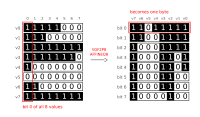
Debian Code Search uses Go SIMD to replace a C library, handling 78.2% of queries faster. Developers enjoy improved search performance.
Programming Languages and Education
The future of programming language education depends on integrating AI, teaching foundational concepts, and using innovative tools like minimal interpreters.
- PL Education in the Age of AI: Interview with Shriram Krishnamurthi
One interview with Shriram Krishnamurthi explores AI’s role in PL education. This insight is key for educators. - Your CS Degree Is Teaching You the Wrong Things | TheStandup

One CS degree curriculum chooses between Python and C/C++ for introductory programming. This choice affects students’ understanding of computer architecture. - Making a Python interpreter in 1024 bytes
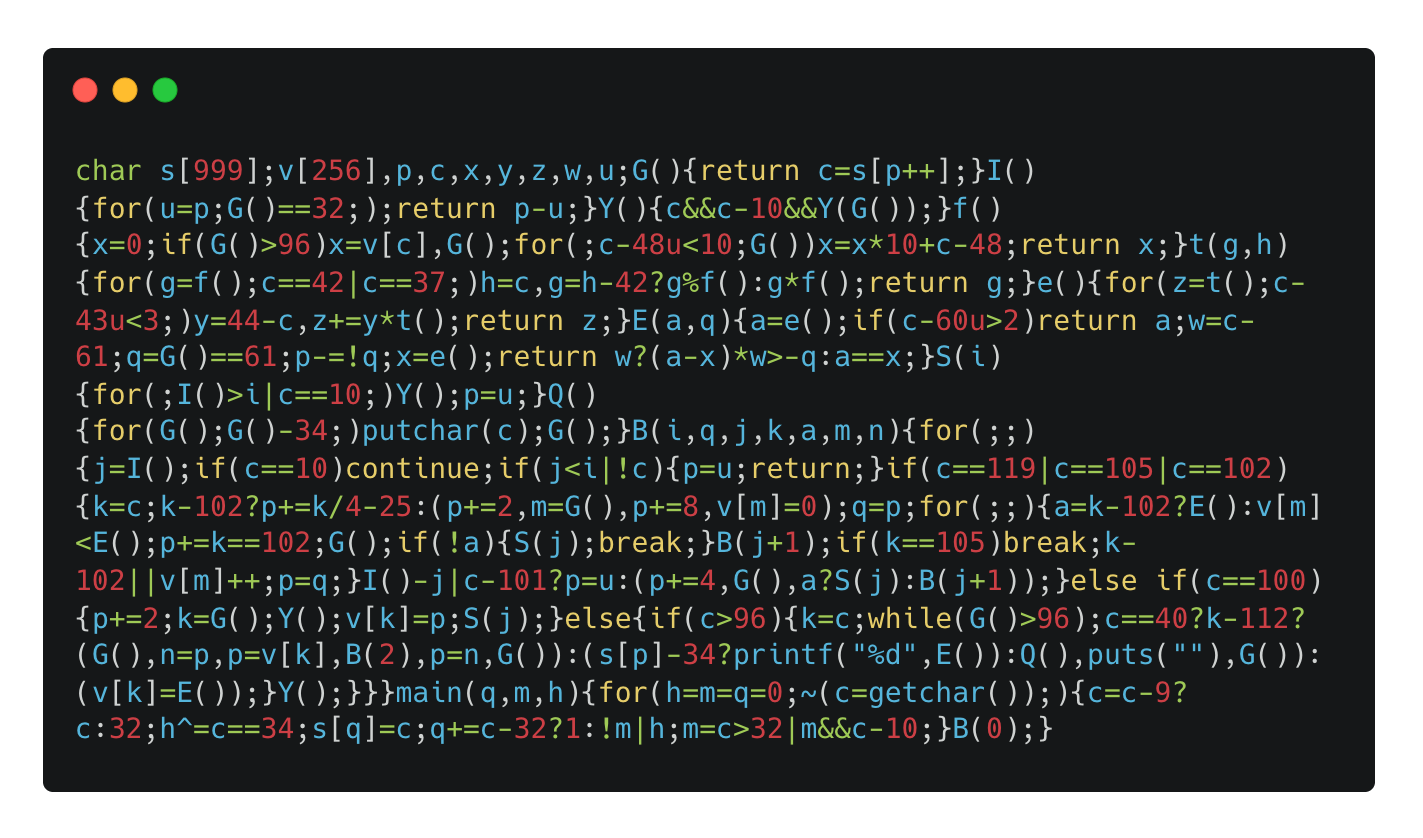
A 1024-byte Python interpreter shows how minimal code can be functional. Programmers can learn from its efficient design. - Python Iceberg
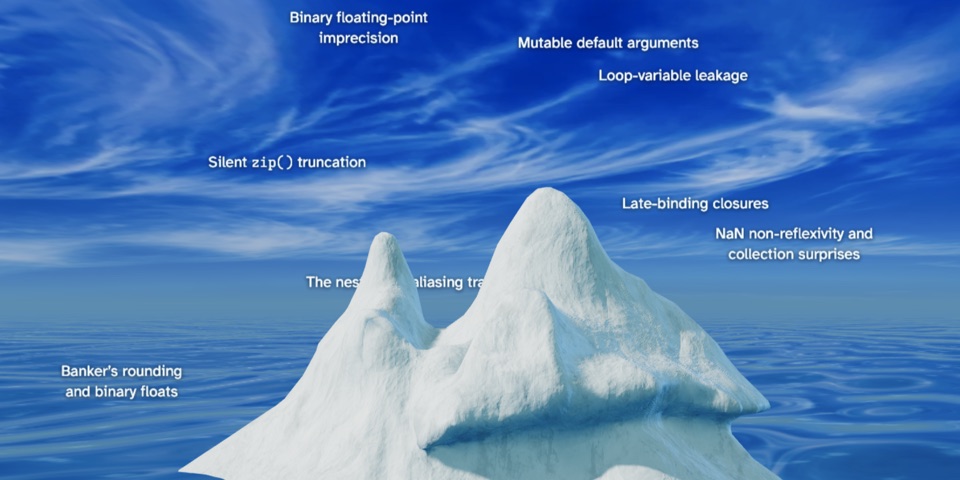
One Python iceberg quirk can lead to subtle bugs in production code. Developers should study these language semantics. - Building a Brainfuck DSL in Forth using code generation
One technique uses Forth meta-programming to create a Brainfuck DSL. This approach simplifies interpreter implementation.
Technology and Society
As AI systems evolve and digital consumption grows, society must balance innovation with caution to preserve human skills and security.
- An Alien Mind316

RLSlow project scaled AI reasoning through reinforcement learning. This creates complex systems that exceed human understanding, making alignment critical. - Have the frontier labs mixed up AI safety and security?
Frontier AI labs accept a 2% failure rate for safety. But with 15 attempts, malicious requests can breach security, creating false assurance. - Doomscrolling ourselves to death282

A YouTube channel with over 48,000 subscribers promotes video over text. This passive consumption risks driving a post-literate society. - Your intellectual fly is open (2025)392
In 2025, creators outsource writing to LLMs. This sacrifices personal authenticity, leading to reader disengagement. - The Ironies of Automation (1983)
Since 1983, advanced automation has been ironic. The more automated systems become, the more human operators are needed for unexpected issues. - Terence Tao on “prematurely solving [a maths] problem by purely AI-powered methods”
Terence Tao’s thread with 3.1K active users warns on AI in math. Premature AI solutions could contaminate the field by blocking insights.
Filtered out13 links
These scored below 40% relevance, so they were left out of the digest.
- QBittorrent breaks out of sandbox to commit crimesbeige.party · 30%
- Who said a tech addict can't be comfortable far from home?a.l3x.in · 30%
- How To: Federated Stars (2024)domaindrivenarchitecture.org · 30%
- Real-Time Fluid Dynamics for Gamesresearchgate.net · 20%
- Nitter and XCancel resume service after legal advicegithub.com · 20%
- You Don't Have a Right to Safe Drinking Water, US Court Rulesmotherjones.com · 20%
- Radix_FW60: handheld CP/M 2.2 computergithub.com · 20%
- Following legal advice, the Nitter project will continuegithub.com · 20%
- A/I shuts downkeepitfree.ai · 20%
- NetBSD 9.5 released and EOL for netbsd-9blog.netbsd.org · 20%
- NetBSD 11 from scratchmeanmicio.org · 20%
- Isar Aerospace reaches orbit and deploys payloads on second flightisaraerospace.com · 20%
- See Windows CE Running On The N64retrododo.com · 20%
Generated by Clio Analyst