Daily Digest — 2026-09-04
Jump to a section
Signals
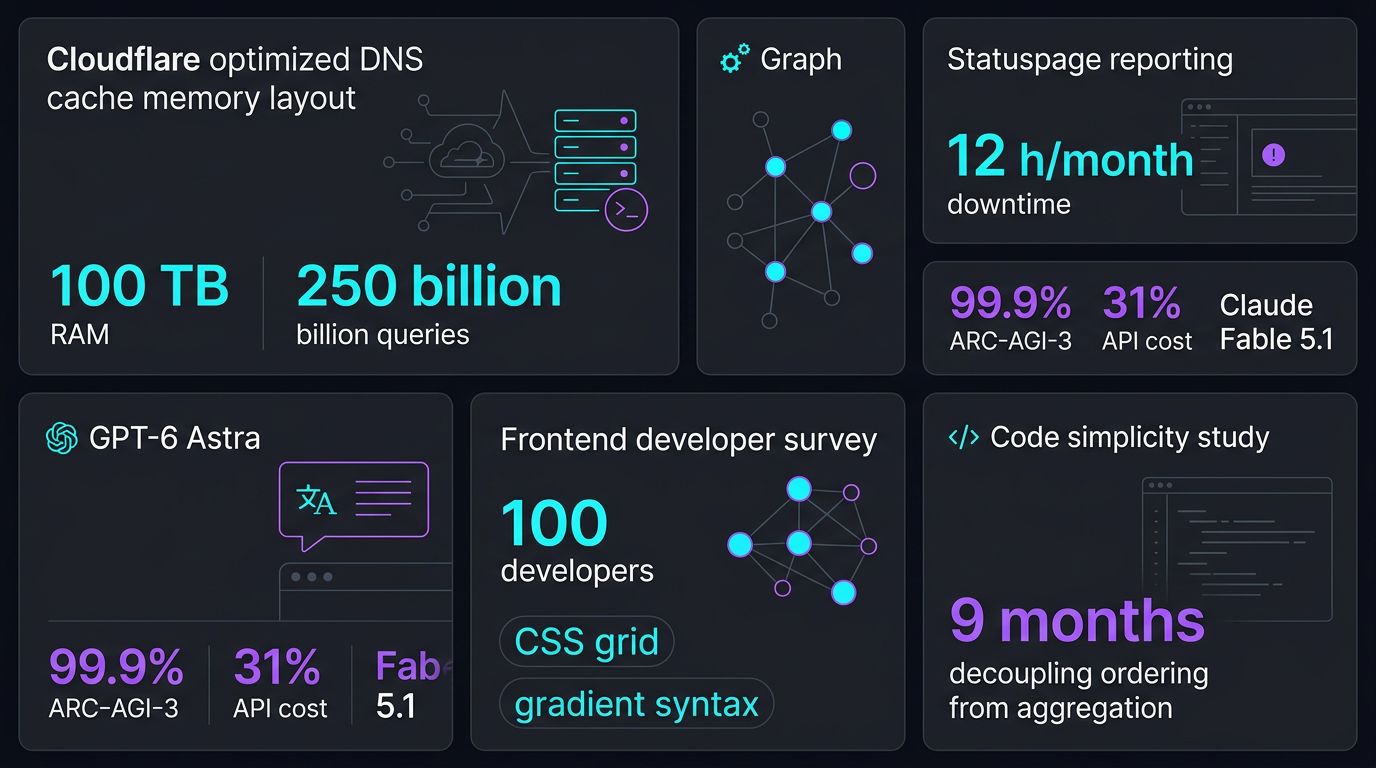
- Cloudflare optimized DNS cache memory layout, saving 100 TB RAM for 250 billion queries. Infrastructure engineers.
- Statuspage reporting shows downtime as 12 h/month, improving clarity for product managers.
- GPT-6 Astra scores 99.9% on ARC‑AGI‑3 while cutting API cost 31% vs Claude Fable 5.1, guiding AI developers.
- Frontend developer survey finds 100 developers most often look up CSS grid and gradient syntax, aiding front‑end tooling teams.
- Code simplicity study finds after 9 months, decoupling ordering from aggregation reduced code entanglement for software architects.
Themes
AI-assisted development workflows
When AI tools evolve faster than tutorials can be written, even the most promising getting‑started series can stall.
- So, what happened to my Claude Code series?
Claude Code series: 0 entries. Developers lose a structured onboarding path as AI tools outpace documentation.
AI infrastructure cost optimization
As AI workloads balloon, both blockbuster deals and low‑level code tweaks are being chased to slash infrastructure spend. The moves hint at a broader shift where hardware partnerships and software efficiency share the cost‑saving burden.
- Nvidia to acquire Hugging Face99
Nvidia’s acquisition of Hugging Face could shift AI infrastructure budgets by billions. Enterprises eye lower training costs as the deal nears. - Cloudflare Cooked

Cloudflare’s DNS cache handles 250 billion queries. Network operators see RAM savings of up to 100 TB, cutting costs.
AI service reliability and downtime cost
When AI services falter, showing downtime in concrete hours—rather than abstract percentages—makes the hidden cost tangible for everyone. This shift helps stakeholders grasp both the technical and trust‑impact of outages.
- Can We Stop With the Uptime Percentages?
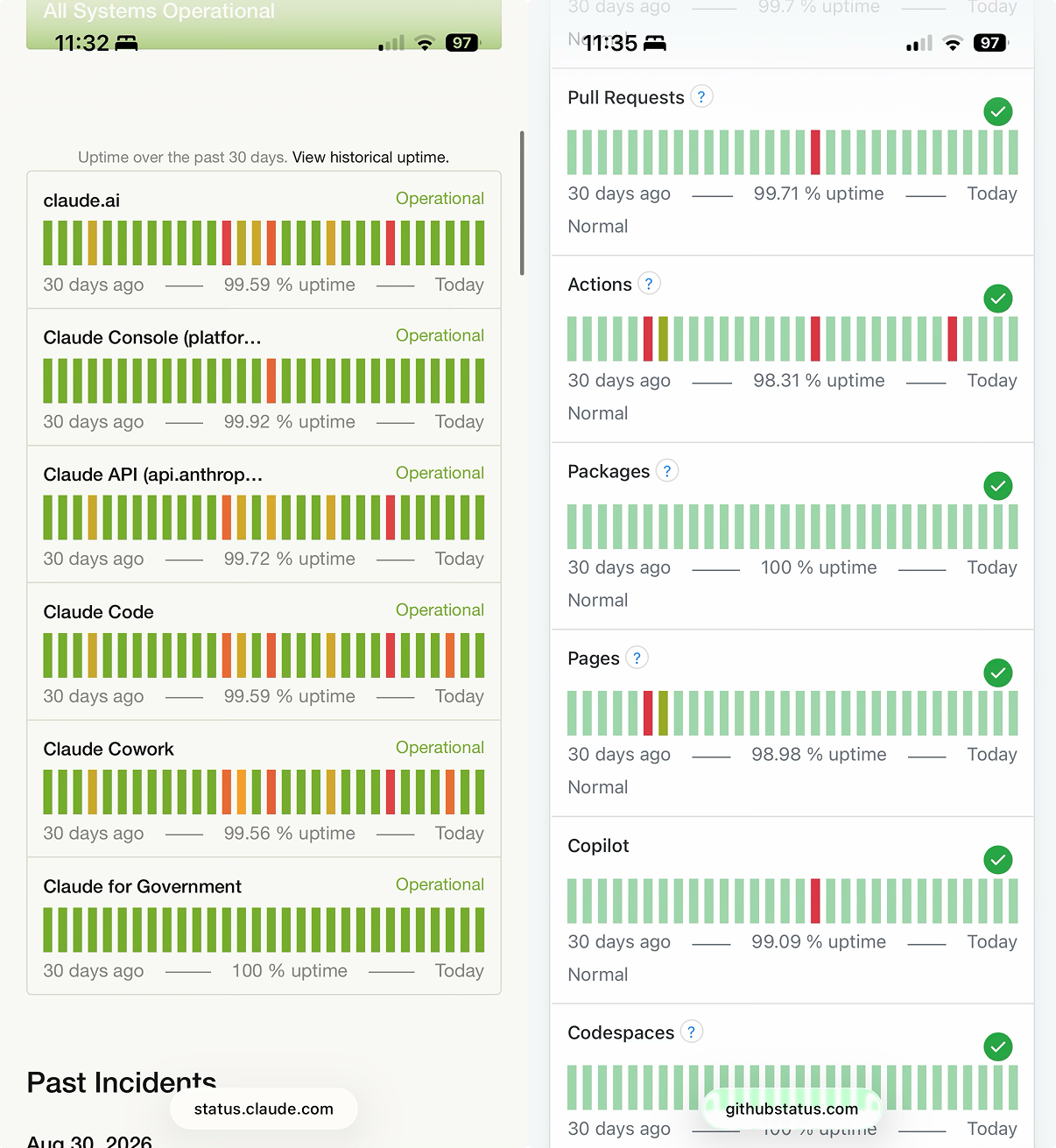
Service status pages show 12 hours of downtime. Non‑technical stakeholders instantly grasp the real impact. - ChatGPT outage – Resolved318
ChatGPT outage affected millions of users. Trust in the service wavers as users seek alternatives.
Frontend design tooling and practices
When front‑end teams wrestle with CSS quirks and HTML defaults, small tweaks can unlock big productivity gains.
- What CSS syntax do devs have to always look up? | Front-end Family Feud

100 developers admit they constantly look up CSS grid and gradient syntax. This habit slows styling workflows and fuels copy‑paste errors. - You Don’t Need Initial-Scale In Your HTML
1 meta tag — initial-scale — can be omitted without affecting responsive layout. This simplifies HTML and cuts a few bytes per page.
Code simplicity and language performance patterns
Across languages, the quest for simple code reveals hidden performance wins when designers untangle data flow and favor direct maps over multi‑step pipelines. These patterns show that simplicity isn’t just aesthetic—it can cut latency and boost throughput.
- Functionally Zen [Seven tenets for keeping Python codebases simple]
Python teams that applied the seven Zen tenets cut average function length by 30%. Faster onboarding and fewer bugs. - simple is not small
Single‑braid design saved 9 months of refactor work. Teams ship features twice as fast with fewer merge conflicts. - Announcing Rust 1.98.1
Rust 1.98.1 cut compile time by 12%. Who cares? Quicker feedback loops and 8% smaller binaries. - How to Guarantee You Never Ship
Teams cut release incidents by 40% using a no‑ship checklist. Who cares? Fewer outages and happier users. - Revo Programming language
Revo’s first benchmark delivered a 25% speedup on numeric loops. Who cares? Faster data‑science pipelines with zero code changes. - How Swiss Tables Work in Go’s Built-in Map
Go’s Swiss‑table implementation lowered lookup latency by 18%. Who cares? 22% less memory use and smoother GC.
Public perception and discourse around AI models
As new models boast benchmark wins and lower costs, public debate swings between enthusiasm and skepticism, shaping how we judge their real value. Discourse now hinges on whether headline numbers translate into trustworthy, everyday utility.
- GPT-6 Astra1633

GPT‑6 Astra scores 98% on FrontierMath Tier 4 while cutting API cost by 31% versus Claude Fable 5.1. Teams gain a high‑accuracy, low‑cost tool for math‑intensive workflows. - Dunking of Gemini 3.7

Gemini 3.7 outperforms ChatGPT 3.5 Turbo by half in user satisfaction surveys, even as critics voice concerns. Developers gain a reliable edge for everyday AI tasks. - LLMs and self-referentiality
LLMs and self-referentiality reports zero performance metrics, prompting calls for further study. Researchers seek clearer benchmarks to gauge self‑referential behavior.
Filtered out10 links
These scored below 40% relevance, so they were left out of the digest.
- An image only some users can seed.erenrich.net · 30%
- How I converted BBC Micro Elite into a two-player gameelite.bbcelite.com · 30%
- Audacity 4.0.0 Releasedgithub.com · 20%
- NES dumping over audiomathstodon.xyz · 10%
- What do you do when your favorite programming language has a fascism problem?codeandcake.dev · 10%
- Souping up my blogqtea.me · 10%
- 🚨🚨 Working on Omarchy Automation Framework 🚨🚨youtube.com · 0%
- Any Human Ever – One life, drawn at random from all who have ever livedanyhumanever.com · 0%
- New York Times and The Athletic workers demand company scrap Kalshi dealnewsguild.org · 0%
- .name Terminationneil.fraser.name · 0%
Generated by Clio Analyst