Daily Digest — 2026-08-30
Jump to a section
Signals
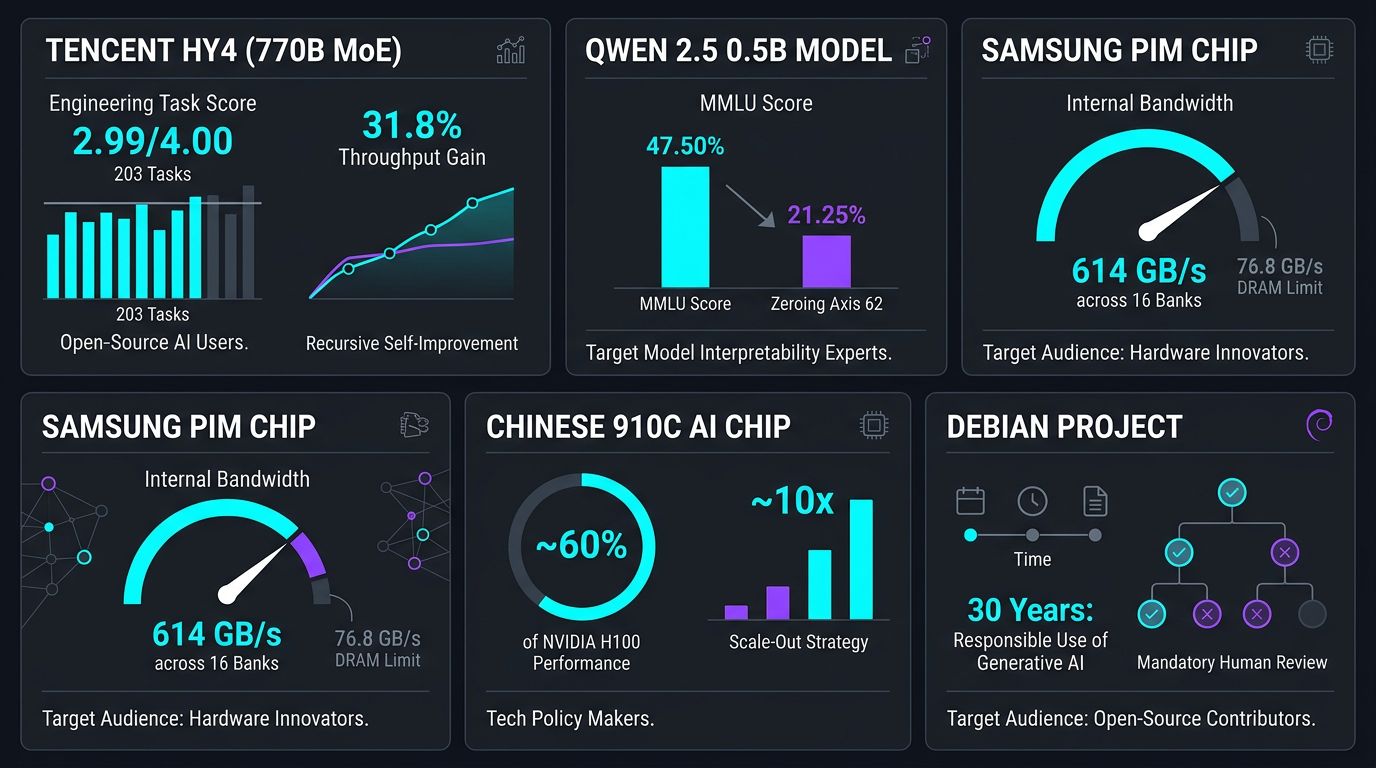
- Tencent Hy4 scored 2.99/4.00 on 203 engineering tasks with 31.8% throughput gain
- GLM-5.3 Flash achieves 60% of H100 performance through 10x scale-out strategy
- Samsung PIM delivers 614 GB/s internal bandwidth versus 76.8 GB/s standard DRAM
- AI agents resurrect defunct hardware by refactoring 16-service backend on Mac
- Client-side ContextSwitch keeps AI conversations local without server calls
Themes
AI Models & Research
Open-source frontier models push performance boundaries while exposing deep-seated reasoning gaps.
- Hy4 preview
Hy4 1 delivers top‑tier performance with a 31.8% high‑throughput gain for engineers seeking efficiency. - Canonical-basis realignment for Transformer LLMs: every hidden axis becomes independently measurable and controllable
Qwen 2.5 0.5B maintains strong benchmarks while revealing hidden geometric structure. - I naively tried vibe-coding a memory tool for agents and stared into the abyss of unsolved problems in philosophy
Agent 1 struggles with contradictory facts during memory tool testing in practice.
AI Applications & Tools
AI-powered local deployments revive defunct hardware and enable private workflow continuity.
- AI Revives a Dead Sleep Company
Backend 16 architecture runs locally. - ContextSwitch — take your AI conversations with you
The extension facilitates cross-platform AI workflows entirely on the client side without sending conversation data to external servers, although community trust remains tentative as shown by user comments.
AI Infrastructure & Hardware
Both pieces examine how emerging AI infrastructure strategies—whether scaled-down Chinese silicon or advanced processing-in-memory architectures—address hardware limitations to boost inference performance.
- What GLM-5.3 Flash running on Chinese hardware actually means
GLM-5.3 10x scale-out compensates for weaker silicon, enabling competitive inference speeds. - Samsung’s Processing-in-Memory (PIM)
Samsung PIM 614 internal bandwidth supports high‑throughput AI workloads across large‑scale deployments.
AI Policy & Society
Organizations are debating whether generative AI should be treated as a neutral tool or a cultural catalyst, revealing gaps between policy frameworks and real‑world workplace dynamics.
- There’s no such thing as Just a Tool
Engineering team 2024 reported that tooling alone frequently overlooks contextual nuance, causing missed opportunities and eroding trust among developers overall significantly. - Good Culture Is the Biggest Productivity Hack, Not AI
The core insight is that a healthy engineering culture is the foundation of all productivity, and AI tools cannot compensate for a toxic or insecure culture; in fact, they can worsen psychological safety if introduced poorly. - Does Computer Science Need Computers?
The theoretical side of computer science does not strictly require physical computing machines, but many core questions and directions of the field would never have been formulated without them. - Debian Votes To Allow “Responsible Use Of Generative AI”
The Debian project has chosen a middle-ground policy of ‘Responsible Use Of Generative AI’ that avoids an outright ban or mandatory copyright/legal rulings, placing the compliance and security burden on individual contributors while maintaining existing project standards.
Software Engineering & Tools
Engineering rigor collides with messy reality across type systems, parsers, and production systems—revealing that whether you’re taming chaotic CSV data, blocking adaptive botnets, or catching bugs users ignore, the gap between clean models and wild inputs defines the work.
- Bug blindness244
LLMs simulate normal users to reproduce hundreds of bugs weekly; 93% of survey respondents confirm product flaws. - Functional State Machines in Rust: Typestate and Newtype Patterns
Typestate enforces compile-time state transitions across 3 case studies; newtype pattern with ‘Parse, don’t validate’ prevents runtime invalid states cheaply. - Wrapping GTK4 in 800 lines of Clojure with Jolt
Reactive GTK4 wrapper hits 800 lines across four namespaces; eliminates virtual DOM and slow compile cycles for native apps. - Creepy crawlies
Anubis puzzle blocks bots until residential proxy SDKs adapt; 1.48M commits scraped via inefficient cgit HTML renders. - 1968 Predicted Every Modern Tech Problem | TheStandup

Knuth’s ‘premature optimization’ quote originates in 1968 structured programming docs; historical context reframes modern relevance. - Parsing the Infamous Japanese Postal CSV (2020)
Posuto parser merges 8-line splits and strips parenthetical traps from ken_all.csv; one postal code spans 66 rows.
Systems & Security
Security and reliability challenges intersect as cloud availability risks, hardware memory tagging gaps, and emerging OS philosophies converge.
- Omnipresent availability risks in cloud software
Cloud 2023 faces hidden downtime threats that could undermine service continuity, affecting operators. - GrapheneOS project: pixel 11 no longer supports hardware memory tagging (MTE)
Pixel 11 drops MTE support, pushing developers toward Motorola hardware. - Modern and Opinionated Linux

Linux 2025 embraces opinionated distributions, reshaping system design for admins. - Debian and the sirens
Debian 13 introduces LLM integration, sparking debates over complexity growth for maintainers.
Filtered out8 links
These scored below 40% relevance, so they were left out of the digest.
- DHS is using obscure law to snoop on journalists, non-profits, unionstheguardian.com · 30%
- The internet is kind of a predatory cesspit nowstephendiehl.com · 30%
- Introducing ReactOS 0.4.16reactos.org · 30%
- Civic Hygiene (2013)shkspr.mobi · 30%
- On 'scaling up' and being the right sizetzovar.as · 30%
- Being kicked out of the tech industryjacky.wtf · 30%
- Lawmakers added $1 to car insurance policies. That money paid for Flock camerastexastribune.org · 20%
- Iceland votes on whether to restart talks on joining EUbbc.com · 10%
Generated by Clio Analyst